
Tokaido Review – A Board Game About Slowing Down
Disclaimer: Tokaido was provided for free by Stonemaier Games, although the writing and opinions of this article are my own.
Imagine you’re stuck in rush hour traffic, already running late for work and desperately trying to make up time. You’re scanning for gaps, eyeing off other lanes, doing mental maths on which one might move first and which is clearly a lost cause. Every passing second cranks your anxiety higher as you picture your boss warming up to a “we need to talk.”
Just writing that has me uncomfortably shifting in my chair.
Now take a deep, calming breath… because Tokaido, designed by Antoine Bauza, is the complete opposite of that nightmare. This is a game about slowing down, soaking in the scenery, and actually enjoying the journey. Here, racing ahead isn’t rewarded. In fact, going slower is often the smarter move.
How to play
Tokaido is a game about going on a pilgrimage across Japan’s longest road, taking in the sights, sampling the local cuisine, and meeting all sorts of interesting characters along the way. Sure, you’re collecting victory points, but you’re also building beautiful panorama photographs, grabbing souvenirs, and stopping off at temples for a little spiritual self-care.
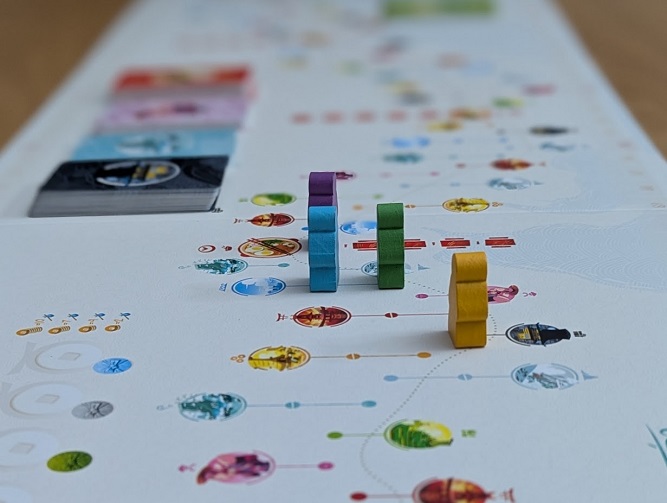
The journey itself is a straight line from Tokyo to Kyoto, broken into four legs, with each one ending in a warm meal at an inn. Between those meals, you’ll visit local attractions represented by spaces on the board. On your turn, you move your traveller forward along this path, looking for an empty spot where you can stop and carry out that space’s action. Then you wait for your next turn.
Which might take a while.
That’s because turn order in Tokaido is based entirely on how far along the road you are. The player furthest behind always goes next. So if you sprint ahead, you might find yourself sitting on your hands while everyone else enjoys multiple turns in a row. However, it might just be worth it to get first dibs on the spaces you really want.
The spaces you’ll be stopping at include:
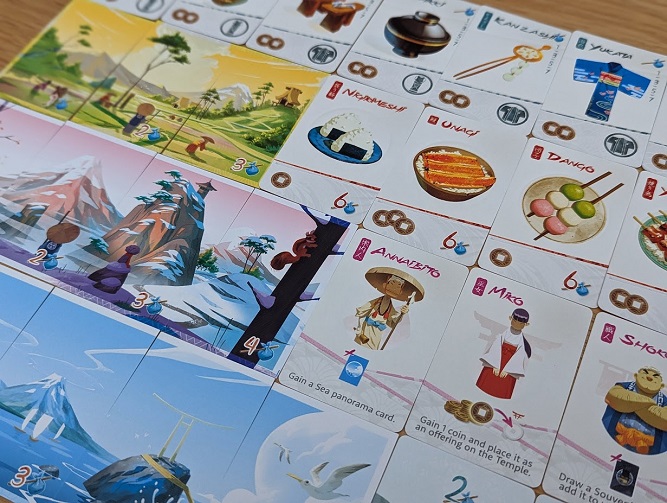
Shop – Draw three souvenir cards and decide which ones to buy. Souvenirs score in sets, so while there are different types, you’ll generally want to specialise. For example, every new clothing item is worth more points if you already own clothes. It’s retail therapy, but strategic.
Farm – One of your main sources of income. Visit a farm, get three coins. It ain’t much, but it’s honest work.
Panorama – Collect pieces of three gorgeous panoramic photos. Each card scores points equal to its position in that panorama. First card? One point. Fifth card? Five points. Join them together to create beautiful and satisfying full picture.
Hot Spring – Take a load off and draw a hot spring card worth two or three points. Simple and relaxing.
Temple – Donate one, two, or three coins to the temple and score that many points. At the end of the game, the biggest donor also bags a chunky ten-point bonus.
Encounters – Draw a card and meet someone along the road. These can trigger the effects of almost any other space in the game, but you won’t know what you’re getting until you flip it. Surprise!
At the end of each leg, everyone stops at an inn for a hot meal. These dishes are worth points, but each one can only be eaten by one player. So whoever arrives first gets first pick from the menu, which suddenly makes being speedy very tempting.
After the fourth and final inn stop, it’s scoring time. You’ll tally up all your points, then add bonuses for things like having the most hot spring visits, collecting the most souvenirs, or being the social butterfly who met the most weird and wonderful travellers.
Once that’s done, you finally find out who managed to relax the most… and who clearly needs to play it again.
What’s new in the Stonemaier edition?
If you’ve been in the hobby for a while, you’ll know Tokaido is anything but new. It originally released back in 2012, which in board game years basically makes it ancient history. But recently, Stonemaier Games picked it up for publishing duties… so naturally we need to ask: what’s changed?
Short answer? Not much.
All the artwork and components remain the same, and everything is still fully compatible with older editions and expansions. Gameplay-wise, nothing has been tweaked or rebalanced either. This is still the same chill, scenic stroll you remember.
Where things have improved is accessibility and player count. This new edition bumps the max player count up to five and introduces an Automa system, meaning you can enjoy a solo journey as well.
The rulebook has also been revised and cleaned up, making it much easier to learn. On top of that, they’ve added extra text to cards and player aids to help keep things flowing mid-game. Something that I always appreciate.
So it’s not a complete overhaul like what Stonemaier did with Libertalia: Winds of Galecrest, but then again, Tokaido never needed that treatment. Instead, it adds a few small, thoughtful touches that simply make an already great game even better.

What’s it like on the road?
Although it’s technically a competitive game, Tokaido feels anything but. Yes, there are victory points and yes, someone wins at the end, but that’s never the focus. This is a game about stopping, taking a breath, and enjoying the journey rather than racing to the finish line or pressuring yourself to perform.
That comes through most clearly in the turn order system. You’re constantly tempted to move as slowly as possible, because the more places you visit, the more chances you have to scoop up points. But go too slow and you might miss out on the spots you really want. So you’re often risking one extra stop and hoping your target space is still free later. Sometimes it pays off. Sometimes it absolutely does not.
Beyond that, the rest of the game keeps things refreshingly simple, especially compared to most modern releases. You move along a single path, stop at an empty space that catches your eye, and carry out its action. That’s it. It’s stress-free and genuinely feels like you’re on holiday. You bounce between different tourist hangouts, browse souvenir shops, and never quite know where you’ll end up next.
There are plenty of different locations to visit, each offering its own little experience. Which, on one hand, gives Tokaido enough variety keeps things fresh throughout its playtime. On the other though, it makes it a bit annoying to learn. As even though this is a very family-friendly title, there’s still a fair bit to set up, explain, and remember.
And that’s probably my only real issue with Tokaido. Even though there are all these different places to visit and mechanics in play, the interactions themselves are fairly shallow. So outside of the turn order puzzle, it never really grabbed the strategic part of my brain.
It’s like heading outside after a rainstorm, excited to splash in puddles, only to find none of them give you that satisfying kaploosh. It’s still fun, but not quite as impactful as you hoped. Given the extra effort you put in to get the game running, Tokaido never quite feels like it pays off that investment.
That said, it’s easy to forgive when what’s on offer is one of the most chill board games you’ll ever play. The production and artwork perfectly match the gameplay, keeping everything warm, friendly, and downright lovely. Special shoutout to the panorama cards, which are stunning once you piece them together.
So if you’re looking for a board game that truly lets you take a load off, Tokaido is an easy recommendation. My wife and I, who absolutely loved our trip to Japan, immediately wanted to go back after just one play. And honestly, if a board game can make you feel like booking a holiday, than it must be pretty darn good.
Tokaido
Players: 1-5
Playing Time: 45-120 min
Designer: Antoine Bauza
Publisher: Stonemaier Games
Tokaido actively encourages you to slow down and enjoy the moment, both on the board and at the table. It may not push your strategic limits, but it absolutely nails how it wants you to feel.
Pros
- One of the most chill board games I’ve ever played
- Turn order system creates clever tension without stress
- Gorgeous artwork that enhances the relaxing mood
- An enjoyable gateway game everyone can enjoy
Cons
- Strategy stays fairly light beyond turn order decisions
- Lots of small rules and locations to remember upfront
- Limited player interaction if you want something sharper
This site keeps going thanks to your support. When buying through links on this post, I may earn a small commission—without any extra cost to you. Full disclosure here.
More chill board games to relax with


How does it compare?
See where this game falls in our board game rankings.