

Pan Am Review – A Top-Tier Strategy Game Hiding Behind A Dull 1920s Suit
Pan Am
Players: 2-4
Playing Time: 60 minutes
Designer: Prospero Hall, Peter Lee
Publisher: Funko Games
I came in expecting something fairly straightforward, but Pan Am kept revealing more depth the longer I played. It’s a smart, satisfying game that rewards good planning, even if it doesn’t immediately grab your attention.
Pros
- Creating routes rewards planning without overcomplicating things
- Worker placement system stays interactive thanks to the bumping mechanic
- Lots of small, meaningful decisions that add up over the game
- Constant fun decisions around spending and making money
- Event cards and variable setup keep each play feeling a little different
- Gateway+ weight that’s approachable but still satisfying
Cons
- Presentation is pretty dry and doesn’t grab attention on the table
- Theme feels subdued compared to more modern, eye-catching games
- The game changes drastically between player counts so what might be perfect one play might not be the next
This site keeps going thanks to your support. When buying through links on this post, I may earn a small commission—without any extra cost to you. Full disclosure here.
After bursting onto the board game scene with Horrified, Prospero Hall and Peter Lee returned with Pan Am. A game that could not be more different.
Where Horrified leaned fully into its goofy, colourful theme, Pan Am feels far more restrained. The colour palette is muted, the components are simple, and nothing immediately jumps off the table.
Then you start playing.
And that’s when you realise there’s a lot more going on here than you first expected. So how much more is there? Let’s dig in and find out.
How to Play
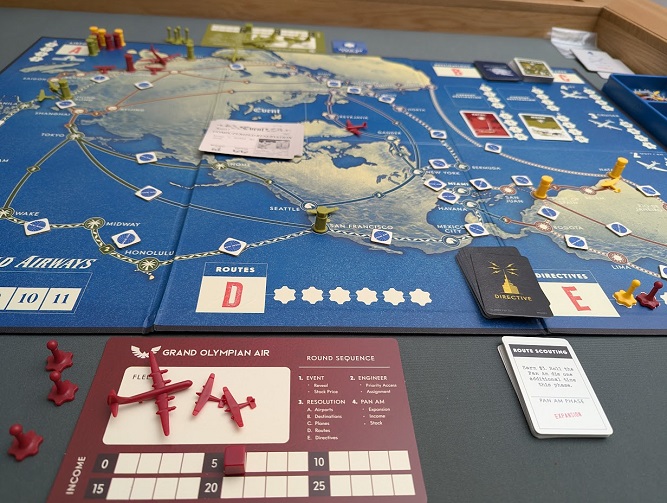
Set in the late 1920s, Pan Am follows the rise of one of the biggest names in air travel. But you are not playing as Pan Am. Instead, you are a small airline trying to make your mark, building routes and selling them off to the giant as it expands. Along the way, you are also trying to invest in this growing airline before the stock price climbs out of reach.
Before getting into the flow of a round, it is worth learning how routes work, as they are crucial to understanding the game. To build a route, you need landing rights in two connected cities, and an airplane big enough to make the journey. You can gain those rights by building an airport, holding a destination card for a city, discarding a destination card of the same colour matching a city, or discarding two cards of any matching colour.
With that in mind, each round begins with a bit of flavour in the form of an event card. These are presented as newspaper clippings tied to real moments in Pan Am’s history. Each one introduces a unique effect for the round, like cheaper upgrades or boosted income, while also setting the current stock price and how aggressively Pan Am will expand later.
Next comes the Engineering phase, which is where most of the action happens. Players take turns placing their engineers onto different spaces around the board, effectively reserving actions for later.
Most of these spaces use a bidding track. When you place an engineer, you take the lowest available spot. If another player wants that same action, they can bump you by placing above you on the track, which makes it more expensive for them to use… but they get to use it. You get your engineer back, giving you the option to jump back in at an even higher cost or pivot to something else.
The available actions cover everything you need to grow your airline:
- Build airports to secure landing rights and increase your income
- Take destination cards, which also grant landing rights in different cities
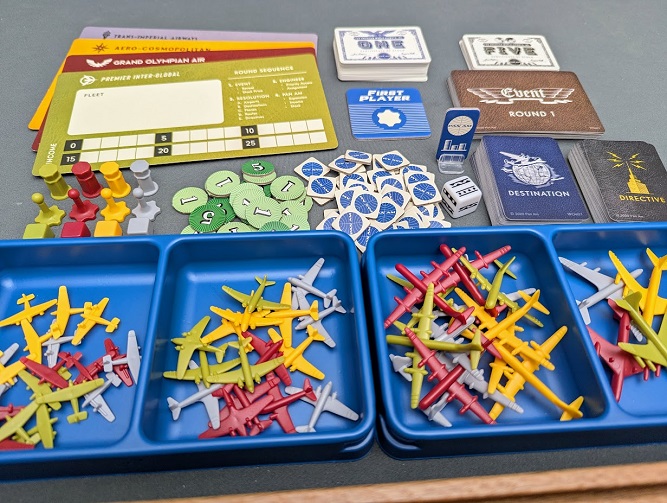
- Buy planes to build routes with
- Create routes between cities, provided you have the rights and a big enough aircraft
- Pick up directive cards, which offer one-time bonuses, and can gives you priority turn order in the next round
Once everyone has placed their engineers or passed, those actions are resolved in order.
Then comes the Pan Am phase.
First, you roll the expansion dice to see where Pan Am grows next. As it expands, creating it’s own routes, it will absorb any player-built routes in its path. As well as block players from building routes there in the future. It’s not all bad though, as when Pan Am builds over your route, you get a tidy little pay out and your plane back, ready to be used again.
After that, players collect income from their airports and routes, then have the opportunity to buy Pan Am stock.
After seven rounds, the player with the most valuable stock portfolio wins. And while you might not have built the biggest airline around, that title will belong to Pan Am, you will have made the most money riding their tailwinds to the top.
More Going On Than You Think
Despite looking like a simple game on the surface, both in terms of production and rules, Pan Am has a lot more going on than it first lets on. And most of it comes back to how you build your routes.
On paper, creating routes is straightforward. Tick a few boxes and you are done. But with a bit of planning, you can turn one route into two, two into four, and four into something that actually wins you the game.
Take airports as a simple example. You can place one in almost any city on the board, but where you place it matters a lot. Drop it into a city with only two connections and it is fairly limited. Place it in a hub with four connections and suddenly that single airport opens up far more opportunities. Same action, very different outcome.
Destination cards take this a step further. If you have a card that matches a city, you can build routes from it and keep the card. That means, with the right setup, a single card can power multiple routes across the game. Once you spot that, your planning shifts from grabbing whatever is available to grabbing what’s most efficient based on the card you already got.
Of course, it is never that simple. Those cards are contested through the worker placement system, and other players can derail your plans at any moment. This is where Pan Am gets clever. Almost every action is available if you are willing to pay for it. So you are constantly weighing up whether something is worth the extra cost, especially when money is so tight.
Another nice wrinkle is how building routes increases your income over time, while selling them gives you an immediate cash boost. You are constantly deciding whether to hold onto a route for steady returns or cash it in at just the right moment.
And all of that feeds into the most important decision in the game, buying stock. Since this happens at the end of every round, you are always balancing your current turn against your future plans. Do you spend big to lock in valuable shares, or hold back so you can take stronger actions next round?
Put it all together, and Pan Am is full of small but meaningful decisions. It might look straightforward, but there is a surprising amount to chew on once you get into it.

Crowded Skies or Open Air?
I really do not have many negatives for Pan Am. If I had to point to one, it would be the presentation. It is a bit dry compared to more modern titles. That said, it fits the theme, and there is something oddly nostalgic about it. It reminds me of those old travel-style board games you might find tucked away in a cupboard somewhere.
But there a couple of things you should know about the game.
I have played this at two and three players, and the difference is noticeable. At three, the game felt tighter, more interactive, and far more contested. At two, you have more breathing room, which makes it easier to set up your plans without interruption.
The interesting part is that the rules barely change. You simply have fewer engineers in play. But with more players competing for the same spaces, every placement matters more. You are forced to do more with less, and your plans are far more likely to be disrupted. Playing at both player counts was enjoyable, but they were very different experiences.
Replayability is also worth touching on. Each round has its own set of four possible event cards, and you only use one of them each game. Which cards make it in is randomised, so every play feels a little different. That affects how Pan Am expands, how much stock costs, and what bonuses come into play. If you enjoy the core system, this is enough to keep things feeling fresh game after game.
So where does that leave it?
Pan Am is a genuinely clever design that hits a lot of the right notes. It sits comfortably in that Gateway+ space. It is not as overwhelming as heavier strategy games, but it is a clear step up from lighter titles like Takenoko or Tokaido. Not one I would use as a first introduction, but a great next step.
It also feels like a game that flies under the radar. The theme is subdued, and the box art does it no favours. But if you can look past that, there is a really solid and satisfying game here.
More Plane Games
Looking for more board games that focus on the world of aviation? These three options stay true to the theme and offer different experiences for anyone wanting a game that is all about the journey and a successful landing.


How Does It Compare?
A score tells you if it’s good, but the leaderboard tells you if it’s worth the shelf space. See the full board game rankings to see the true pecking order.