

Cuius Regio – Production Set First Look

I just had the chance to learn Cuius Regio from the game’s developer, Mike Sigler, on his advance production set. Mike is an old colleague, friend, and also co-developer of my own Coast Watchers design.
Cuius Regio depicts the campaigns for control of Germany in the Thirty Years War. It turns out to be the operational 30YW game that I have been waiting for, ever since playing the SPI Thirty Years War battle quad games of the 1970s.
The game is designed by Francisco “Pako” Gradaille – another friend and the designer of Plantagenet, Volume IV in my Levy & Campaign Series.
The operational maneuver, similar to GCACW but with strong Thirty Years War supply aspects, meshes beautifully with a political-diplomatic underlay required to tell this long war’s story. That makes the decisions of what to do with your forces difficult – and historical. Operational objectives – particularly when considering the long haul of the war – are subtle to suss out. When forming, marching, and battling with your armies, you must account for each turn’s coming winter, when troops evaporate if inadequately housed.
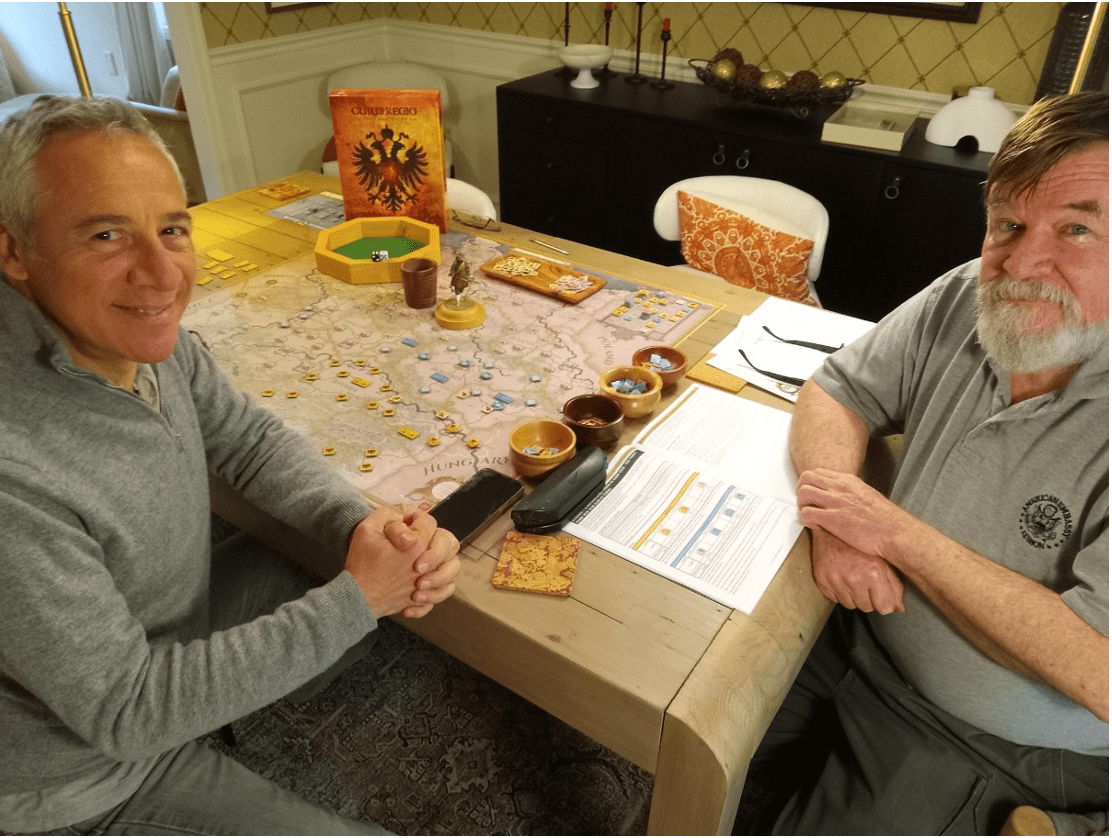
We both learned the game from its developer, Mike Sigler (at right).

Similar to Ragnar/MMP’s Angola, we get a great-power cockpit fight, here for post-Reformation Germany: No one can afford the Emperor to be too strong or too weak, lest their religious independence or larger European ambitions be threatened. Whichever side – Catholic Imperialist or anti-Habsburg Protestant – is behind gets help with new allies.
In our game, after a lackluster 1618, our Imperialists successfully recruited the mighty Bavaria to the war, then as well in 1620 the province of Lusatia, small but strategically situated north of the Bohemian rebels and an ally the latter had sought for themselves as a potential sanctuary from defeat on the Bohemian plain.
Thus Cuius Regio will organically generate a patchwork of German alliances to tell a different politico-military tale each play. And the stabilizing diplomatic subsystem can readily reproduce the full 30 years without seeing a blowout for either side.
Our learning game only covered the kickoff Bohemian Revolt of 1618 to 1620. Satisfyingly, we had a giant “White Mountain” battle for Prague right on historical cue, in late 1620 – though in our case seeing a defensive Protestant victory. Great stuff!
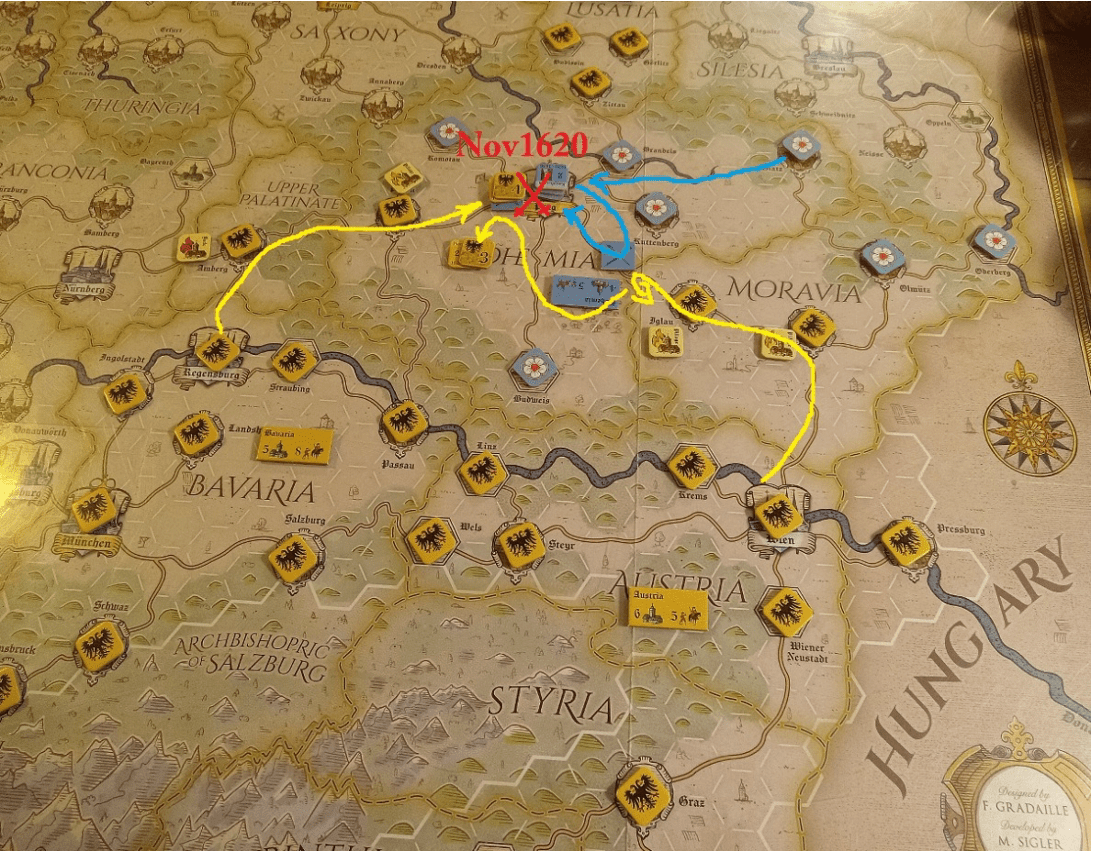
We later met for another learning session, with Mike again leading Duca and me through play, same sides but taking on the more expansive Swedish intervention beginning in 1630. We tried screened mats for hidden army strength this time and got through 2 years of historical campaigning…

(We added small glass beads to mark victory space possession.)
In 1630, my Protestants reduced Imperial holdings in the north and Silesia and conquered Bremen and Silesia. But the Imperialists start from a big edge in great cities and electorates, and Duca’s Imperialists built on that with unopposed conquest of much of the Rhineland.
That seemed to force more direct action by the Swedes, so King Gustavus went for that in 1631.
A) The King with a big cavalry-heavy army attacks Nürnberg, but there an entrenched Pappenheim soundly defeats the Swedes – shades of Gustavus’s historical repulse at Alte Veste! The King must retire back north but at least is able to bring Magdeburg and Anhalt over.
B) Johan Banér with a second major army at Breslau was to head west to follow up on the hoped-for success by the King. But that latter’s repulse immobilizes Banér who must now guarantee the defense of both Silesia and Saxony.
C) The Imperialist lieutenant general Johann von Aldringen continues the Imperialist romp down the Rhine, invading Hesse and Westphalia, picking up Frankfurt and the great city Electorate of Köln. But the Imperialist’s abortive invasion of Lorraine the previous year has enabled the Protestant marshal Knyphausen to raise a mercenary force with artillery there: Knyphausen from Strasbourg scoops up Lorraine’s second great city Metz and dives into the now undefended Palatinate.
D) Pappenheim, having earlier contemplated an assault on Protestant marshal Bernhard of Saxe-Weimar’s bridgehead over the Danube at Regensburg must now head east to counter Knyphausen. The latter still gains Mainz and Frankfurt for the Protestants for this year, at least, as both sides go into early winter quarters.
Throughout, play saw rich discussion and a range of views among the 3 of us. My feeling is that I learned more about how to handle campaigns but have much yet to learn in order to play well, particularly in how to effectively take the offensive in this game’s tight inter-binding of military clashes, sustenance of troops, and political intrigues in the Thirty Years War.

Check out this previous InsideGMT article from Pako himself to read more about maneuver in the game and how differently things can work out in 1618-1620 (showing playtest art, in that case).
The Cuius Regio print run is done and, per GMT’s April Update, was set to load in late April. So the product must as of now (May) be in transit across the sea, heading toward the GMT Warehouse. And that means the preorder discount will soon lapse as delivery ensues!
– Volko