

Chalice of Poison: Victory in War
Now that we’ve talked about Chalice of Poison’s gaming system and origins, let’s talk about the game itself. When I teach games, I like to start with explaining how you win the game, so why should these designer blog articles be any different?
How does one “win” the Iran-Iraq War?
The story of the Iran-Iraq War is one of stalemate on the ground. Ironically, this stalemate left each country’s definition of victory in constant flux. Over the course of the war’s eight years, both countries had changing objectives, to include, at varying times:
- Iraq hoped a limited invasion would collapse the fledgling Iranian revolutionary government.
- Iraq hoped that routing the Iranian military and forcing the remaining troops out of the cities would enable an internal counterrevolution.
- Iran hoped a counter-invasion would incite a full-fledged revolt among Kurds and Shia to take down the Iraqi regime.
- Iran hoped that Iraq would be so desperate to stop the counter-invasion that Saddam Hussein would agree to step down as part of the peace talks.
- Iraq hoped that Iran would be so desperate to return to the status quo ante with nothing gained or lost, except for countless lives and suffering, that it would consider it a victory because at least the regime survived and did not have to pay reparations. Iran proved willing to accept these terms because it could not continue fighting at the current rate.
None of the maximalist objectives of Iraq’s 1980 invasion (objective A or B) or Iran’s 1982 counter-invasion (objective C or D) came to fruition. Instead, the war ended with objective E, an effective stalemate, after both countries reached a point of exhaustion.
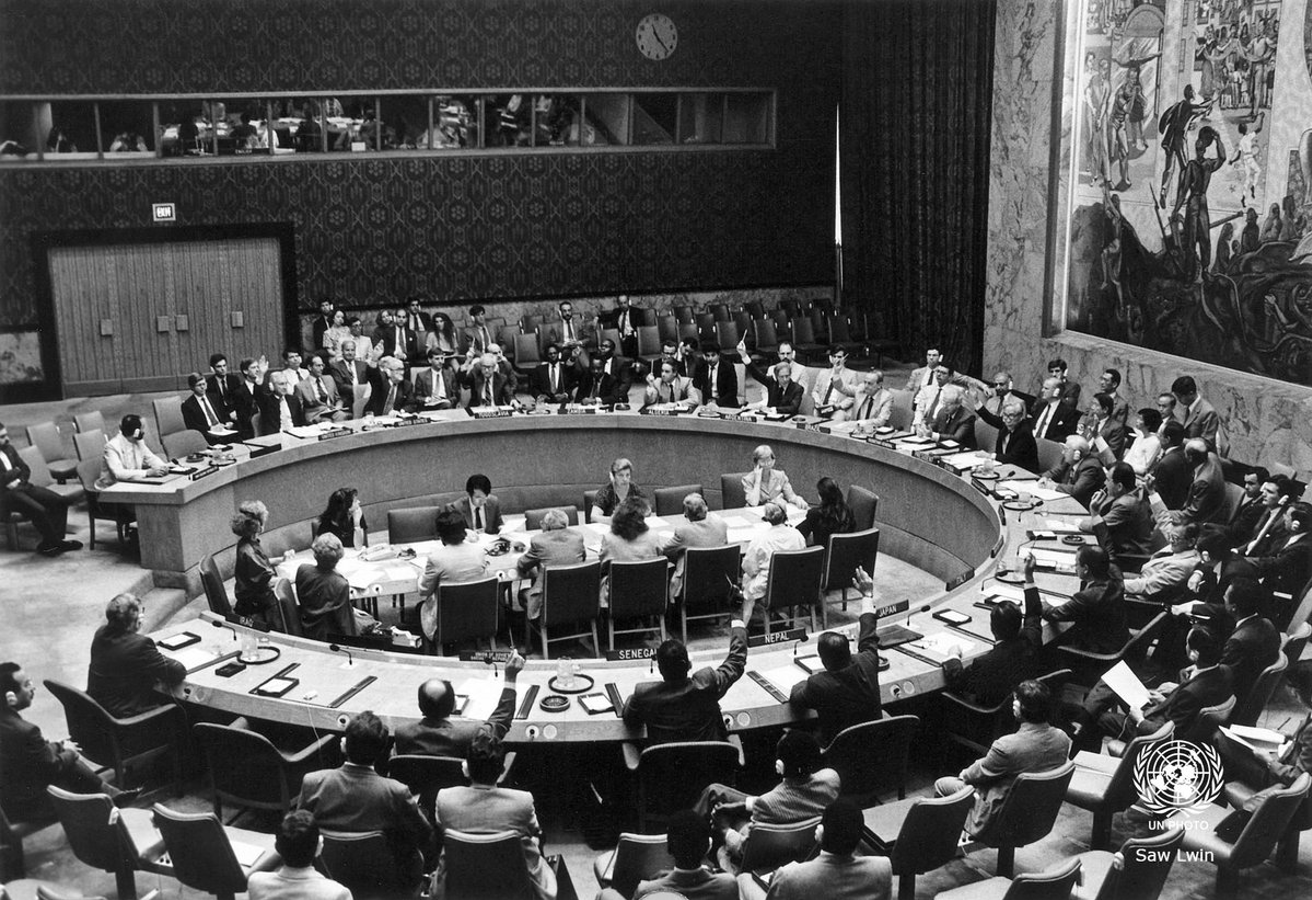
Iraq and Iran both hoped the war would end in decisive battle, but it ended in a begrudgingly accepted UN Security Council Resolution (Source: United Nations)
Two Ticking Clocks
This was the initial challenge with designing Chalice of Poison: How does one design a game around a war where neither side won anything, but where both sides could have potentially won by a lot? How does a game allow for players to achieve all of these varied potential victory conditions, where a player could have a massive, rapid win by seizing the enemy’s capital and forcing regime change, or else could win a minimalist victory by accepting that at least they did not lose territory?
The solution was to have variable victory conditions that change throughout the game, and to have two sets of victory conditions: one related to war progress, and the other related to internal political stability. This article focuses on the war progress, victory conditions, and mechanics; internal political stability will wait until the next article.
Both of these conditions are maximalist (read: difficult to achieve) early in the game and the conflict. As the war drags on and both countries become more desperate to end the war in any advantageous position, regardless of how slight, the conditions gradually reduce. Additionally, as players expend their state capacity to try to win the war, they may find their regimes become more fragile over time.
The game represents the first “ticking clock” with an Objective marker. It starts at 10 victory points (VP), but reduces throughout the game. If a player’s VP marker ever meets or exceeds the objective at the end of a turn, that player wins the game. VPs are zero-sum for both players, marked with a single double-sided VP counter, so if one player is ahead, then the other player is behind (e.g., if Iraq is on 2 VP, Iran is effectively at -2 VP). (The second “ticking clock” takes the form of a Political Power pool that does not refresh fully every turn, and will dwindle as the game progresses. The next article will talk more about that.)

The War Progress track. Currently, Iraq has 2 VP, which might be enough to win the game on future turns! But, currently the objective is 10 VP, so it falls far short of current goals. (Not final graphics)
The objective marker typically moves in three ways, each marked with a dove icon and a number of arrows, either to the left or right. First, it moves at the beginning of each turn, moving faster on later turns, symbolizing weariness as the war drags on without a clear victor. Second, it can move when players take certain “Desperate Measures,” which represent radical actions they can take out of desperation not to lose the war. Third, on any turn in which the side winning the war switches from one country to the other, the objective reduces by one, reflecting a feeling of futility as initiative changes hands.
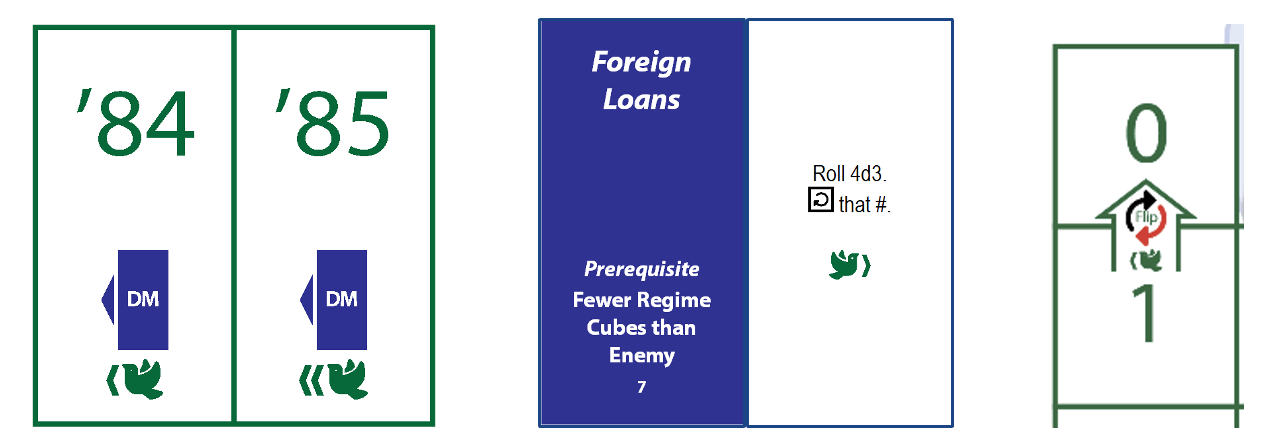
Some examples of dove icons moving the objective marker: when a new turn begins, when a player takes out loans (from lenders who expect results), or when the winning player changes. (Not final graphics)
War Progress
As the VP objective changes, typically getting lower throughout the game, players will attempt to gain VPs and meet this objective. They primarily do this by capturing enemy territory. The game’s War Map, which makes up most of the board, shows the current status of the war. The point-to-point map is broken down into squares, which represent territory in Iraq (black) and Iran (red) that may be captured by the other side.
Each of these spaces contains symbols that provide bonuses or penalties when a country captures a space. Most relevant to this article are the stars, each of which represent a VP. Spaces with VPs typically represent important strategic or symbolic targets, to include major cities, religious centers, and so forth; the more stars, the more important that location is for war progress. (Additionally, circles represent Economy and hexagons represent Dissident groups; both of these mechanics will appear in future articles.)

Part of the Northern Ground Front. Mosul, a major Iraqi city, provides 2 VP. Marivan, a smaller Iranian city 10 miles from the border, provides none. (Not final graphics)
As mentioned earlier, VPs in Chalice of Poison are zero-sum. As such, the game only tracks the winning country’s VP. If the points ever go from one to zero, players should flip the VP counter to indicate that the other country is winning, and then count that side’s score. (This means that a country can win with zero points, which probably reflects the real-world historical outcome.)

Both sides of the VP counter. (Not final graphics)
Fronts on a Point-to-Point Map
As mentioned, players gain VPs by capturing territory on the War Map. This section explains how capturing territory works.
When drawing the game map, I had to use a point-to-point map rather than a to-scale, geographically literal map in order to fit the theme. First, the amount of terrain that the countries fought over was tiny, meaning that a to-scale map would have had lots of empty space. Second, the game map needed to be simple so that it did not distract from the game’s political mechanics. Third, the terrain between Iran and Iraq is rugged, mountainous in some areas and marshy in others, which means that only a few corridors existed for the countries to attempt to fight or advance.
Each of these corridors appears in the game as a different front. At game start, each side has 5 Fronts: one Air, three Ground (North, Center, and South), and one Navy. A sixth Ground (Marshes) Front starts inactive, but may be activated through gameplay. Air can attack any front, Navy can attack in the Persian Gulf and the nearby coast, and Ground can attack across the major corridors throughout the country.
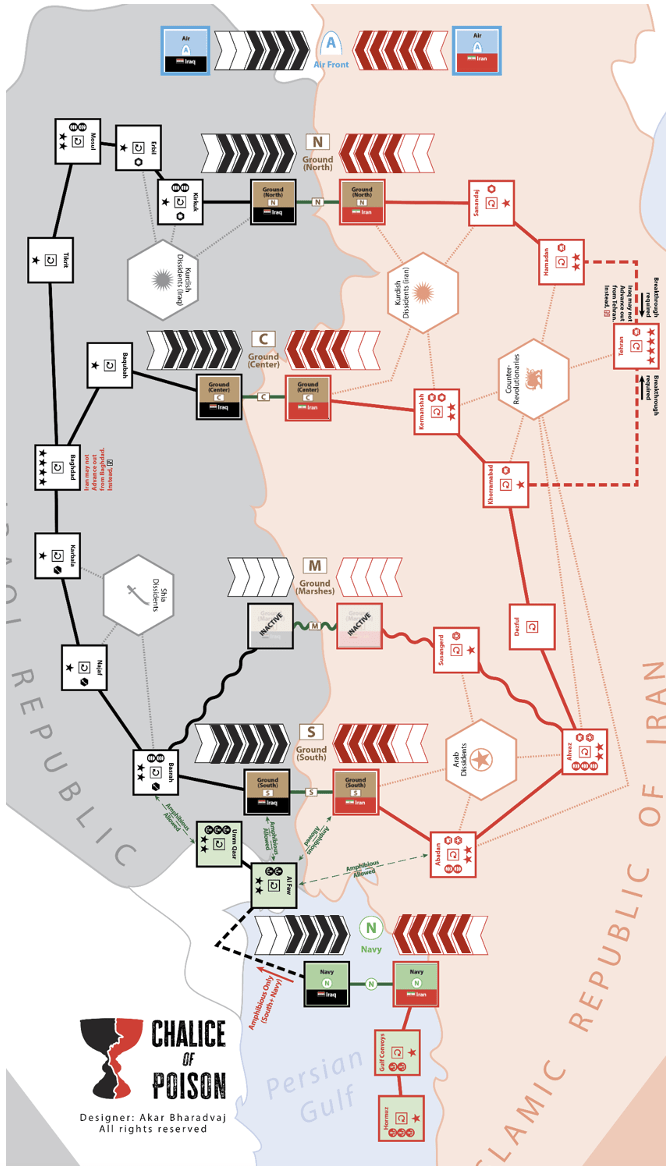
The latest version of the War Map and the starting point of each Front. (Not final graphics)
Each Front appears on the map in a specific location, which shows the maximum extent of that side’s control on the War Map. Additionally, at the Front’s starting position on the map, each Front indicates the military strengths for both sides, marked with wooden chevrons. A front advances during the Battle Phase if it attacks the enemy and has more military strength than the corresponding enemy military front after combat.
Whenever a Front captures a space with stars in it, that side gains that many VPs. If a player’s Fronts have captured VPs greater than or equal to the current objective at the end of the turn, then that player wins the game!

Iran decides to attack in the Ground (Center) Front to retake its lost space, Qasr-e-Shirin. After the battle, it has a stronger Ground (Center) Front than Iraq (four chevrons versus two), so it advances and takes the space. Qasr-e-Shirin does not have any stars on it, which means that Iran does not gain VP for taking the space. (Not final graphics)
These combat mechanics may seem a bit abstract at first glance. This abstraction is necessary because combat in itself is not the game’s focus. Most player decisions are meant to strengthen Fronts and their attached Commanders, to improve their ability to defeat the enemy and capture those precious VPs. These preparations for battle are the core of the game, more so than the battle themselves. Players will need to plan carefully and take steps to better organize their militaries, or else the Battle Phase will go poorly for them.
Stay tuned for future articles describing the Battle Resolution process in more detail, in addition to the reforms players can make to improve their militaries. But before that, we will take a trip to Baghdad and Tehran, and better understand how these two regimes utilize and maintain their political power, in a new article coming out next month.