

Meet The Qin: A Civilization of GMT’s Ancient Civilizations of East Asia
By Mark McLaughlin & Fred Schachter
Hopefully, this series provokes your interest and enthusiasm regarding this third offering of the “Ancient Civs” Series: Ancient Civilizations of East Asia. This latest article introduces one of the game’s most historically notable of its nineteen Civilizations: The Qin.
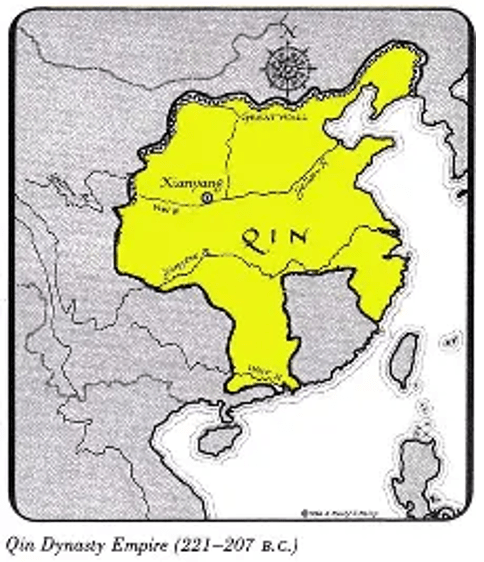
The Qin are arguably the most iconic of all civilizations in the game. After all, not only did the Qin give China its first emperor, commence building the Great Wall, and constructed the world-famous tomb filled with terracotta warriors: but they also gave the nation its very name (Qin=Chin=China). Three of their salient contributions to Chinese history are represented by this Civilization’s Cultural Attributes: the powers allocated to the Qin (see Figure 4: The Qin Cultural Display).
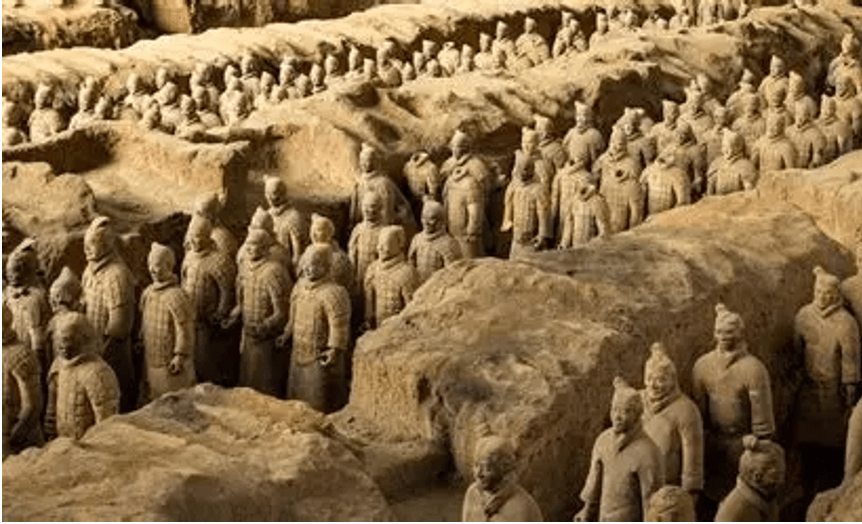
Figure 1: Qin Terracotta Warriors – This is a mere portion of the tomb’s extensively excavated contents: figures include warriors, chariots and horses. Estimates from 2007 were that the three pits containing the Terracotta Army hold more than 8,000 soldiers, 130 chariots drawn by 520 horses, and 150 cavalry horses
The Qin accomplishments include eliminating human sacrifice in their domains (Human sacrifice in Ancient China: what a revelation that was as the team did ACEA’s historical research!). Under Qin rule, written communications, as well as weights, measures, and coinage, were standardized. They also adroitly used diplomacy, as any veteran player of GMT’s “Ancient Civs” series knows, is a key part of this multi-player contest, to achieving their expansionist goals.
Here’s a short YouTube video which, remarkably and with beautiful illustrations (it includes some nice maps), conveys the Qin Empire’s history: The Entire History of The Qin Dynasty Explained in 10 Minutes Should a written presentation be preferred, use this link: Qin dynasty – Wikipedia
In battle, the Qin were formidable indeed! Check out this link to a YouTube video of their military tactics. This is something to behold and then understand how the Chinese cinematic fable of clouds and clouds of arrows was supplanted, collapsed, by archeological research! New Terracotta Army Research Reveals Why Qin Shi Huang’s Invincible Army Collapsed
This fascinating video shows how discoveries in the terra-cotta warriors’ tomb influenced perceptions of how the Qin Army functioned and its amazing parallels to Western Civilizations’ use of the phalanx and a professional army with more than a few similarities to Macedon & Rome’s. The Qin enlisted soldiers who’d be granted land at their enlistments’ end… a much less expensive alternative to a professional corps of charioteers! Their road network to move troops by a long-walled border, the progenitor of the Great Wall of China, would be something Ancient Romans would recognize and appreciate.

Figure 2: Qin Dynasty Soldiers
The Qin, in ACEA game terms adopted “Legalism” as their overarching philosophy. Readers are urged to check out this video, which is not without a sense of humor, to learn more regarding that aspect of their culture and an Ancient Civilizations of East Asia player Philosophy choice: Legalism: Crime & Punishment in Qin Dynasty China | WooKong

Figure 3: A Qin Dynasty Court
The Qin are arguably the strongest, or at least among the strongest, of all the Civilizations in the game – but then again, historically, they earned it. As such, the Qin are an ideal civilization for a new player, as with their martial powers, they can fend off aggressive, more experienced rivals. On the other hand, if an aggressive, experienced player is the Qin, the game’s other players should prepare to withstand the winds of war that will almost assuredly sweep down across the fertile areas of central China. Coalition anyone?

Figure 4: ACEA’s Civilization Display for The Qin: This format should be familiar to those who’ve played either of the other two of GMT’s “Ancient Civs.” Series: Ancient Civilizations of the Inner Sea GMT Games – Ancient Civilizations of the Inner Sea and/or Ancient Civilizations of the Middle East GMT Games – Ancient Civilizations of the Middle East. For more information, see these games’ referenced GMT Sites for their Rulebooks & and a host of other game material.
As First Emperor of China, the Qin can raise a powerful army of up to three white disks in a Competition – something which each turn almost guarantees them victory in at least one fight they’re engaged in. As the Great Wall Builder, the Qin receive one free Stronghold each turn and, with the Terracotta Warrior Tomb, Cultural Attribute the Qin may advance on the Cultural Development Track one space for free at the end of each Epoch… albeit never to a Track’s fourth space.
Don’t dismiss this Cultural Development Track Qin attribute. During playtesting, we’d generally agree to two Epochs of play (Remember, an ACEA game is of whatever length the players agree to. There’s no requirement to play all four possible Epochs.). Those two FREE spaces of advance during the course of such a game, if into a Track’s third space each time, are worth 12 Resources! For more regarding this Ancient Civilizations of East Asia game feature, see: An Overview of Ancient Civilizations of East Asia’s Cultural Development Tracks – InsideGMT
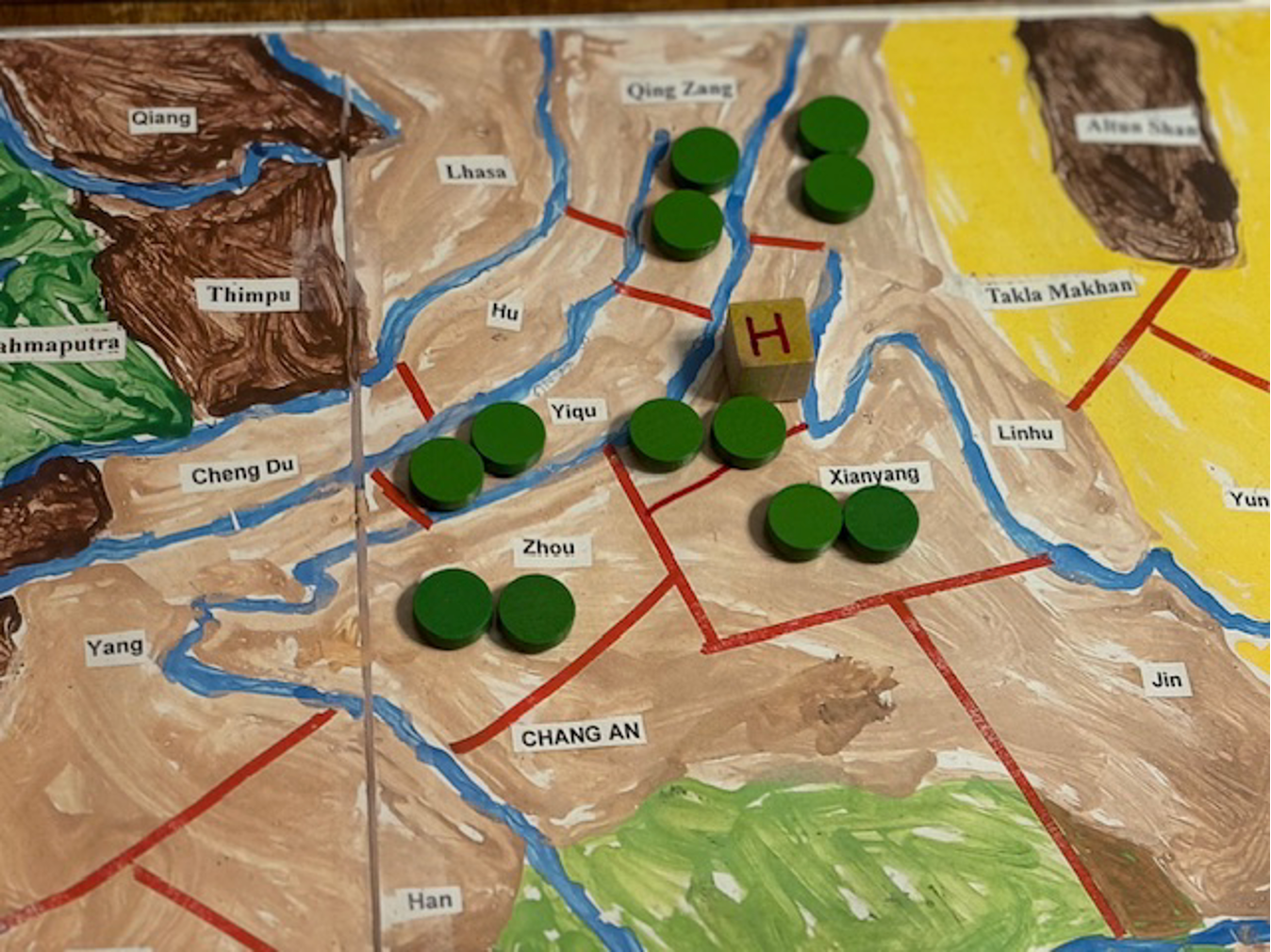
Figure 5: The Qin’s initial placement of disks on ACEA’s playtest map: The “H” small wooden block indicates this Civilization’s Standard Game Homeland: the arable land area of Qin. The produced game’s components will be similar to ACME’s Homeland Blocks.
The Qin are up against the west map edge and their northern reaches are adjacent to two Silk Road desert areas: an exposure generally safe unless the Xiongnu Nomad Civilization is in the game or particular Must Play Barbarian Invasion Cards are played against them. Otherwise, an expansion towards southeast Asia is possible, or perhaps more rewarding and historical, expand east and southeast into the very heart of China.
Next up in this “Meet the Civs” Series, we move matters back south… way south, to examine the Southeast Asian City States Civilization.