

CCV Faction Spotlight: National Liberation Front
In this week’s “Faction Spotlight,” we’ll cover the National Liberation Front (NLF), commonly known as the Viet Cong. The NLF represents one of the two Communist Factions opposing the Free World Forces in Combat Commander: Vietnam. Although directed and eventually eclipsed by the North Vietnamese military, the NLF’s distinct operational style and major contribution to the Communist war effort necessitates a serious treatment of the group in any tactical Vietnam War game.

Before the formal beginning of the NLF, small groups of guerrilla forces resisted South Vietnamese forces in the late 1950s. Over the early 1960s, surges of recruits and military assistance from North Vietnam allowed the NLF’s military wing, the People’s Liberation Armed Forces (PLAF), to quickly form larger military units including battalions, regiments, and divisions. By 1963-64, the PLAF’s military forces posed a serious threat, leading to embarrassing South Vietnamese government defeats at Ap Bac and Binh Gia. Many early American “search and destroy” missions, such as Operation Starlite (1965), sought to disperse the NLF’s larger military forces in populated areas to shield pacification efforts. After the progressive exhaustion of liberated areas in South Vietnam and the major military losses during the Tet Offensive, the NLF’s military role in the Communist war effort sharply declined. After mid-1969, North Vietnamese forces dominated the war effort and even served as “filler” replacements for decimated NLF units until the end of the war.

Depictions of NLF forces on wargame box covers from 1984 to 2023
To highlight the hybrid nature of the NLF, Combat Commander: Vietnam gives the NLF a 36-card “Partisan” Fate Deck and an Order of Battle with a wide range of formations. Like with Chad’s Combat Commander: Europe, the NLF faction also covers the armed forces of other minor “insurgent” allies, such as the Khmer Rouge in Cambodia and the Pathet Lao in Laos.
Three-Tiered Force Structure
For many casual gamers of the Vietnam War, the NLF fits the romanticized image of “people’s war” (e.g., Saigon 75’s box cover above): a ragtag group of local “farmers by day and guerrillas by night” fighting the most powerful country in the world. Such depictions of the Vietnam War further the “national liberation” narrative of the war that pits the Vietnamese people against the invading Americans and their South Vietnamese puppet forces. Nothing personifies such an approach to the Vietnam War more than dressing NLF troops in the typical peasant attire of conical hats and black pajamas (e.g., 65: Squad-Level Combat in the Jungle of Vietnam takes such an approach with its Viet Cong counter art), equating insurgent military forces with the rural population of South Vietnam. Although a tempting narrative for American audiences seeking tidy abstractions for understanding the war, such an approach does not survive first contact with Vietnamese history, particularly when modeling the NLF’s military forces at the tactical scale of Combat Commander: Vietnam.
NLF forces operated using a three-tiered force structure. The lowest tier constituted the guerrillas and self-defense forces that operated near their local village. Guerrillas come the closest to matching the common “people’s war” image. During the heights of the insurgency’s rural mobilization, guerrillas with the support of the local population in liberated areas could raise the costs of Free World Force sweeps through harassment, constructing fortifications, and setting traps. Yet local guerrillas rarely operated as organized platoons that launched coordinated military attacks at the scale needed for most tactical games. Given their focus on dispersed harassment rather than fighting engagements, the NLF Faction in Combat Commander: Vietnam omits local guerrillas from its Order of Battle.
Instead, our game begins with the second tier of NLF troops: Local Forces. Local Forces generally operated as platoons and companies in their home districts, roaming around multiple villages. Many provinces also included “Provincial Local Force” battalions that operated only within the districts of their home province. Given their larger formation size, local force units often found themselves in engagements at the Combat Commander scale. However, local forces also deviated from the “people’s war” depiction. First, such forces represented full-time military units rather than part-time militia fighters, possessing the equivalent of “Weapon” counters in Combat Commander such as light machine guns, mortars, and recoilless rifles. Second, local forces did not fight in the conical hats featured in many Vietnam War games. Instead, they favored more practical headgear, such as the almost as “iconic” floppy hat depicted on the other covers above (and more recently modeled by Volko Ruhnke).

Playtest counters for NLF Local Force, Main Force, and NVA Fillers using our artist Euan’s figures
In Combat Commander: Vietnam, Local Force formations possess a low VP cost but high Initiative (see the work in progress Order of Battle card below). They’ll almost always be on defense, but usually get to act first and often will be seeking to leverage our new Break Contact mechanic rather than sticking around for a long drawn out fight. After 1968, the exhaustion of the NLF’s liberated areas meant that Local Forces could no longer find replacements. To keep the Local Forces operating, North Vietnam began breaking down their military forces and inserting them into Local Forces as “fillers.” In CCV, North Vietnamese Filler Squads provide greater firepower but at the expense of lower mobility.

Work in Progress Order of Battle Cards for Use with Random Scenario Generator (Playtest Art)
Third, NLF forces served as Main Forces which operated in military units at the battalion or larger size. Main Forces followed the orders of Communist Military Regions and could serve across multiple provinces. The best equipped Main Force units were far more analogous to the North Vietnamese military. They commonly served with heavy weapons platoons and could sometimes rely on dedicated regimental or division mortar and rocket units. When possessing a significant numerical advantage, NLF Main Forces attacked Free World Forces camps and bases in large-scale attacks, attempting to overwhelm small garrison forces in daring night assaults led by specially trained sappers.
Much of the NLF’s Order of Battle in Combat Commander Vietnam features Main Forces including the Elite Rifle Company, Sapper and Wave Assault formations. Unlike the Local Forces and less trained Main Force formations that primarily find themselves on defense in the game, the NLF’s elite forces will often be attacking smaller Free World Force units using the Night rules formally introduced in Combat Commander: Pacific (2008).
By only possessing 36 cards, the NLF’s Fate deck has an advantage on Defend postures, quickly racking up points before Breaking Contact, but is more fragile on Attack. On Attack, NLF players will rely heavily on their Creep Orders during Night to close quickly with the enemy and leverage their deck’s higher distribution of Ambush cards to win melees. In addition, to model variation in the training of the NLF forces, their deck also uses the new Advisor mechanic (shared with the ARVN deck). North Vietnamese advisors help NLF players deal with Command Confusions by converting them into Fire, Fire Support, and Recover Orders.
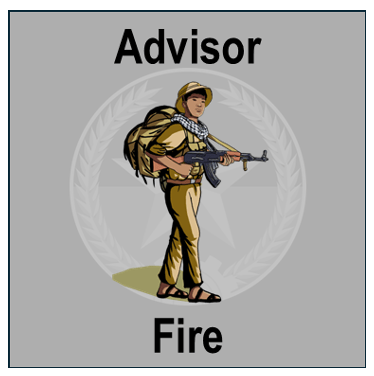
Playtest art of an NLF Advisor allowing NLF to convert Command Confusion Orders to “Fire”
The Advisor mechanic allows us to simply model two implications of the NLF’s less developed military. First, in 1964, as the NLF conventionalized their forces, the training and effectiveness of their units sharply increased, allowing them to stand and fight against ARVN forces. Similarly, Local Forces lacked the military training of their Main Force counterparts. In the Order of Battle, NLF formations possess Advisors only from 1964-1975 and not for Local Forces. Second, Advisors also let us reflect the variety in what Advisors taught to their trainees: disciplined fire, calling in fire support, or staying in the field.
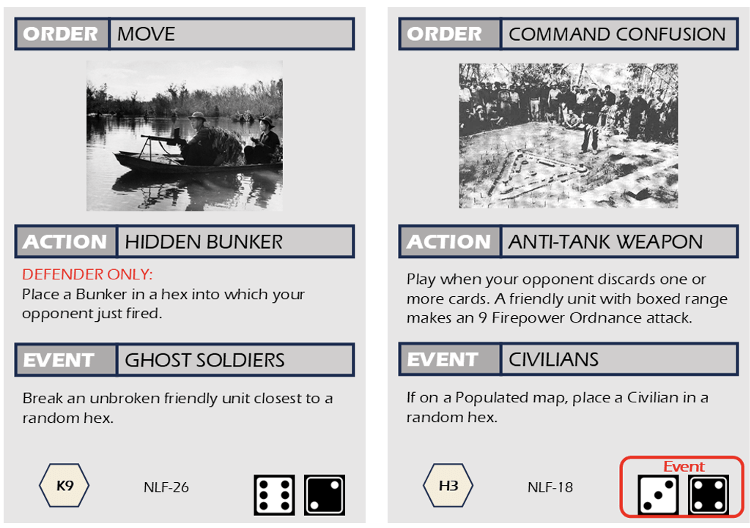
Prototype NLF Fate Deck Cards in the style of Combat Commander: Europe
Conclusion
As one of the two Communist factions in the game, the NLF will become a familiar faction for players. Twelve of the twenty-four base game scenarios include their faction. Yet the mechanics needed to properly model the NLF in Combat Commander: Vietnam means their faction provides a lot of different play experiences. Their Local Forces will nearly always be on Defense, hoping to delay the enemy enough to breakaway, whereas their Sappers at Night will put even the best Free World formation on the back foot. On Patrol scenarios, their forces can nimbly move across the map with the Creep Order, outmaneuvering their better equipped opponents (except for the Special Forces Faction or ANZAC). Although not as hard hitting as the more conventional North Vietnamese Faction, the NLF poses a serious military threat for any players naive enough to treat them simply as an armed militia barely distinguishable from the peasantry.
For those wanting to read more about the NLF have two main options. First, for the military side of the NLF, the best options in English are Mangold and Penycate’s The Tunnels of Cu Chi or Landing and Cragg’s Inside the VC and NVA (2008). Second, for a broader view of the NLF, I’d recommend David Elliott’s The Vietnamese War (2003, 2006), which covers a lot of different aspects of the insurgency. The much longer first edition is hard to track down, so one is best off looking for the “abridged” later edition. RAND also conducted a number of studies on the NLF and have made them available online, including on the NLF’s military forces and tactics. However, since they vary in quality, those reports should be approached with a bit of care. Those recommendations reflect only the most accessible sources. For the design, we also relied on archival evidence and Vietnamese language histories, but those sources are much less beginner friendly!