

The Weimar Republic: Four Bot Tutorial
This tutorial will guide players through the operation of the Non-Player (NP) factions for The Weimar Republic, using an illustrated example of play. It is presumed that the player is generally comfortable with the rules and flow of the game, so the focus of the tutorial will be on operating the NP factions. The NP factions are designed to substitute for missing human players or there is discomfort in playing certain factions. The NP factions are not as flexible and innovative as a human player, however at times they can create surprises. For the tutorial all four factions are Non-Players; the terms Yellow Bot and Coalition NP, Black Bot and RC NP, Red Bot and KPD NP, and Brown Bot and NSDAP NP are synonyms.
1. Set Up
The tutorial will start from early 1928 and use the Black Sun Rising scenario. Follow the scenario setup rules [9.5] to place the board and play mats in comfortable reach. Distribute the Special Cards, track markers, faction pieces, and on-board Influence, Leverage, Cadres, and Units as described. Mark the Conservative Cliques in Bayern, Ostpreußen, and Reaction Level 5 as A, B, and C, respectively [8.4].
Take the Golden Twenties deck and separate out the Election and Lingering Event cards. In line with the scenario, discard the Election cards and place the Mandatory cards #54 Gustav Stresemann and #57 Paul von Hindenburg in the Lingering Events box. Due to the effect of Paul von Hindenburg, all Rogue Freikorps have an SV of 3, so we remove the Coalition Supremacy marker from Berlin. Of the remaining Lingering Events the scenario requires three, and for this tutorial the cards will be #60 Racial Theory, #62 Roter Frontkämperfbund, and #80 Young Plan. Place these in the Lingering Events box and discard the remaining Lingering Events and Election cards.
Deal the following cards from the remaining Golden Twenties Era deck to each faction and place them face-down to create a hand of cards for each Bot. The first listed card will be topmost (first drawn) in the NP faction’s hand, a Bot does not view and order cards before play, nor will a human player see any of the Bot’s cards face up before play excepting any unplayed Parliamentary Control cards.

Shuffle each faction’s nine Bot cards together and place them face down near the matching faction’s play mat and Event cards.
Finally, the Black Sun Rising scenario has the following special rules:
- Stance tracks [1.3, 5.3] are not in play; all counters on KPD and NSDAP faction mats are always Available. Stances are treated as Pragmatic for all Event purposes.
- Ignore the Reaction Limited rule [5.7]; Reaction Level can exceed Progress Level by more than 1.
Footnote: Playthroughs are difficult; on playing through you may see a space where influence could go. If so, play on, and see how your variant changes. This is your cardboard time machine.
The NP factions are just engines with no foresight or strategic planning. They are designed to complicate and challenge and work better when playing as a challenge to human opponents.
2. 1928
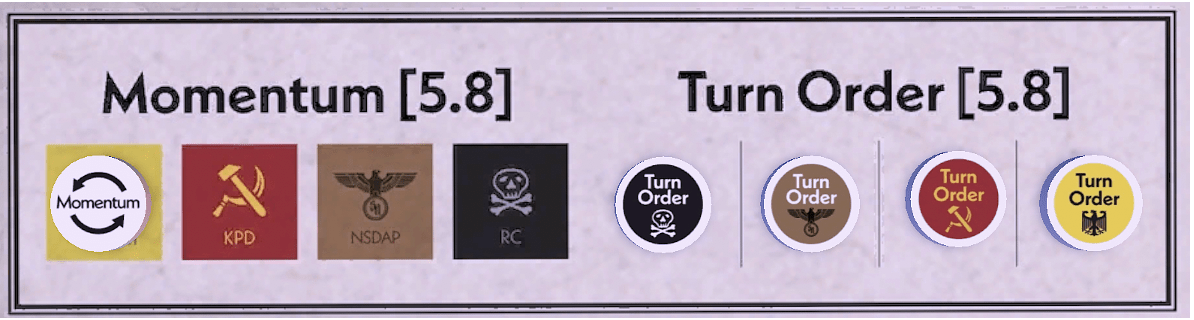
The first task is to determine turn order [5.8]. The Coalition has Momentum and so a Coalition Bot card is flipped to determine the order of the other factions [8.4]. The top yellow Bot card shows #9 Prussian Provinces.
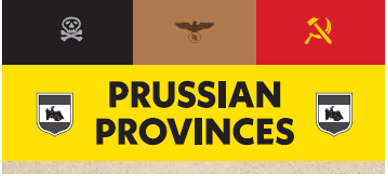
The turn order will be RC, NSDAP, KPD, then Coalition, and turn order markers adjusted.
Since the Bot card was not played for the Coalition’s turn, all other text on the card is ignored. The card will remain face up near the Yellow Bot cards until a reshuffle is required.
From here on, each Bot’s turn will flow in the following cycle:
- Draw a Bot card and, if required, draw an Event card.
- Faction interrupts: If respective cards are Available, the Coalition plays the Article 48 card if triggered, and the Active faction may play Reichstag Seats.
- Play a Parliamentary Control card, if possible.
- Activate the Event.
- Take Actions.
Recalling this five-step flow will help keep you oriented during a turn. Human players can mix up this play order at will, with the important exception that any two Actions [6.0] cannot be interleaved by other card play.
2.1 Early 1928 – Radical Conservatives
The RC flip their first Bot card, #31 Clique C, and draw an Event, #111 Intellectuals.
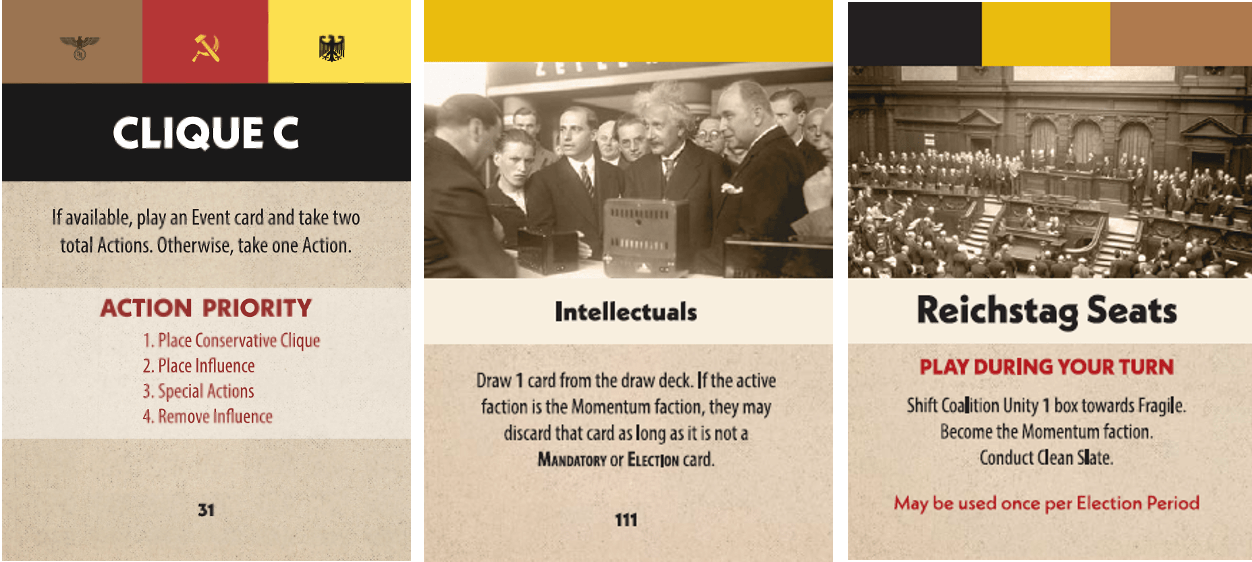
The Event is not marked with the ‘48’ symbol, so the Coalition will not play Article 48 [8.7]. The RC hold Reichstag Seats and, as they are not the Momentum player, the card will be played. This play would normally degrade the Coalition unity from Sound to Fragile however the Stresemann Lingering Event blocks this, however the RC do win Momentum. The Clean Slate [5.11] occurs, but the yellow Leverage in Berlin and black Leverage in Ostpreußen are preserved by the respective factions’ Dominance of the spaces; the black Leverage in Bayern returns to the rightmost empty box on the RC player mat.
Comment: Bots tend to fire off Reichstag Seats shortly after an Election, and this play is one human players may not usually make. For the purposes of this tutorial, we will follow the NP rules to the letter; if the NP faction is playing with humans, an agreement to override the Bot and not play Reichstag Seats at this juncture could be appropriate.
The RC do not hold any PC Cards, so next is the Event. A card is drawn and shuffled into the faction draw deck: #82 Referendum. Good fortune, a card to the RC advantage and its prerequisite Young Plan is already a Lingering Event. (Note, this would be drawn and added face down; it is shown for the purpose of this example only.)
Now come the two Actions, as determined by the Bot card.
The first consideration in the Action Priority, Place Conservative Clique, is skipped as Clique C is not Available.
The second consideration, Place Influence Action, the spaces under consideration are based around the Impulse Space, Clique A in Bayern, plus spaces within range determined by Middle Class Sympathies (MCS), as well as Berlin and adjacent spaces (Provinz Sachsen and Brandenburg) [6.6]. The current Reaction level 3 permits the faction to place one black cube, with the goal to win Dominance [8.6, section 4, Step B]. The possibilities are Bayern or Württemberg; other spaces in range of Clique A or in Berlin and adjacent spaces will not win Dominance with a single cube placement. The final decision of which specific space [8.6, section 4, Step E] follows the priorities and met at priority 1, the Impulse Space, and a black cube is placed in Bayern. This completes the first Action. This space-selection process will be used frequently by the Bots and the process will become clear quickly.
Note: Bayern, Clique A, is the Impulse Space. When placing or removing Influence spaces within range of the Clique plus Berlin and adjacent are eligible spaces [8.2]. There are numerous other actions dependent on the Impulse Space.

A human RC player can always Place or Remove Influence near a Clique or Berlin and adjacent spaces (Provinz Sachsen, Brandenburg); for the Bot as stated in 8.2 the Berlin-and-adjacent is an Impulse Space only when the Clique is not on the map.
The third consideration is the Special Action. A roll of 5 gives Agitation Actions. The Advance Reaction track Action is not possible as there is no black Leverage adjacent to Reaction Level 4. The Assassination Action is possible as the Assassination marker on the Reaction track is Available [8.6, section 4, Step D, priority 2]. The Assassination’s targets, in order, are the KPD then Coalition then NSDAP, as determined by the current Bot card. An Assassination on the KPD removes red Influence or KPD Cadres [6.6], and looking at the priorities table [8.6, Section 3] the priorities are Cadre over Influence. The sole KPD Cadre is in Köln, so RC places the Assassinations marker in Köln with its yellow/red side showing and removes the KPD Cadre. The only Available box for the Cadre is the USSR Deals track, so there it goes. A bomb in the Trades Hall printing press during a critical meeting does its work. This completes the second Action.
Finally, the RC Bot deck is shuffled, as per card instruction, with the only discard, Card #29, and the RC turn ends. The NSDAP becomes the Active faction.
2.2 Early 1928 – NSDAP
The NSDAP draws #24 Hamburg, however the Bot card does not allow for an Event card and only one Action.
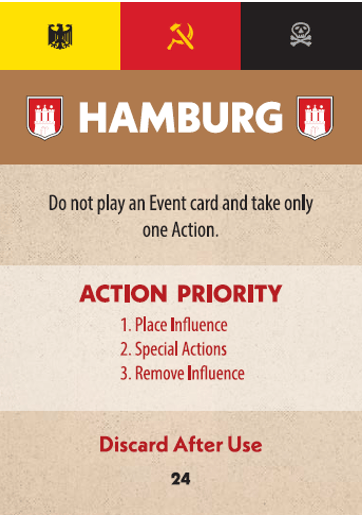
The NSDAP do not have a PC card to play, and so fall to their first and only Action, Place Influence, which, at the current economic condition, allows for one brown cube.
The placement priority process [8.6, section 4, Step B] seeks a place to gain Dominance. There is only one space, Niederschliesien, so there is no need to consider the priorities. On placing the brown cube this ends the turn.
2.3 Early 1928 – KPD
The KPD draws #17 Köln and draw the Event, #97 Ostjuden, followed by two Actions. The Coalition will not play Article 48 to cancel the Event text because the “48” symbol is not present on this Event card, and the faction does not hold a PC card.

The Event shifts Berlin from three yellow and one black cube to two each for the Coalition and RC, with consequent loss of Dominance. The NSDAP takes Momentum from the RC, and now considers a Place Influence or Remove Influence Action. Given the choice regarding placing or removing Influence the NSDAP Bot prefers to remove opposing Influence [8.6, Section 1, NP NSDAP]. There is no space in which removing another faction’s cube will win the NSDAP Dominance, so the choice is to remove another’s Dominance through cube placement [8.6, section 4, Step B, priority 2]. The NSDAP draws a Bot card from its own deck to determine the target faction, and draws #19 München. The NSDAP aims for the Coalition then the RC then the KPD, with preference for the Impulse Space, München. To remove Coalition Dominance, there are many possible spaces; however, the closest is Hessen. Spaces like Provinz Westfalen are not accessible by the NSDAP, and the Coalition has Supremacy in München itself.
Comment: Chasing for Dominance is characteristic of the middle game, where all factions have influence everywhere. In the Crisis Era especially, the NSDAP and KPD Bots will tend to expand and link the cities, and in the Decline Era, when the Economy permits multiple cube placements, still more placement options open, but here in the late 1920s the factions try to win spaces where they can.
Play now returns to the KPD. The Place Influence Action would, if placed in Köln, give Dominance, except the yellow/red Assassination marker blocks this [6.4]. The only other spaces to give KPD Dominance is Thüringen or Hessen, and by priorities [8.6, section 4, Step E, priority 2] it is Hessen.

Finally the KPD Special Action. A roll of 1, Military Actions, has first a Place Unit Action then an Assault Action.
Comment: Many Special Actions for the NP factions would require two separate Actions by a human player. This advantage compensates for the Bot’s lack of planning.
Place Unit Actions [6,4] occur where there is Dominance (Sachsen or Hessen), Parliamentary Control or a Cadre (nowhere), or, as permitted by Roter Frontkämperfbund Lingering Event, wherever the KPD has Presence (Berlin, Köln, Provinz Westfalen, Rheinprovinz, Thüringen, Bayern). Of these spaces, there are opposing units in Berlin and Bayern, so a single Worker’s Militia will not give the KPD Supremacy nor break another’s Supremacy [8.6, section 4, Step C, priority 1 & 2], and the KPD already has Supremacy in Köln. The remaining choice is to gain Supremacy elsewhere, among Provinz Westfalen, Rheinprovinz, Hessen, Thüringen, or Sachsen. The final choice [8.6, section 4, Step E, priority 3] selects Provinz Westfalen to place the Worker Militia. There are no SA units in this space, so the Sworn Enemies rule does not trigger.
Comment: When using the Section 3 priorities list, skip those Units the current Action does not allow to place. The Place Unit Action does not permit placement of a Strike or KPD Cadre.
The Special Action now permits an Assault Action. The first target faction is RC. There are Worker Militia and Rogue Freikorps units together in Berlin, however the Potential Assault Strength of the KPD (SV 1) is not greater than that of the RC (SV 2 + 1 for Paul von Hindenburg Lingering Event). The same calculation applies against the other factions in other spaces, so with no eligible target the KPD declines the Assault Action, and thereby completes the turn.
2.4 Early 1928 – Coalition
The Yellow Bot card flipped is #7 Köln, and the Event drawn is #93 Neue Sachlichkeit. The Coalition will not play Article 48 to cancel the text of the event.
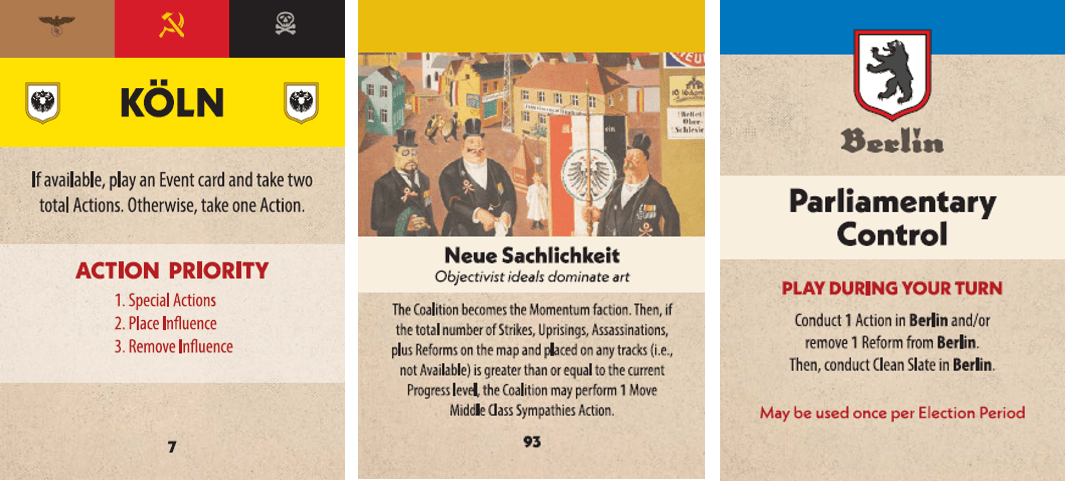
Before the Event triggers, the faction will play a PC card. As per scenario setup, the Coalition holds all PC cards except Köln. For the Coalition, this means rolling on their Special Action table. The roll is a 2: Reform Actions. With no Reform markers on the map, the Coalition’s Sudden Victory marker is not available to be placed, so they skip to the next Action, Place Reform, which is permitted as Unity is not Fragile and the Reform on Progress 2 is Available. To select a space, [8.6, section 4, Step E, priority 3] the Coalition chooses the highest PV space in the Impulse Space; the specific Impulse Space is dictated by the PC card played. Of the cards, selecting the Berlin PC card gives the highest possible PV. As such, the Coalition plays the Berlin PC card, and places the Reform marker from Progress 2 in the city; the Clean Slate in the region has no effect. The Berlin card is flipped face-down and is not available for the remainder of this Election cycle.
Now the Event activates. The Coalition becomes the Momentum faction. There is one Assassination and one Reform on the map. This total of two items is not greater than Progress, currently level 4, so the rest of the Event does not trigger.
Finally two Actions: for the Coalition, it is a Special Action first. The die roll, 5, is an Economic Action. The first option is skipped while the Economy is not two boxes from Stable. The second is to Place Leverage on the Map. There is no Strike on the map, and consulting the priority list for pieces to or from a track [8.6, section 4, Step D], the choice is met at priority 4, U.S. Deals, and the destination is the Impulse Space, Köln [8.6, section 4, Step E, priority 1].
The normal Action is Place Influence with, as usual, an aim to gain Dominance. The Bot card dictates the Impulse Space is Köln (priority 1), however the red/yellow Assassination marker prevents this. Of the other spaces where a single yellow cube can win, Thüringen, Baden, Württemburg, Pommern, or Oberschlesien, proximity gives Baden as the choice [8.6, section 4, Step E, priority 2].
This now concludes the four Action Rounds of Early 1928. Following the Sequence of Play [4.0] there is no Sudden Victory or Election Step. The Turn Marker is flipped to Late 1928 and the next round begins.
2.5 Late 1928 – Radical Conservatives
The RC draws card #33 Clique B; no Event card will be drawn.
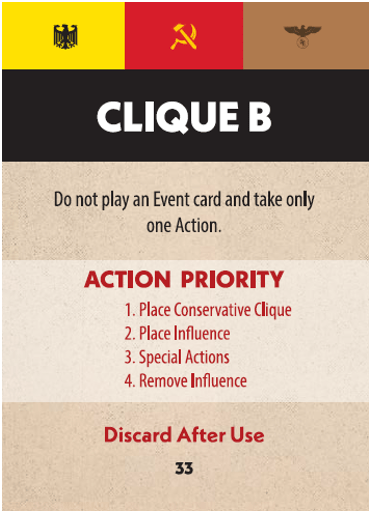
Reichstag Seats has been played and the faction has no PC cards, so to Actions. Place Conservative Clique is not possible, so it will be a single Place Influence Action in proximity to Clique B in Ostpreußen or Berlin and adjacent areas. Following the goal and priority rules [8.6, section 4, Step B and Step E], only Pommern meets the requirements: the RC places a black cube in Pommern.
The RC clearly needs to garner more Middle Class Sympathies. That completes the turn.
2.6 Late 1928 – NSDAP
The NSDAP drew #22 Berlin, and the Event #65 Overseas Loans. The Event interrupts the NSDAP’s turn with Coalition play.

First, the Coalition conducts a Move MCS Action. There are MCS pawns on the RC and NSDAP player mats, and one Available to the Coalition on Progress/Reaction 4. The choice involves moving a piece to or from a track [8.6, section 4a, Step D] and the selection is to select a faction mat before the Progress/Reaction track. This is also in accord with the NP Coalition choices in which removing opposing units is prioritised over moving MCS to the Coalition faction mat. To select, the Coalition draws a bot card from its own stack to select the target faction, and #1 Berlin selects for the RC then NSDAP then KPD.
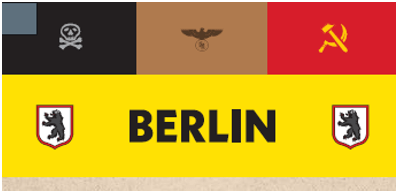
The MCS taken from the RC will go to the Progress/Reaction track box 3 [8.6, section 4, Step D, option 2]. This is a good move for the Coalition, because keeping the number of MCS in circulation as low as possible is useful, holding the favour of the middle classes is of great value to the reactionary factions. The rest of the Event allows a Place or Remove Influence Action, and the NP Coalition bot preferences Removal [8.6 step 1]. Removal of a black cube in Berlin achieved this aim and restored Dominance to the Coalition in the capital.
Play now returns to the NSDAP. For the Place Influence Action, there are no spaces where one brown cube would gain Dominance for NSDAP, but there are several spaces where one brown cube would remove another faction’s Dominance. The first target, as per the Active faction’s bot card #22 Berlin is the KPD, and placement of a brown cube in Hessen neutralises KPD Dominance. Yes, a human player would obviously have chosen Berlin, but the Bot card chases the target faction. For a Special Action the Bot rolls a 3: Assassination. The Assassination marker will come first from the faction mat then the Reaction mat [8.6, section 4, Step D]; recall that both NSDAP and KPD Stance is ignored in this scenario. The Bot card targets the KPD then the Coalition. Looking at the priorities table [8.6, Section 3] for KPD as a target that may be affected by Assassination [6.5], NSDAP will seek a KPD Cadre (none), then KPD Influence, then if necessary the target switches to the Coalition for Reform, then Coalition Influence. There is KPD influence available and removal in Hessen, Thüringen, or Sachsen will lose KPD Dominance, but only in Hessen will this win NSDAP Dominance [8.6, section 4, Step B, priority 1]. The NSDAP places the Assassinations marker from its faction mat in Hessen with its yellow/red side showing, and removes one red cube.
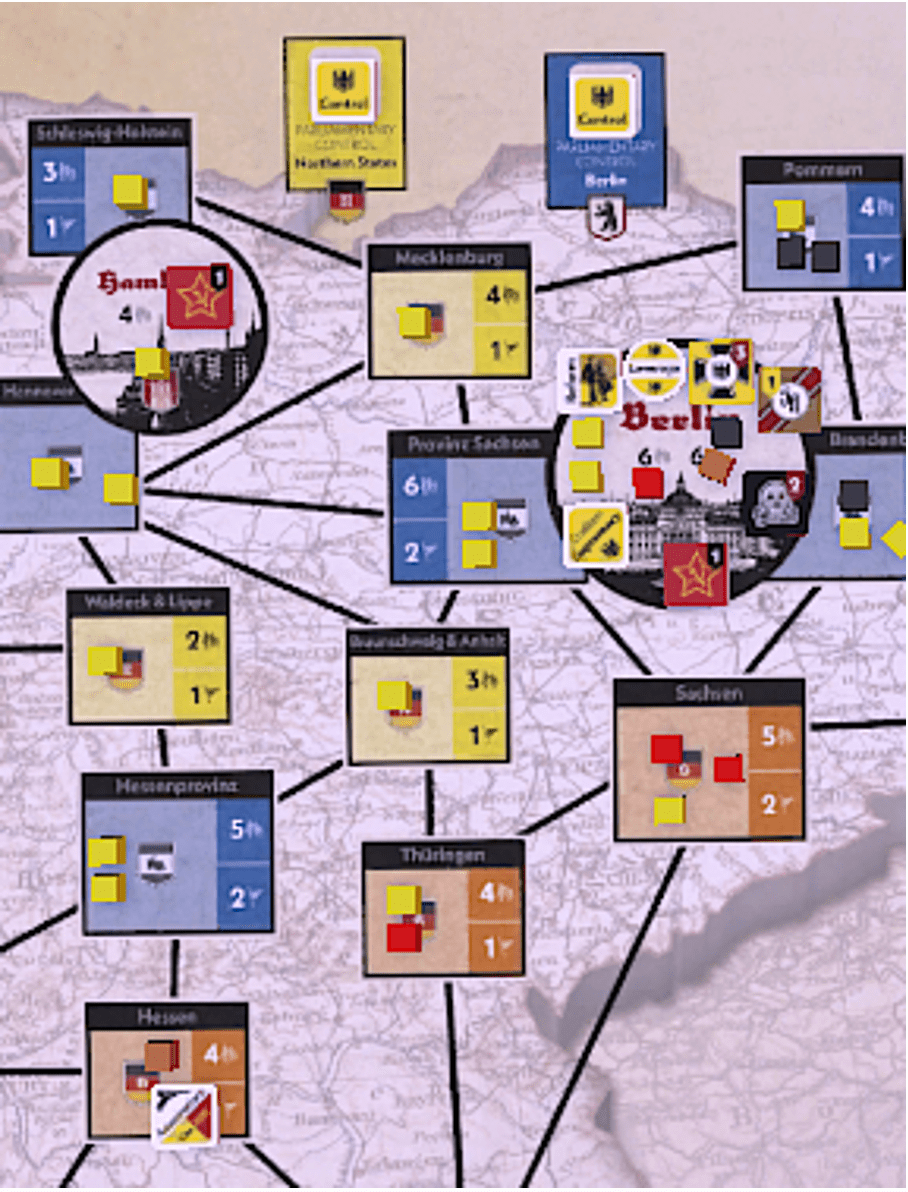
Comment: Bots tend not to follow up on advantage to lock in a position; a human player would play the Assassination first, to open space for influence play, then add Influence while a space was below the population limit.
2.7 Late 1928 – KDP
KPD comes back with its own #10 Berlin card for an Event and two Actions. The Event is #84 Stahlhelm, which again requires a short interruption for RC play.

The RC have Supremacy in Bayern and Ostpreußen, granting two Actions. There are no unflipped Freikorps so the choice is only two Place Unit Actions. The Action is permitted in areas with RC Parliamentary Control (nowhere) or Dominance (Bayern, Pommern, and Ostpreußen). When placing units, the bot will try to gain Supremacy in a space with opponents’ units first [8.6 section 4 step C], then in spaces with no units. The first placement in Pommern. The next choice needs an Impulse Space. On choosing a Bot card, #30 Clique A, allows for placement of the second Freikorp is Bayern. One RC Rogue Freikorps is placed in Bayern. The RC have built a formidable force in the south to cement power there.
Comment: The Bots cannot select a Move Units action, so there will never be a march on Berlin.
The KPD Place Influence Action wins Dominance with a single cube in Thüringen [8.6, section 4, Step E, priority 2].
The Special Action roll is 3, Place Strike or Flip Strike. As Stance is not considered in the scenario, all four Strikes are Available. The KPD Dominates Thüringen and Sachsen, and selection is the latter [8.6, section 4, Step E, priority 2] has a Strike break out in Sachsen. It is perhaps not an optimal move, a human player may ensure that there are Worker Militia to guard the Strike from Assault or place the Strike further from the action where a Leverage action is of no benefit, but breaking a single Strike may be a waste of an Action and the Assassination in Hessen means there are no electoral gains to be won in the Southern States.
2.8 Late 1928 – Coalition
The Coalition draws the Bot card #4 München and the Event #63 Blutmai, however this will not be blocked with play of Article 48.
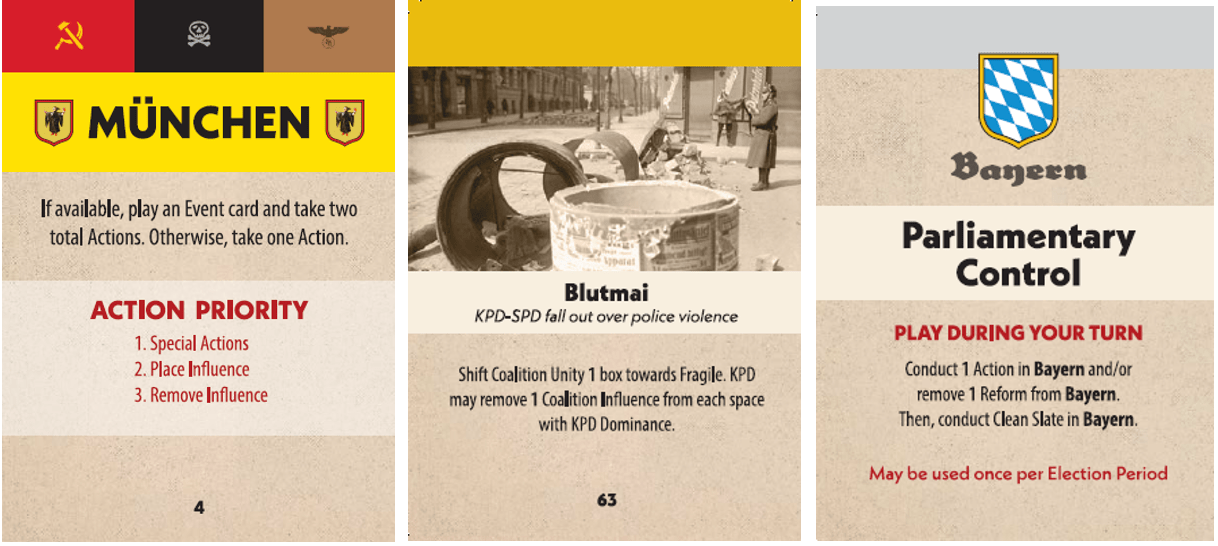
Again the Coalition holds several PC cards and so will first attempt to take one Action using one PC card. They roll on their Special Actions table and roll a 2: Reform Actions. There is an Available Reform on the Progress track. Of the PC cards held to limit the choice of spaces and by priority [8.6, section 4, Step E, priority 3] Bayern is the selection. On playing the Bayern PC card, the Reform is placed there; the Clean Slate has no effect.
The Event does not degrade Coalition stability due to the protection from Gustav Stresemann Lingering Event, however yellow cubes are removed from Thüringen and Sachsen.
The first Coalition Action is a Special Action, and a roll of 4 is a Military Action. There are no Available Reichswehr for the Place Unit Action, so proceed to the Assault. The first target is the KPD and there are Reichswehr and Worker Militia both in Berlin. The first test is of Potential Assault Strength, with the Coalition of SV 6 (Reichswehr plus Berlin parliamentary control and yellow Leverage; bots never spend a MCS pawn during Assaults) versus the KPD SV 1 (one Worker Militia). The other NP factions will not lend Sturmabteilung nor Rogue Freikorps [8.0 Never Loan Units], so the Assault proceeds per 6.2. First, make a Loyalty Test: Progress is at least equal to Reaction, so the Coalition units remain Loyal for this Assault. The Coalition rolls 2 and the KPD a 4, to result in the loss of one Worker Militia and the KPD cube (SV 1 + 1), however no harm falls to the veteran Reichwehr. However due to the Paul von Hindenburg Lingering Event the Rogue Freikorps have SV 3, matching the Reichswehr, and preventing Coalition Supremacy. The Coalition itself loses an influence: its bullying is widely reported.

Comment: This is clearly a tactical blunder. Human players may agree that an Assault in München may be a less risky choice, however for the purposes of this example we allow the Bots to make occasional bone-headed moves.
The turn concludes with a Place Influence Action centred from München. The single cube goes to Württemberg for Dominance.
This now concludes the four Action Rounds of Late 1928.
During the New Year Step, the Momentum faction, the Coalition, flips a Bot card and draws the card #1 Berlin. The new turn order remains RC – NSDAP – KPD – Coalition.
3. 1929
3.1 Early 1929 – Radical Conservatives
The RC draws from the bot deck card #29 Clique A. As this is the final year of the Era, there is the check to ensure there are no Mandatory or Election cards [8.7]. Checking the RC hand there is #68 Urban Crime, and #95 Thomas Mann, and #82 Referendum, none of which are Mandatory Events. On a random draw, #82 Referendum is selected as the Event.

As the RC are not the Momentum faction, no Election is held. Even if the RC were the Momentum faction, it would be blocked by Coalition play of Article 48. Nevertheless, it is worth checking the state of Germany: in Regional Elections, the Coalition would win Berlin (Coalition 4 PV including for Reform and Leverage) and the RC would win Bayern (5 PV versus Coalition 3 PV for Reform). The Coalition would retain Hamburg, München, Northern States, and Prussian Provinces; Assassinations in the Southern States and Köln would mean no Election would be held there. Further, a General Election would not change the shape of the political landscape; the Coalition would retain a comfortable lead and Reichstag Seats would remain with the RC.
As Clique C is not Available, first comes a Place Influence Action in Bayern (Clique A), or Berlin and adjacent spaces. There is no area within the Impulse Region of Clique A or Berlin area to win RC Dominance; however, by placing a black cube in Berlin, Brandenburg, or Hessen, the Dominance of another faction is broken. The current Bot card selects the Coalition over the NSDAP, so the placement is into Berlin to secure the RC a lead.
The Special Action roll is a 3 and the RC undertakes an Economic Leverage Action. There is no yellow Leverage on the Economy track to remove, so the Place on track Action is considered. There is black Leverage on the player mat, so the leftmost black Leverage goes to the Leverage 1 on the Mass Unemployment side of the Economy track. The RC’s advocacy for German business is likely perfectly sound and orthodox. It is booming here in March 1929; nothing could possibly go wrong(!).
3.2 Early 1929 – NSDAP
The NSDAP draws #19 München. A check of the NDSAP draw deck does not show any Mandatory cards or Elections, and Event #72 Ernst Jünger is drawn.

For the Event the RC performs one Action, and the first Action on the NP NSDAP choice list [8.6 Section 1] is Move Middle Class Sympathies to their faction mat. The RC takes the MCS on the 3 space of the Progress/Reaction track. Finally, as Reaction Level 3 is not higher than Progress Level 4, the second effect of the Event does not trigger and play returns to the NSDAP.
The NSDAP’s first Action is Place Influence. There is no space where the faction can win Dominance. Scanning the map for a placement for a single brown cube the only places are Berlin or Brandenburg [8.6, section 4, Step B] however Brandenburg is closer to the Impulse Space.
For the Special Action a die roll of 2 is a Stance Action, however the scenario ignores Stance and the Special Action shifts to an Assassination Action. The two Assassination markers that the NSDAP can reach are played and not Available, so next is to a Cadre Action. The NSDAP has Dominance in Hessen and Neiderschlesien; Hessen is the choice based on proximity to the Impulse Space. The Cadres are available from the faction mat due to Stance and the Reaction track, however the priority is the faction mat.
3.3 Early 1929 – KPD
The KPD draws #15 Hamburg, which permits only one Action. As there was no Event draw, there was also no check of the KPD deck for Mandatory cards or Elections.

The Place Influence Action will, on placement of a single red cube, not give Dominance to the KPD, so the Bot will next consider removing another faction’s Dominance. By proximity to the Impulse Space and target faction of the Coalition, the choices are Oldenburg, Waldeck & Lippe, or Braunschwieg & Anhalt, and by priority the selection is Braunschweig and Anhalt.
3.4 Early 1929 – Coalition
The Coalition draws the #6 Southern States card. This permits no Event and just one Action for the turn.

The Coalition holds several PC cards and so will first attempt to take one Action using one PC card. They roll on their Special Actions table and roll a 6: Economic Actions. A PC card can only affect spaces in the respective area so the first priority, involving the Economic track, is not possible. The second option is to Place Leverage on the Map, preferable where a Strike is. The one strike is in Sachsen and the Southern States PC card is Available. The yellow Leverage on the U.S.S.R. Deals track [8.6, section 4, Step D, priority 5] goes to Sachsen, the Strike back to the KPD player mat. The unions are mollified, and Southern States PC card flipped for the rest of the Election cycle. Further, the Clean Slate in the Southern States removes the Assassination in Hessen back to the Reaction track [8.6, section 4, Step D, priority 2].
The single Action permitted by the Southern States Bot card and is a Special Action die roll of 2 is a Reform Action. The Place Sudden Victory option is not possible, however the Place Reform certainly is. Within the Southern States all spaces are eligible, but by priorities both Baden and Württemberg are equally preferred, so a die roll to choose lands on the latter; the Reform shifts from the Progress 3 box and into Württemberg. A new industrial relations act announced in Stuttgart shows the NP Bot is progressing well.
The Turn Marker flips to late 1929.
3.6 Late 1929 – Radical Conservatives
The RC draws #32 Clique B, and the Event drawn is #95 Thomas Mann.

The Event permits one (Progress Level 4 versus Reaction Level 3) Place Influence Action by the Coalition. The Coalition draws bot card #2 Berlin to determine the Impulse Space. To gain Dominance, the nearest space is Brandenburg, now at its population limit with three yellow, two brown, and one black cube. A pity when Berlin was calling… The Coalition Bot cards are also reshuffled into a refreshed draw deck.
For the RC Actions, the process is familiar: no third Clique to place, so a Place Influence in the Impulse Region of Clique B or Berlin and adjacent areas. There is no place to win Dominance, so the next choice is to remove Dominance of opposing factions. There is no place to break any other Faction Dominance by the addition of a single black cube, so no Place Influence Action is possible.
Next is a Special Action. The Special Action die roll is a 4, and the RC moves Middle Class Sympathies. The first option [8.6, section 4, Step D] is a faction mat. The NP RC always aims to move MCS to its faction mat, however none are Available on the Progress/Reaction track. Following the target factions of the Bot card, the first target, the KPD, has no MCS and so the single MCS of the NSDAP returns to the Progress/Reaction track space 3.
The second Action is a Remove Influence Action, following the target factions and with an initial priority of winning Dominance [8.6, section 4, Step B, priority 1]. In the Impulse Region of Clique B or Berlin and adjacent areas the removal of one yellow cube from Posen-Westpreussen does the trick.
3.7 Late 1929 – NSDAP
The NSDAP flip the #23 Hamburg and draw #105 Wirtschaftspartei.
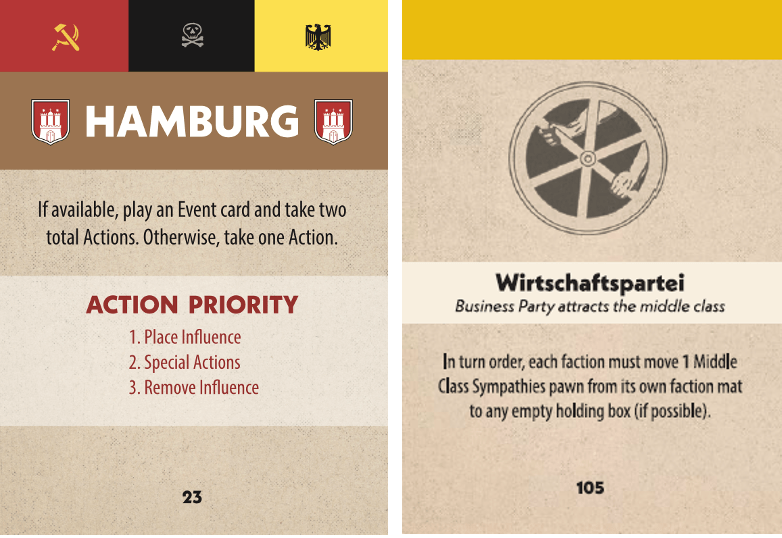
In triggering the Event, both the RC and Coalition lose one MCS each to the Progress/Reaction track, certainly some amusing retribution. Note that this is not a Move MCS Action by the NSDAP, so the Racial Theory Lingering Event does not shift Momentum.
The Place Influence Action comes next. No single brown cube grants NSDAP Dominance; however, placement in Berlin or Posen-Westpreussen breaks RC Dominance; based on the Impulse Space a second brown cube goes into Berlin.
The Special Action die roll is 4: Assassination, and the marker newly freed allows this mischief. The first target faction is the Coalition, and both a Reform or Influence may be removed. The preference order for removing pieces [8.6 Section 3] is for Reform, and of the three on the map, the one in Berlin is closest to the Impulse Space. Daylight shots in the Alexanderplatz throws the Berlin city council into upheaval, and the planned education reforms will not proceed.

3.8 Late 1929 – KPD
The KPD draws #13 München and #53 Rentenmark.

The Event requires Gustav Stresemann as a prerequisite, so it can trigger. The Economy is already at Stable. The only effects that can be resolved are removing Leverage from the map or Economy track. For the KPD, the Order of Operations has the shift of the Economy to Mass Unemployment as a preference, so the black Leverage remains on the Economy track. Yellow Leverage from Berlin, Köln, and Sachsen are returned to the U.S. Deals track.
The Place Influence Action has the KPD searching for a place to win Dominance as near to the Impulse Space as possible. A single red cube in Brandenburg & Anhalt is the only space to win Dominance.
The Special Action roll is 5, Place Cadre. With no considerations for Stance this is simple enough, a place with KPD Dominance as close as possible to the Impulse Space, and the choice is Sachsen.
3.9 Late 1929 – Coalition
The Bot Card is #8 Hamburg, and the Event is #90 Mittelstand.

The Coalition first uses a PC card. A roll of 3: Political Actions cannot be completed by a PC card. Next on the list is a Military Action. There are Reichswehr in Berlin and München, however only the München PC card is available and so played to conduct the Action. The Place Unit action is not possible, and shifting to the Assault action the only option is against the Sturmabteilung units. The Coalition has SV 5 (Reichswehr + Parliamentary Control) and the NSDAP 3 (2x Sturmabteilung + Cadre). There is no concern about loyalty, so the rolls of 3 and 1 respectively disperse the Sturmabteiling; unlike the previous efforts in Berlin the Coalition does not lose any influence. The Clean Slate has no effect. The München PC flips for the remainder of the Election period.
The Event is #90 Mittelstand and the Coalition follows up with its Momentum to undertake two Move Middle Class Sympathies Action. Coming on the back of Rentenmark, both Actions shift the MCS from the Progress/Reaction track to the Coalition! This is a valuable shift in political good will.
For a Special Action the Coalition rolls 3: Political Action. The NP Coalition takes another MCS pawn from the Progress/Reaction track and Coalition Unity improves to Strong. This is an incredible stroke of good fortune! The SPD, DDP, Zentrum, and more recently the DVP have their differences and can work collaboratively, and even the cautious middle classes’ interests flow to the government, and there are no MCS Available for the RC or NSDAP. One more Reform and a Sudden Victory is in sight.
Finally for the Place Influence Action. There is no place where a single cube wins Dominance. The Bot next looks to remove another faction’s Dominance: the KPD is untouchable, however a single yellow cube in Hessen or Niederschlesien challenges the NSDAP. Both are equidistant from Hamburg, so the choice falls to Niederschlesien.
After the streak of good news, the Coalition is shaken by Minister Stresemann’s sudden ill health and shortly after comes disturbing news from Wall Street. The next storm is here.
4. Entering Decline
Following 4.0, there are no Sudden Victory markers nor Elections to consider. The turn marker flips to Early 1930, and with that the relative stability of the Golden Twenties comes to an end; the Decline era commences.
The Economy Marker now moves to under the rightmost of the two Dollar Dependence markers (above Leverage 2). Populist solutions to the county’s difficulties created by the KPD and NSDAP reach willing ears, with these factions now placing or removing two cubes per Influence Action.
The Coalition, as Momentum player, flips the Northern States Bot card and the new turn order will be NSDAP – RC – KPD – Coalition.
The Lingering Events Gustav Streseman, Paul von Hindenburg, and Young Plan are now discarded; Racial Theory and Roter Frontkämperfbund persist. All nine Bot cards per faction are collected and reshuffled. The Bots do not take a penalty for held cards [4.0 part 6, 8.4]. Prepare the Decline deck [9.1] and deal each faction six cards.
4.1 Early 1930 – NSDAP
The Bot Card is #26 Köln, and the Event is #90 Grossraum.
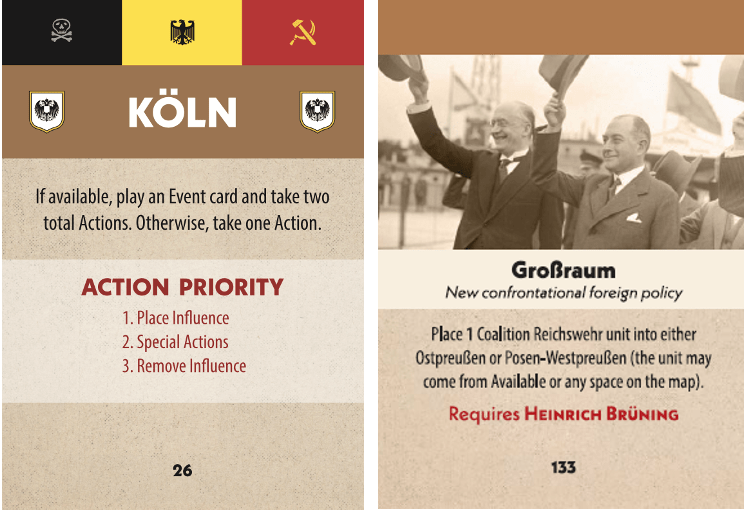
The event does not trigger as its prconditions are not met, nevertheless the faction will still play two Actions. The Place Influence Action for now allows placement of up to two cubes per Action [5.5]. Searching the map for a space in which two cubes win Dominance and meet the requirements of the Place Action leaves Berlin or Niederschlesien; note the red/yellow Assassination does not affect this faction. By proximity to the Impulse Space it is Berlin, now at three brown, two black, and one yellow cube.
The Special Action is a 1: Military Action. The possibilities of a Place Unit action are Berlin or Hessen, and based on the Impulse Location Hessen is again the choice. This placement does not trigger a Sworn Enemies immediate assault. Of the spaces in which Sturmabteilung units are with units of an opposing faction, there are none in which the potential Assault Strength exceeds that of the opponent, and so no Assault.
4.2 Early 1930 – RC
The RC draw #35 Clique C and #119 Heinrich Brüning.

The Event triggers and, following the austerity measures of the Brüning leadership, the Coalition Unity degrades to Sound and Economy one step from Mass Unemployment. While the Article 48 card has not triggered in this election cycle, its loss will certainly be felt in the upcoming years. The Coalition’s preconditions for Sudden Victory are now lost, and unlikely to be returned.
The first Action, Place Clique, is not possible. Next for consideration is Place Influence. There is no place to win Dominance by placing a single black cube, nor remove another’s Dominance by placement. Actually, there is only one space in the Impulse Region with capacity left, Provinz Sachsen, and a black cube goes there. The second RC Action then is a Special Action die roll of 4 and Political Actions, moving a MCS from the target faction, Coalition, back to the Progress/Reaction track.
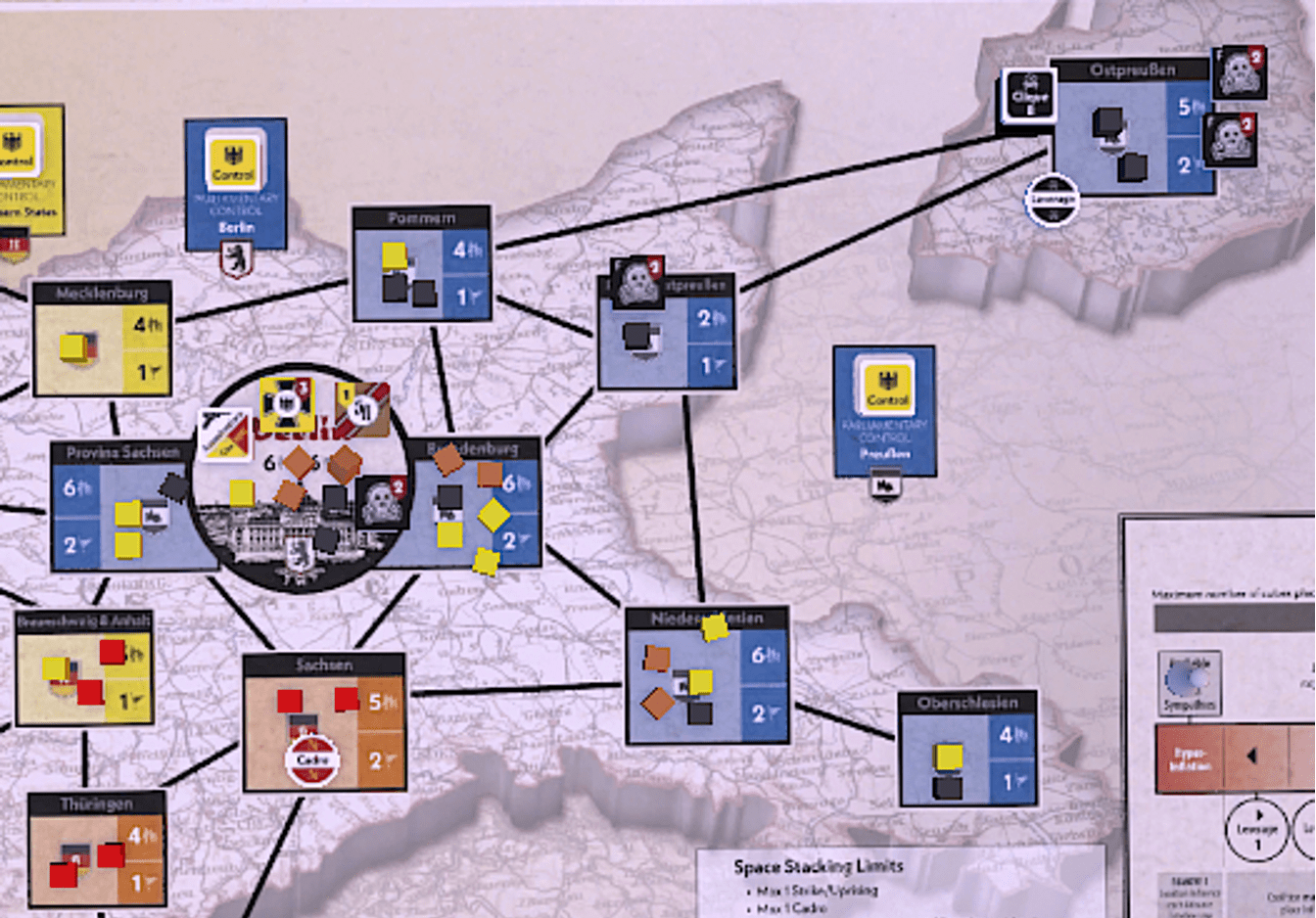
4.3 Early 1930 – KPD
The KPD draws #13 München and the Event is is #156 Election.

For the KPD’s Place Influence Action, the search is for a space in which two cubes win Dominance. These include Provinz Westfalen, Rheinprovinz, or Hessen, and as close to the Impulse Space is Hessen.
4.4 Early 1930 – Coalition
The Coalition draws #9 Prussian Provinces.

The Coalition holds the PC cards for Preußen, Hamburg, and Northern States. The die roll of 6 is an Economic Action, which will be Place Leverage on Map. By the usual space choices, the highest PV spaces within these cards in Provinz Westfalen or Hamburg, corresponding to the Preußen or Hamburg PC cards; the decision falls to Population Value and a yellow Leverage from the U.S. Deals track is placed in Provinz Westfalen. A Clean Slate in Preußen has no effect (Both Köln and Berlin are surrounded by Prussia, they are not considered a part of Preußen for the purpose of the PC card, and the Assassination markers in the game remain.)
Finally the Coalition rolls for a Special Actions for the Bot card rolls again a 6: Economic Actions. The Economy marker is a long way from Stable and the black Leverage is removed from the track back to the RC playmat and a yellow Leverage from the U.S. Deals track replaces it.
Comment: This is an example of a Bot Action that requires two separate Actions by a human player.
4.5 Election
Brüning faces the first challenge. In the Regional Elections Hamburg (PV 4 Coalition), München (PV 4 Coalition, PV 2 NSDAP), Northern States (PV 3 Coalition, PV 1 KPD), Southern States (PV 4 Coalition, PV 5 KPD, PV 2 NSDAP) and Prussian Provinces (PV 17 Coalition, PV 4 RC) are Coalition wins and retain the PC cards, while Bayern (PV 3 Coalition, PV 5 RC) is an RC win and transfer of the PC card. Due to the Assassinations in Köln and Berlin no elections are held there, to the detriment of the NSDAP. In the General Election the Coalition extended its lead with Momentum, MCS, and progressive sentiments in Berlin. The Coalition comfortably wins the election, and the RC retains the opposition, albeit on a thinner margin, and collects the Reichstag Seats. If there is a lesson to be seen here, the Assassinations crippled challenges to the Coalition.
The Clean Slate returns both Assassination markers, and yellow Leverage remains in Provinz Westfalen and black Leverage in Ostpreußen.
The turn marker flips to Late 1930.
4.6 Late 1930 – NSDAP
The NSDAP Bot draws #23 Hamburg, and the Event is #118 Enabling Act.

The Event cannot trigger, so straight to two Actions. Two brown cubes in Oberschlesien is the only play to win Dominance, Sachsen goes begging but the Impulse Space is in the north.
A Special Action roll of 2: Stance Actions are skipped in this Scenario as Stance is ignored, so next move to an Assassination. The marker will come from the player mat and target the KPD first, and by selection [8.6, Section 3] the target is Sachsen and the last KPDd Cadre on the map.
4.7 Late 1930 – RC
The RC Bot draws #31 Clique C and the Event is #127 Reichstagsbrand.
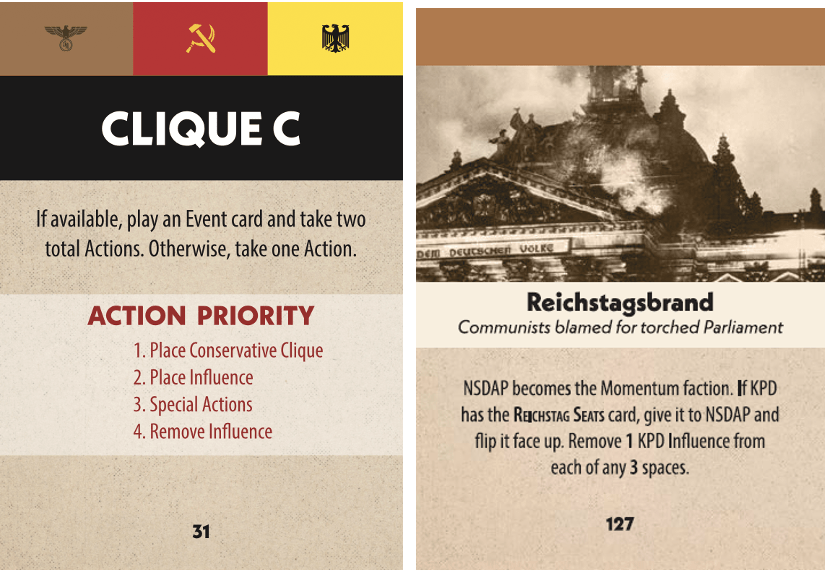
The first play is the Reichstag Seats, reducing the Coalition Unity to Fragile, winning Momentum to the RC, and the Clean Slate removes the Assassination in Sachsen back to the NSDAP mat
The second play is the Bayern Parliamentary Card. The conservative Landsrat overturns the Reform, which returns back to Progress 3. The Clean Slate has no effect
It is surely just a coincidence that as the NSDAP influence leads in Berlin and reforms enacted by the Stresemann government are overturned, the centre of democratic decision making is rendered unusable. As the Reichstag burns, the increasingly ineffectual KPD are scapegoated. The NSDAP grasps Momentum. There is no place in which removing a single red cube gains the RC Dominance, however removing a cube from Hessen and Braunschweig & Anhalt removes the KPD Dominance from these spaces. For the third cube removal the choice is by proximity decision [ 8.4, Section E] the last is removed from Bayern.
Finally the Special Action roll is a 2: Cultural Leverage Action. The Place Leverage on a track Action has a black Leverage moved from the RC playmat to Reaction 2, and the yellow Leverage on Progress 4 returns to the U.S. Deals track.
The reactionary factions are on the rise; now to the progressives.
4.8 Late 1930 – KPD
The KPD Bot draws #15 Hamburg.
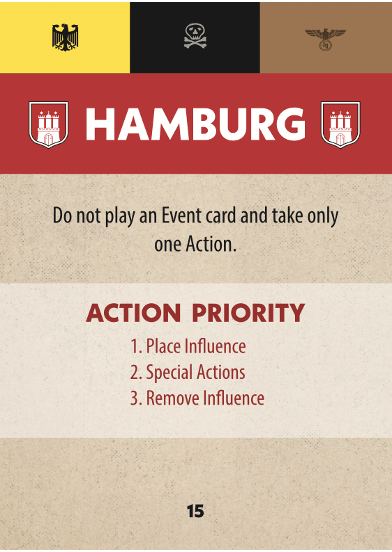
With up to two cubes to win Dominance the choice as close to the Impulse Space is Braunschweig & Anhalt. From previous heights the KPD is not out of the game but can act as little more than a spoiler in selected areas and the dream of the German Soviet Republic has evaporated.

4.9 Late 1930 – Coalition
The Coalition Bot draws #1 Berlin and the Event is #137 SA Banned.
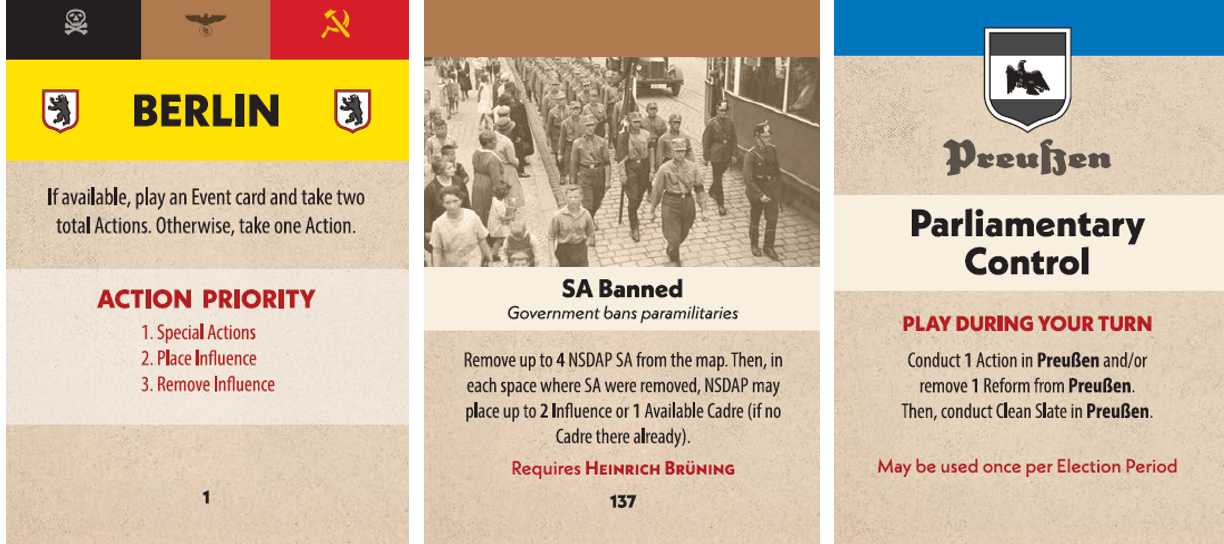
First, consider the PC cards. The Special Action roll of 1: Reform Actions arises. The highest PV space in which the Coalition still holds a PC card are Hamburg, Provinz Westfalen, and München, and by PV then random choice the selection is Provinz Westfalen. Not a bad choice; the electoral push will help hold Preußen and the matching PC card is flipped.
The Event triggers as the precondition Heinrich Brüning is in play. The Event requires removing four Sturmabteilung units, and as there are only three on the map, in Berlin, Hessen, and Bayern, all three are lost. For the replacement of the removed units by a Cadre or Influence, the preference is for Cadres over Influence [8.6 Section 3]. There are two Cadres available: one on the player mat and the other on the Reaction track. A second Cadre cannot be placed in Hessen, so NSDAP Cadres form in Berlin and Bayern, and two brown cubes in Hessen.
The Coalition now takes its actions. The Special Action roll is a 3: Political Action. The Coalition takes the Available MCS from the Progress/Reaction 3 space to its mat and improves Unity to Sound. Heavy-handed suppression of political opponents seems to be a popular choice but may well be a problem later to hold regional governance from the NSDAP. Finally, the final action is to Place Influence, and a single cube in Köln wins Dominance.
The Coalition enters 1931 in a surprisingly strong state, but the high water mark is past and in future elections will prove an increasing challenge. It is likely other factions will need to transfer electoral support to the Coalition to support a weakened Republic [7.2], at least until it is no longer useful to do so. And just perhaps the Coalition can hold until 1933.
We trust that this has shown the workings of the NP factions, and shown a number of plays in which the Bots can string together some surprising and challenging actions.