

Chalice of Poison: Political Power and Regime Collapse
Last month, I talked about how players can win Chalice of Poison, by winning the Iran-Iraq War. I described the victory conditions as “two ticking clocks,” which start off maximalist (read: difficult to achieve) early in the game and get easier as the game (and conflict) progresses. The article talked about the first “ticking clock”: an Objective marker that starts at 10 victory points (VPs), but then drops over the course of the game. If a player’s VP marker meets or exceeds the objective at the end of a turn, that player wins the game.
This month, I’m going to talk about the second “ticking clock”: Political Power. This mechanism is the core of Chalice of Poison’s system, and what makes it unique.
What is Political Power in the game?
Represented by wooden cubes, Power is the main “currency” in the game. Players use Power to reform their militaries; they can either exhaust it (indicating that it has been expended) or place it elsewhere on the board (indicating that they have devolved power to their commanders and given them more control over how they fight).
The twist is that power cubes are a resource in short supply, so using them comes at a tremendous risk. You will need to expend them to win the war, but if you expend them too quickly and run out, your regime collapses, and you lose the game. Similarly, if you devolve too much power to your commanders, they may wonder why they are still following your orders, and attempt a coup d’etat to take down your government. Each country also has a number of dissident groups who seek their own power and independence; they will take Power cubes from your regime throughout the game, and if any of them become too powerful, they may rise up and attempt to declare independence from your regime.
Why center a wargame around political power?
As I mentioned in my first article for InsideGMT, the realist theory of international relations argues that a state’s primary objective is self-preservation. States do not fight wars to achieve military success alone, but to achieve political ends. I wanted this game to reflect this reality, not only because I thought it was interesting, but because modeling a stalemate like the Iran-Iraq War has limited interest as just military forces on a map.
Research into authoritarian regimes at war reflected the importance of modeling political power, suggesting that self-preservation in a centralized authoritarian state requires consolidation of power in the face of threats both external and internal. This consolidation limits military professionalism, because an effective fighting force requires some decentralization. Empowered forces can make their own decisions based on changes to the situation on the ground, rather than relying on fixed orders from headquarters or the capital.
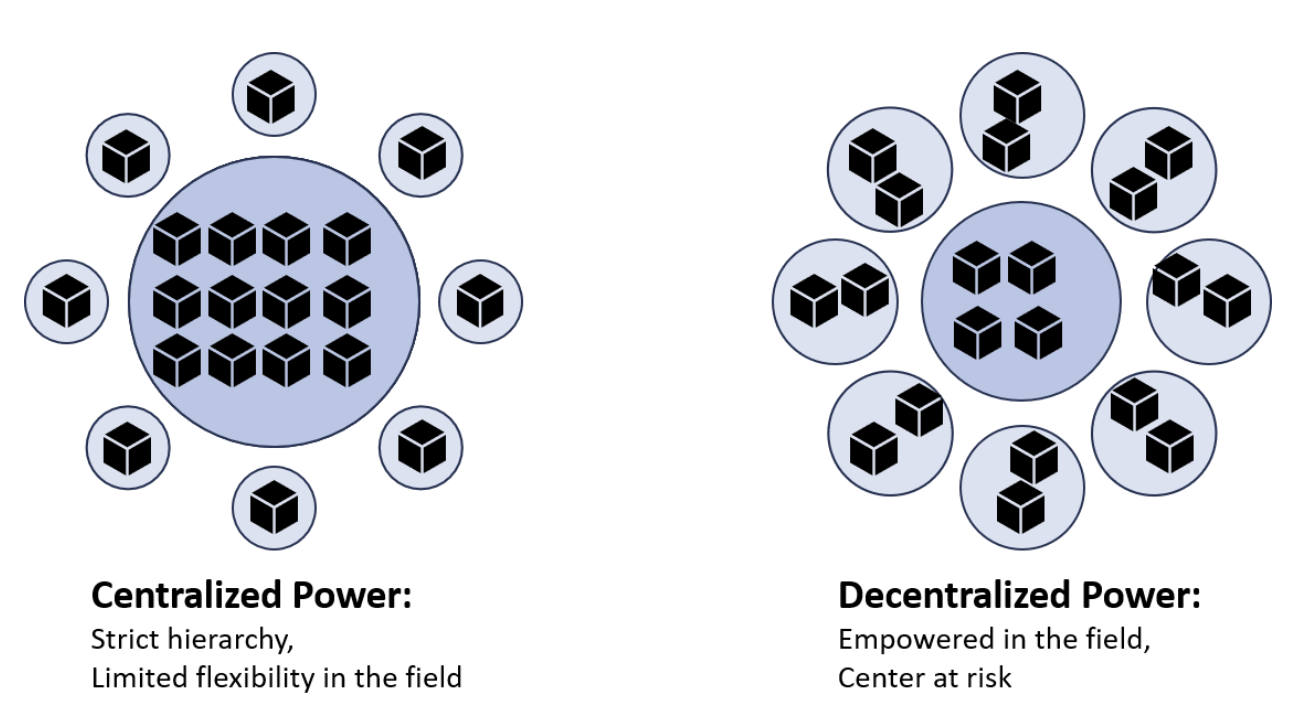
Authoritarian militaries tend to look like the one on the left: strong hierarchies mitigate internal risk,
but allow little flexibility to adapt to conditions on the ground. (Source: Akar Bharadvaj)
Every game requires players to have constraints and trade-offs, to ensure that they cannot just do everything. Power seemed the primary limiter to these authoritarian regimes, so it made sense to have it be the currency in the game. Design-wise, making them wooden cubes rather than a track or something else made sense, because it allowed players to immediately visualize expending it, pushing it downwards, or having a dwindling pool of it. Additionally, cubes benefited from being less precisely countable than a track, which subtly encouraged players to take risks and play off of their instincts, rather than attempting to “math out” every decision.
Where does political power reside in the game?
Political power cubes can be in one of the following locations:
- The Regime pool represents the political power in the hands of the country’s current government. Cubes in this pool can either be Ready, meaning they are available to exhaust to conduct in-game actions and reforms, or in Reserve, which means they contribute to a regime’s power, but are not expendable to perform actions.
- The Exhausted pool is where Ready cubes go when players conduct actions. These cubes do not contribute to a regime’s power, but they may return to the regime during Replenishment, which is explained later in this article.
- The Removed pool contains cubes that may never come back to the Regime. Certain game conditions may effectively remove these cubes from the game.
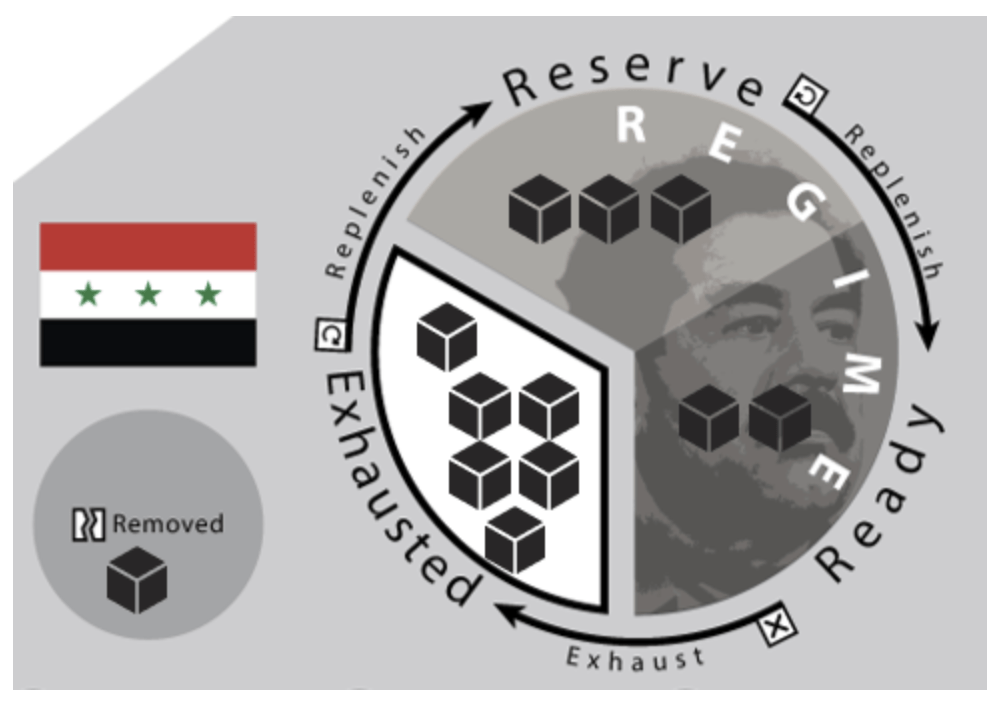
Iraq’s Regime Power is made up of two Ready cubes and three Reserve, for a total of five.
Iraq also has six Exhausted cubes, which may cycle into the Regime on a future turn.
One cube is in the Removed pool, and may never enter play again. (Source: Akar Bharadvaj)
- Each of a player’s Commanders has cubes on it, which represent its current Level. Typically, the more cubes that Commanders have on them, the more powerful they are in combat, but at the expense of the Regime’s power. Players may remove cubes from Commander through certain actions, most commonly by removing them from their role and replacing them with a new Commander.

This Iraqi Commander is currently at Level 6: he started off at Level 4, and then gained two more cubes through lessons learned in battle. He is very good at combat, but becoming a risk to his own regime. (Source: Akar Bharadvaj)
- Five Dissident Groups represent internal threats to the two regimes. Cubes in a Dissident space represent both the strength of these groups and a pool of national power that falls outside the Regime’s grasp. Regimes may fight against Dissidents to exhaust their power (and eventually replenish it).
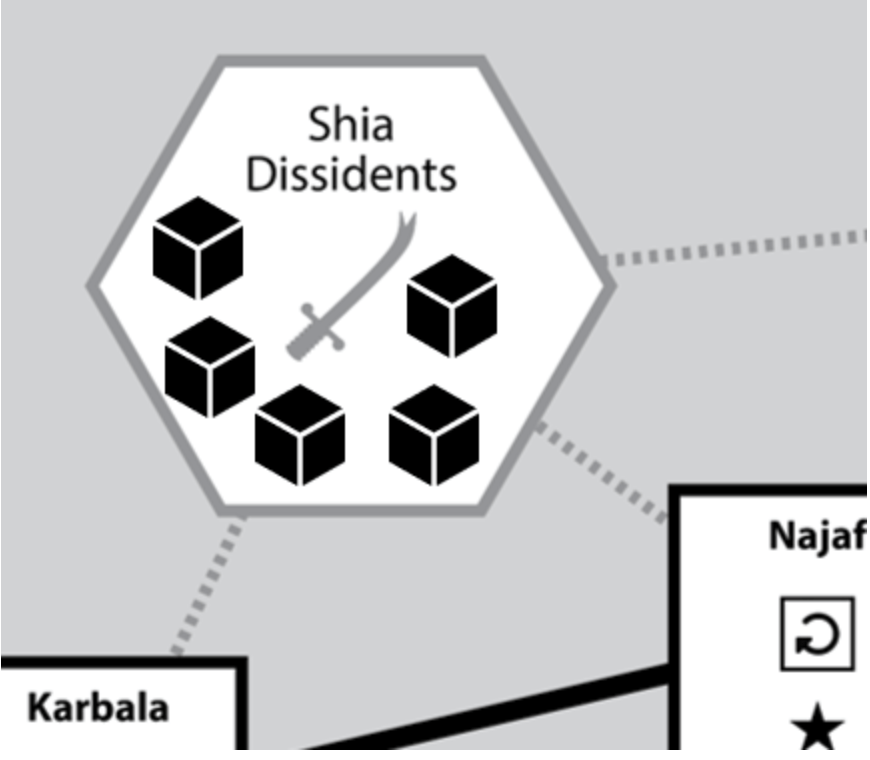
Iraq’s Shia Dissidents currently have a strength of five. These are cubes that are taken out of the Regime’s power pool, and may cause problems during the Unrest Phase. (Source: Akar Bharadvaj)
How do players use their regime’s power?
Most actions in the game require exhausting or moving cubes; a player must have Ready Power to choose to take such an action. If the player has insufficient cubes in Ready, they may not perform the action. When players perform these actions, they must either move a number of Ready cubes to Exhausted, or else move it to the requisite location, as listed on the action.

The Level 3 Empower action is powerful, but expensive. Reforming her military to this level required the Iraq player to place three cubes on this card. Again, all cubes used in this action are removed from the Regime pool, increasing the risk of unrest-related threats. (Source: Akar Bharadvaj)
Typically, the more powerful the action, the more cubes it costs. Certain actions require removing cubes from the Regime permanently, meaning that they are extremely costly, but hopefully valuable enough to warrant the cost. Reforming militaries is a necessary risk.
Certain game conditions, such as player attacks or dissident attacks, may involuntarily force a player to exhaust or move cubes. If forced, and the player has no cubes in the specified location, they must move it from Reserve instead.
How do players regain their regime’s power?
Players may choose to take a large number of actions each turn based on their Ready Power, but they will not receive the same amount back each turn. The game has a “push-your-luck” element, so that the more actions they take, the more the risk of regime collapse.
Power replenishment generally occurs in four ways, each marked with a replenishment icon ():
- During the Economy step during the Planning Phase, when players roll 3d3, and both players replenish that many cubes.
- When claiming certain Desperate Measures markers during the Action Phase.
- As an optional bonus when playing the Pass action.
- When seizing territory during the Battle Phase.
Each replenishment icon () moves a single cube one step, from Exhausted to Reserve, or Reserve to Ready. This cycle takes time, so a player that uses a lot of political power on one turn may face a shortage the next.
What are the risks of using too much power?
As mentioned earlier, power represents another “ticking clock”; players will find themselves with reduced power as the game proceeds. The most direct risk of reduced amounts of power is that a regime is curtailed in what actions it can take, given the cube costs for each action. However, another risk is more severe: too little Regime power can lose a player the game.
At the end of each turn, during the Unrest Phase, players do three checks to see if they lose the game. If a regime is unstable enough, that player may fail multiple checks in one turn, leading to a broad cascade of problems.
- The first check is for Regime Collapse. Players check their Regime pool, represented by both the Ready and Reserve cubes. If this pool is empty of power cubes, then that player’s regime collapses, and loses the game.
- The second check is for an Uprising. If any Dissident group on the board has more power cubes than that country’s regime, then that Dissident group attempts an uprising. Each military force within range of the Dissident group may attempt to quell the uprising, essentially engaging in one round of combat to reduce the strength of the Dissident group. If the Dissident group still has more cubes than the regime after this fight, then that player loses.
- The third check is for a Coup. If a Commander or group of coordinating Commanders has more cubes than that country’s regime, then they attempt a Coup! Those Commanders are removed from the board and placed on a special Coup board. Now, that player must fight a series of battles against their formerly loyal Commander(s)! If, during these battles, the Commander(s) seize that country’s capital (Baghdad or Tehran), then that player loses.
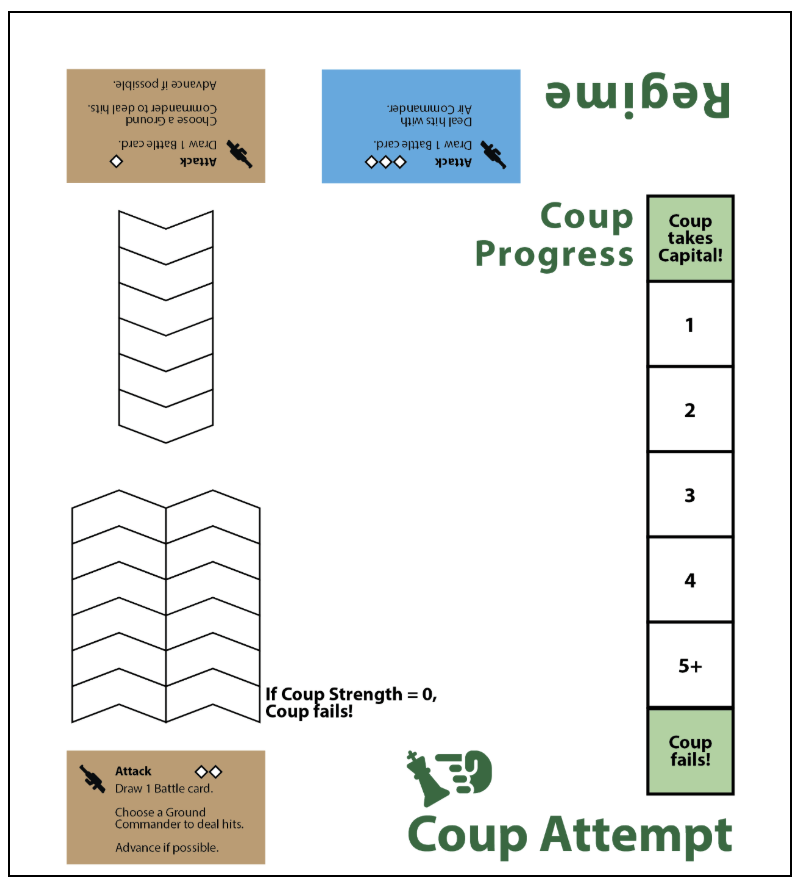
When a coup attempt breaks out, that player must resolve a certain number of battles and determine if that regime falls, or quells the coup and lives to fight again.. (Source: Akar Bharadvaj)
If one player loses during this phase and the other remains standing, then that player wins. Both players may lose the game simultaneously during this phase; if they both lose, then Henry Kissinger wins the game.
Thanks for reading about the Power mechanic, which I consider the most unique mechanism in the game! Stay tuned for the next article, which describes how players resolve battles to include taking attrition, gaining and losing territory, and having commanders learn lessons from combat…