

Small box, big deal: why card games rock
When I was a kid I thought that the concept of ‘card games’ consisted entirely of the games you could play with an ordinary pack of red or blue Bicycle brand playing cards. I was an unwitting card game purist. I even thought Uno was some kind of imposter version of ‘Crazy Eights’, which I knew you could already play with any old card deck you found at your grandparents’ house. But how wrong I was. It wasn't until I started looking for more portable board games as an adult that I realised there was a whole world of games without boards, games where the cards create the board, and games that make you put on flimsy prop futuristic sunglasses and say, “Boards? Where We’re going we don’t need… boards.”
Then I discovered the joy of travelling with small box card games, and loved being able to go from buying new games abroad and bringing them home in my carry-on to literally carrying them onto the plane in my hand and playing mid-flight. It all started during a snowstorm-related overnight Heathrow layover when, bored and exhausted, I was relieved to be invited to play Uno with other strandees from Milan and Beijing. I have since played Fluxx on the narrow ledge of an airport bar, and Dobble at 30,000 feet. Back on the ground, I accepted that although some games may come in small packages, it doesn't automatically mean they’re playable on a plane tray table. Iota, for instance, the tiniest game on this list, can take up an entire dining table before players run out of cards.
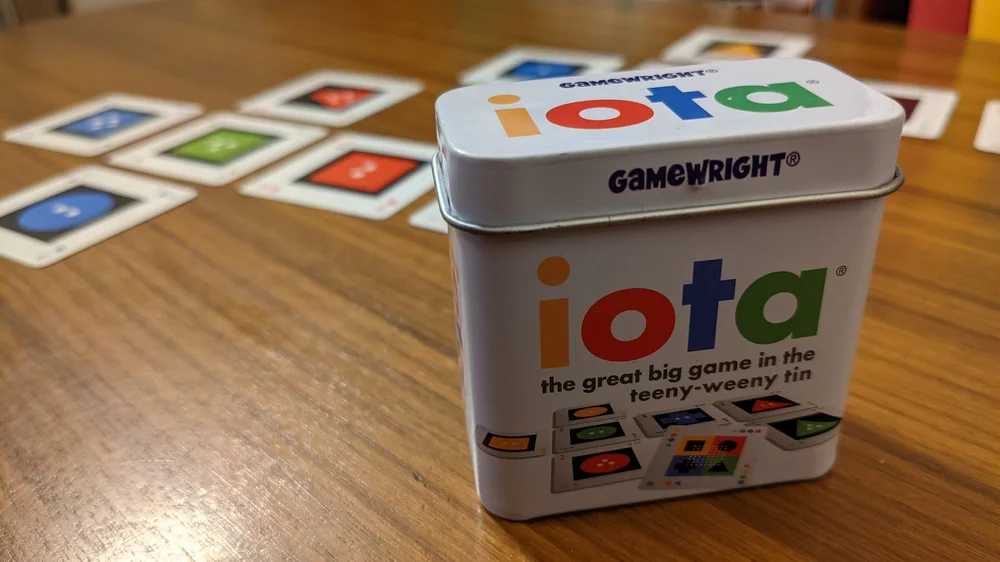
It’s true. Some people don’t care about the world of small box card games one iota. Today’s blog is about why they’re wrong.
Small box card games may come in small packages, but their game mechanics, skill levels and subject matter are more varied than you’d think. As well as handy travel games, they also make great ice breaker games at the start of the night or on a first date, and are absolutely excellent gifts. Here’s a small sample to give you an idea of what’s out there.
Fluxx
Fluxx (2-6 players) is great to start with because the RULES ARE ON THE TABLE. There’s no explaining to do (sorrynotsorry, Gamesplainers…). Each card in your hand can be played to cause a different type of action, and the most common actions are to create a rule or select a new goal or object of the game. The cards that create rules say things like… ‘draw three cards but play two.’ And talk about shifting goalposts - you can literally change the object of the game to suit the cards in your hand, simply by replacing the goal card that’s in play at the start. There are generic versions of Fluxx, but I’m a particular fan of the themed games as they can tap into fun inside knowledge from your favourite fandoms. Firefly Fluxx, other than being a bit of a dare every time I try to say it without swearing, has adorable goals that relate to particular episodes (think strawberries and Kaylee). Doctor Who Fluxx includes references to new and old Who, and allows for some fun goal pairings.
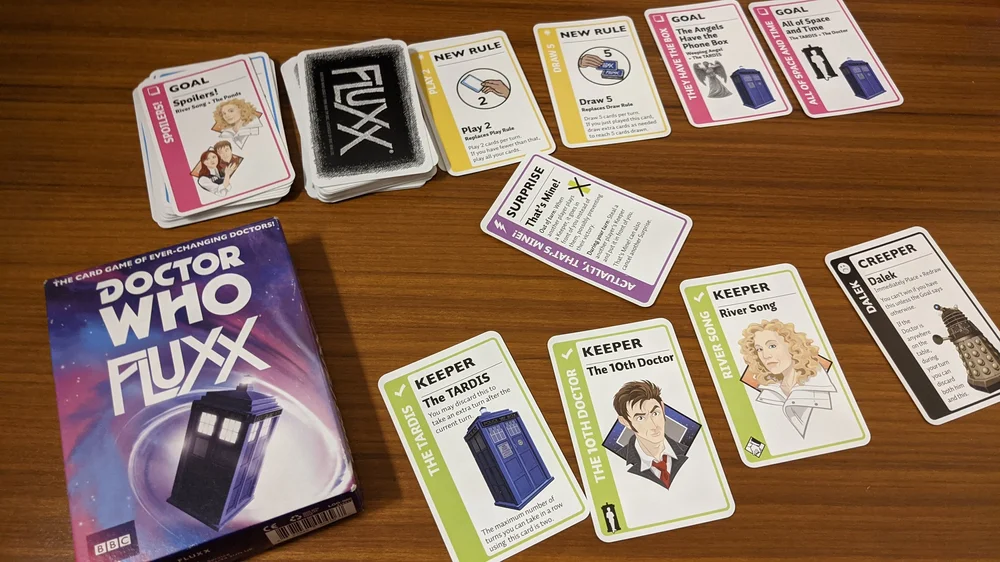
Doctor Who Fluxx, like other small card games, is bigger on the inside.
Anomia
Anomia is one of my favourite ever games. It’s a quick, shouty party game for 3-6 players, and in terms of bang for buck, you get a lot of entertainment out of this small package. Anomia is a fast-thinking competitive word-based game that randomly pits players against each other by asking for general knowledge in quickfire rounds. The rounds and opponents are determined randomly by how the cards happen to be drawn. Because you can use one deck, the other, or mix them together, the game never really gets stale, and remains a firm favourite of mine, five years after I first played it. Note - it can cause arguments… but usually the fun kind and not the table flipping sort!
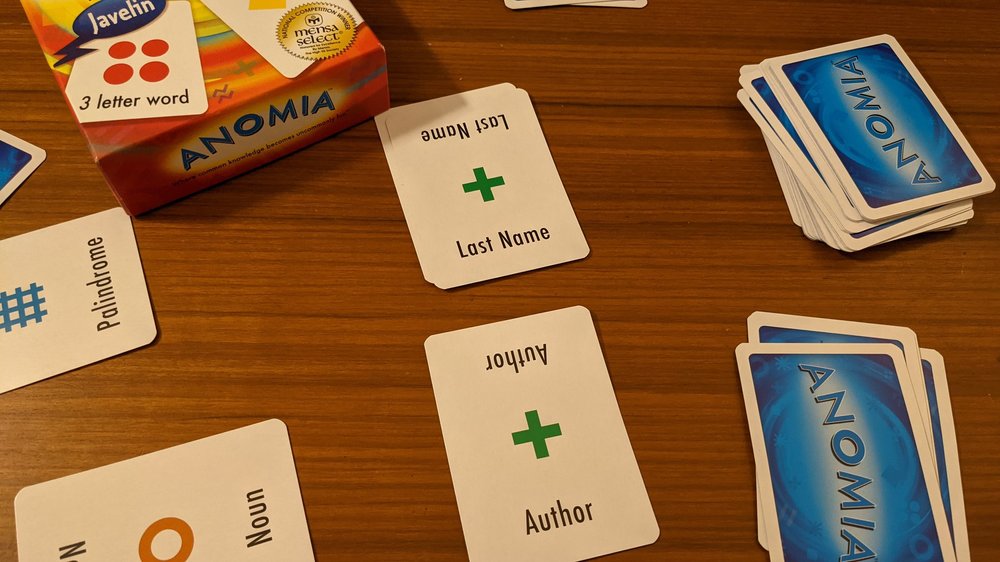
Anomia means forgetting the name of things… an apt title for this game.
Iota
Iota (2-4 players) is a truly tiny game. The packaging is tiny, the cards are tiny… the whole thing is very satisfyingly smol. The experience of playing such an adorable game was only enhanced for me one time, when I was able to play Iota with someone called Iona. If that sort of thing pleases you as well, you will find the object of this game highly fulfilling, particularly as an aperitif at the start of a game night or as a palate cleanser between heavier games. Iota is like… deconstructed reverse Uno meets gin rummy plus dominoes. It’s a more satisfying, flat Quirkle. Stay with me! Game play involves putting down tile-like cards that create sets of all the same or all different colour/number/shape sequences. As turns are played, the combinations grow, and it takes up a surprising amount of space at the end. The tin will fit in that pocket in a pair of jeans that nothing fits in, and it has great replayability.
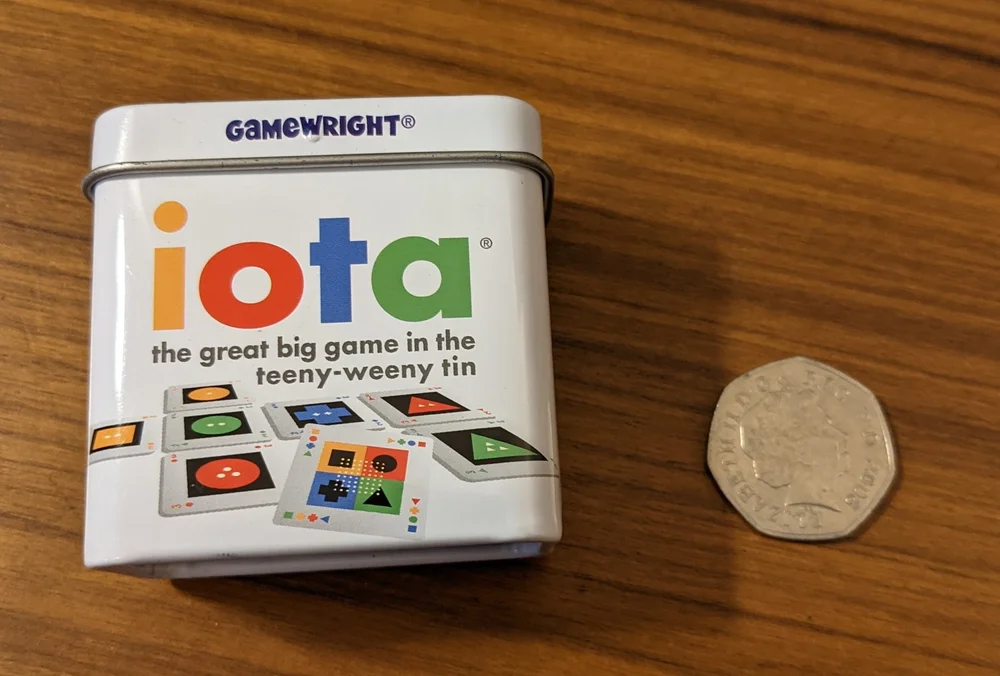
Good things really do come in small packages. And you shouldn’t doubt that one iota.
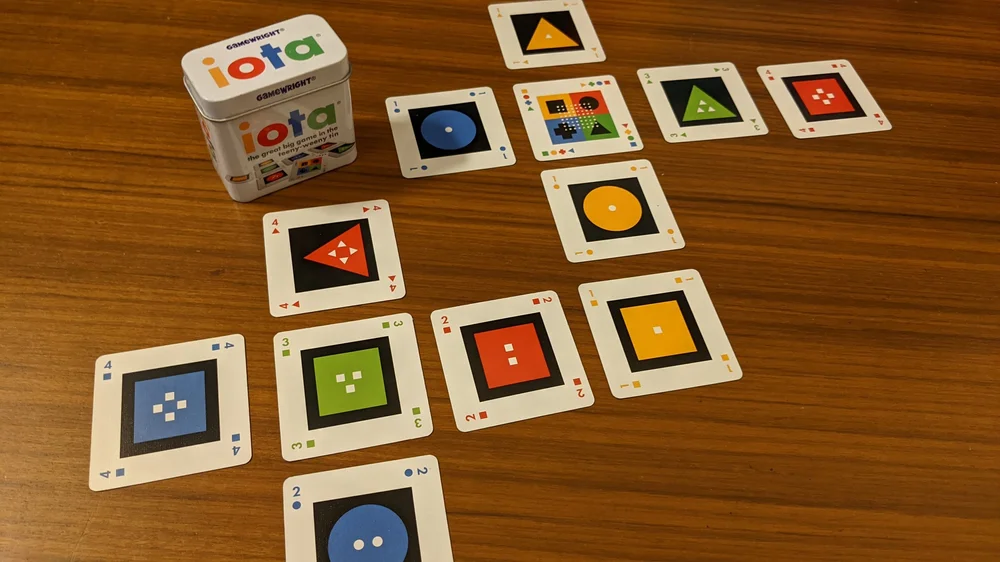
Put that extra leaf in your custom-built gaming table! It’s time to play Iota!
Dobble
Dobble (2-8 players) is very popular, easy to learn, and can cause more arguments than Anomia. Don’t let that stop you. It’s a quite ingenious variation on snap, combined with Where’s Wally: you need to identify the matching picture from within a random set of images displayed on each pair of cards as they are flipped over, and the winner of each round collects the cards to form a points pile. It is incredibly mathematically pleasing how it works. (If you want to know more about the formula that makes it possible for every pair of cards to definitely have one matching set of pictures, check out this video by my friend and Stand-up Mathematician Matt Parker.) Like Iota, it also comes in an extremely satisfying tin.
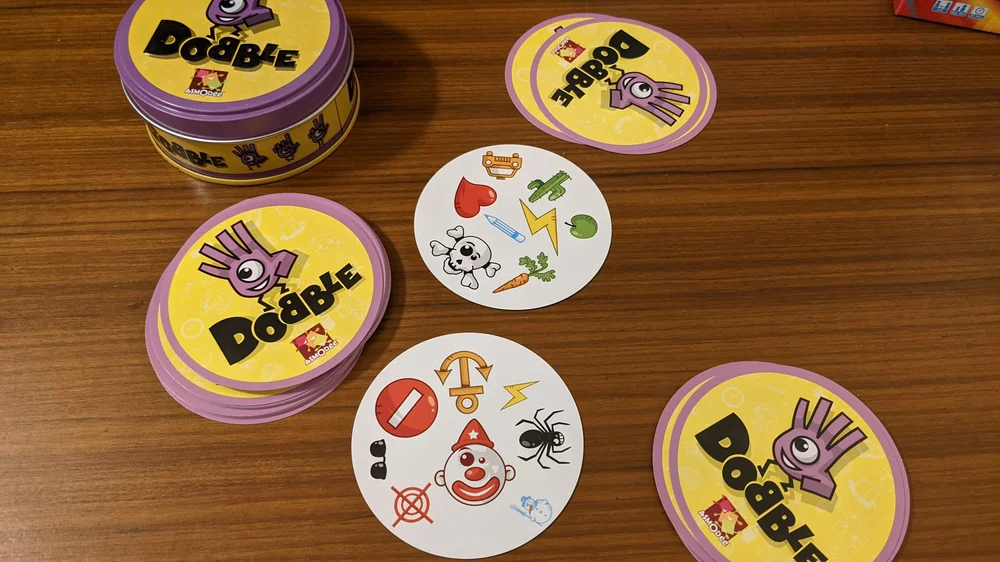
Have you dabbled in Dobble? Do give it a go!
Timeline
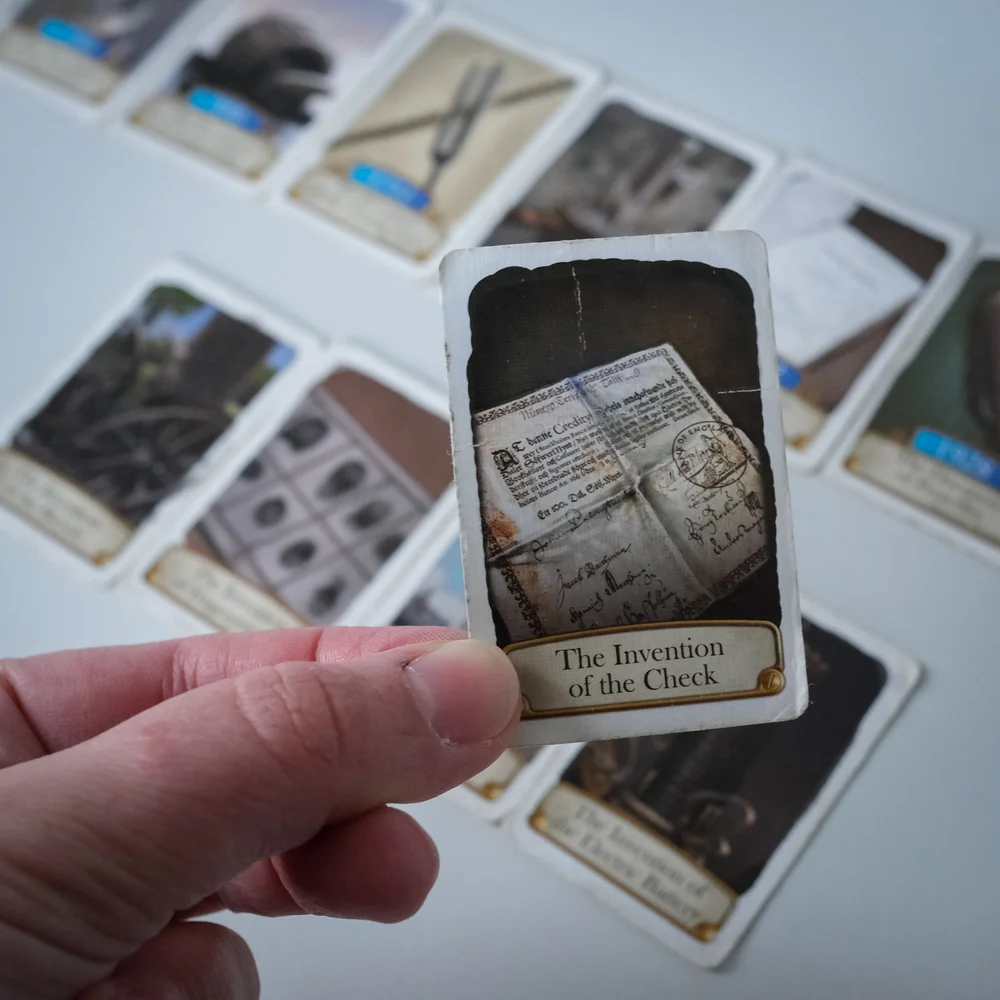
Time flies when you’re playing the Timeline series…
Timeline: Inventions (2-8 players) is so simple and clever that I’m very jealous I didn’t invent it. Each game in the series is a set of tiny cards with an event named and illustrated on one side, and the same event on the reverse, but this time with the addition of the year it happened. Dealt yearless side up, players must lay their cards on the table in the correct timeline order, and the winner is the first to use up all their cards. Get the date wrong though, and you have to draw a new card, so the game can go on for quite a while.
My mom and I nearly got through the whole pack in one sitting, and I’m looking forward to playing the final set of cards this holiday season. I bought her the Inventions set, and that is my favourite - I enjoy puzzling out the cause and effect certain inventions must have had on each other (although that strategy doesn’t always help - pencils were invented a LONG time before pencil rubbers were!) and it really lends itself to very cool talking points. The other versions may appeal to you more - Timeline: Classic is more general, Timeline: Events focuses on notable moments in history, and Timeline: Music & Cinema keeps people talking almost as much as the inventions one - it’s infuriating and satisfying in equal measure when you realise you’re gaming with a secret ‘80s movie buff or prog rock specialist.
Twin It!
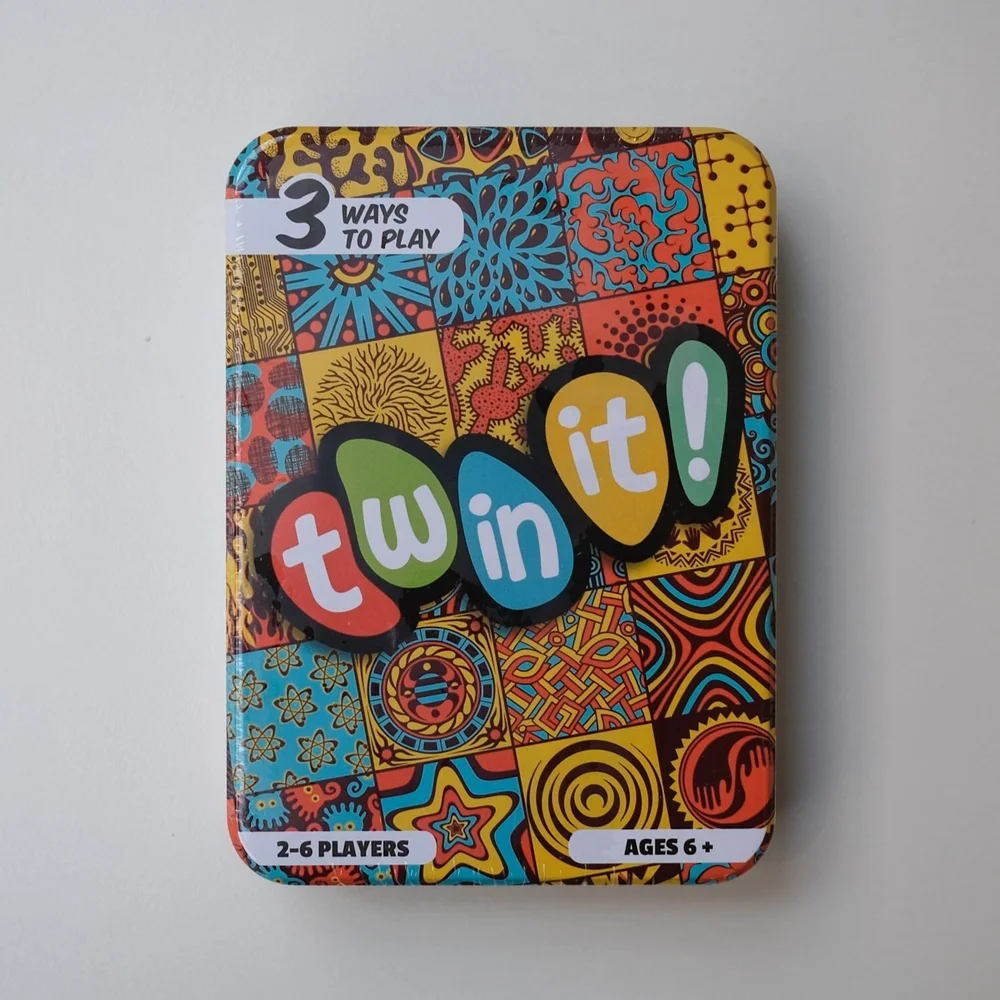
You’ve got to Twin It to win it! (sorry).
Twin It! (2-6 players) is the psychedelic lovechild of memory and snap. The illustrations on each double-sided card are similar enough in pattern and palette that most people are really hard pressed to spot the duplicates, which makes it all the more useful that all cards remain in play - even when they’ve been ‘won’ by someone who’s already matched a pair, and even when they’re revealed on the draw pile when a different card is officially in play! Oh yes - there are pairs of pairs, so the same matches can come up again and again.
If you’re not in the zone or find the sort of game based on observational skills difficult, don’t worry - with this twist on the genre you will be mesmerised and entertained by the very groovy card designs and probably won’t mind, even when your opponents are quicker every time.
Pick a Dog
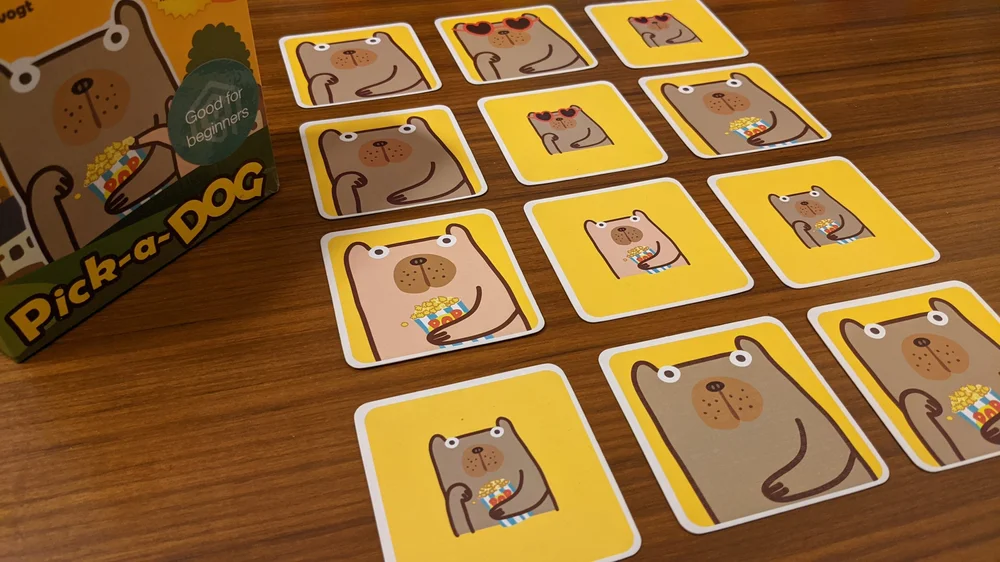
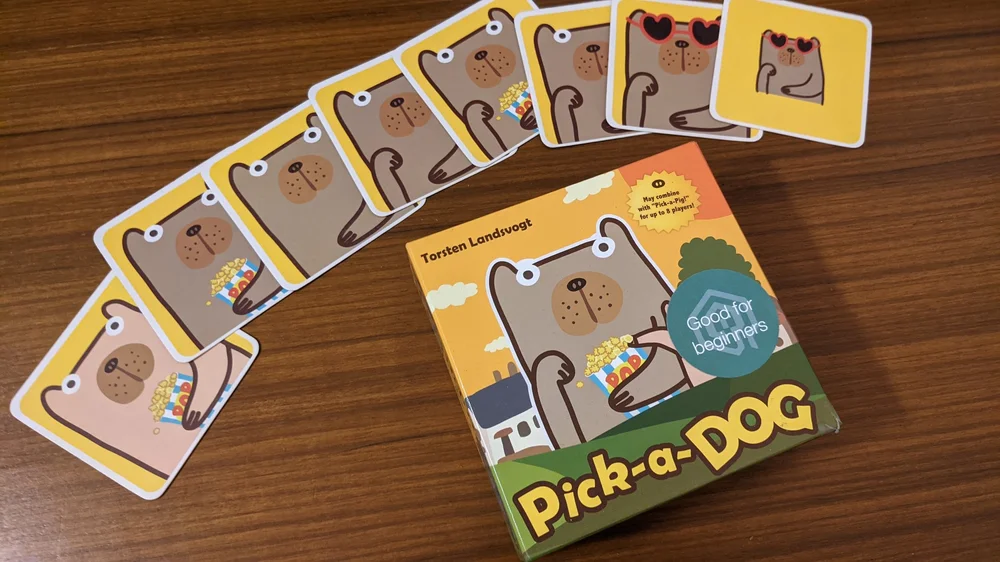
Pick-a-Dog (1-5 players) (and its virtually identical sibling games, Pick-a-Pig, Pick-a-Seal and Pick-a-Polar-Bear) rely on high-speed matching, but with storytelling added in. You start by laying out a grid of cards that may match, but mostly don’t quite match exactly. Each player turns over their own starting card, which sets off a round of looking for matches in the grid. Though there are some exact matches, all the pictures are similar - they feature a dog who can be depicted with a number of binary qualities: looking pale or having a tan, holding popcorn or not, wearing sunglasses or not, standing near to you or far away, and using one hand or two hands.
The twist in the matching portion of the game is that you can only match cards that are either exact, or follow a sequence where there is only ONE change per card (you can go from sunglasses to no sunglasses, for example, but not from far to near at the same time). The free-for-all ends when there are no more matches to make (but watch out - if you call it and there are still more matches available, you forfeit your hand and can’t score any points that round, while the other players can resume).
Scoring is fun and unusual (or at least it is the way we teach it at The Treehouse!): to prove you’ve made a true sequence with only one difference on each card, you have to tell a story about your buddy the dog that reflects the pictures as you reveal them. It’s very cute indeed. If you discover mistakes in anyone’s sequence, those cards go straight into the discard pile. The players earn the cards they’ve proven are in a sequence each round, and at the end of the game, the winner is the one who has the most cards.
Sushi Go!
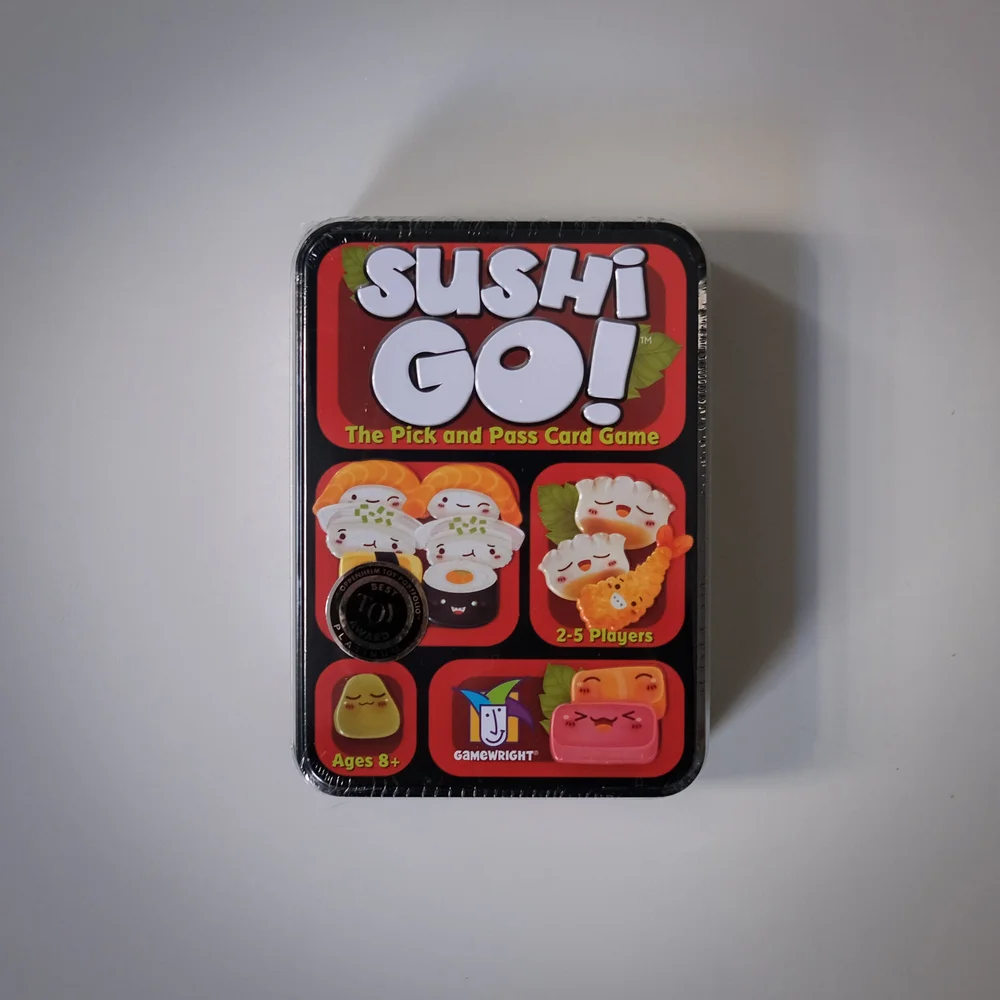
It’s food with faces on it. That’s an instant yes in my book.
Sushi Go! (2-5 players) is a fast-paced game that may make you hungry. It’s unusual because you pass your hand to the next player each turn - which means you get to see all the cards, and you can strategise whilst choosing what card you’ll play next - or what card you’ll steal to mess up an opponent. You earn points for creating sets of sushi types which you lay down on the table in front of you - and there’s no ‘takey-backsies’ - everyone reveals their card choice at the same time before passing their hand on. After three rounds and some genuinely creative scoring (adding wasabi gives you more points, and pudding isn’t scored until the end), the person with the most points wins! And then everyone goes out for sushi. (Or maybe not, I guess? I mean, I would, but I’m not everyone.)
We Didn’t Playtest This At All!
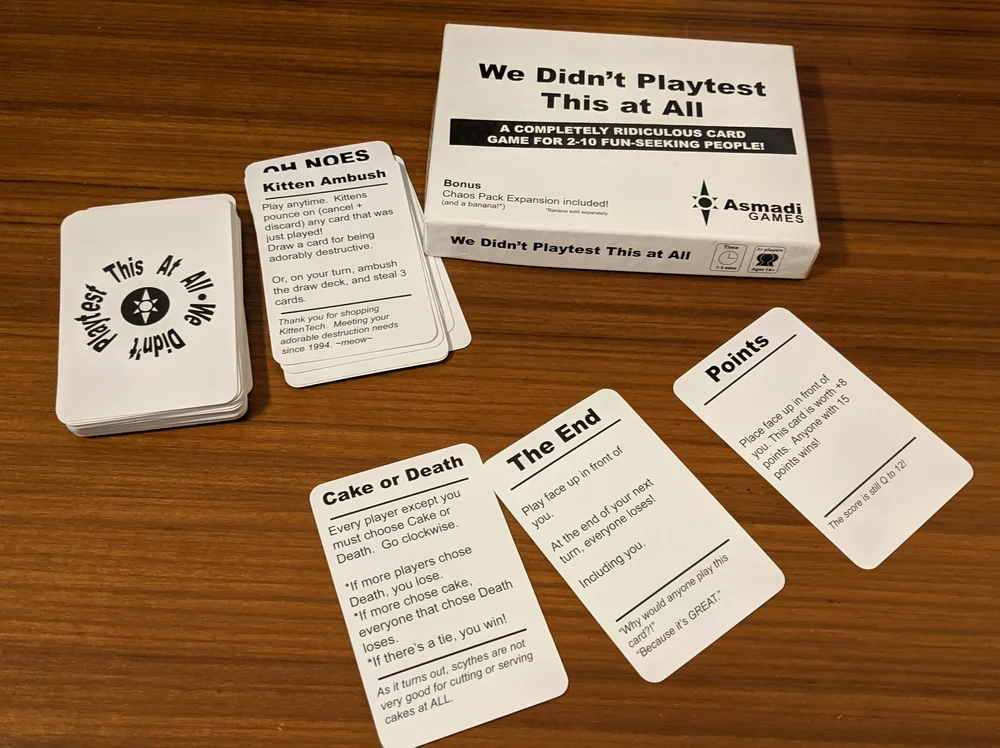
I mean, We Didn’t Playtest This At All! is basically a drinking game without the drinks (2-10 players). It’s extremely silly and has somehow captured the sort of game your uni housemates make up after a big night out at three in the morning while watching Sharknado on the Scifi Channel. In some ways it is like Fluxx, because the rules are usually on each card. In other ways it is a bit like playing any card game as a small child where an older sibling or cousin is constantly changing the rules of a game they’ve just taught you so that you can lose and they can not only win, but also lord their win over you for the rest of the family visit (we’ve worked it through and we all get along fine now).
Since I’m not a big drinker, I can only imagine that the reason I enjoy this game is because it is so, so absurd. It appeals to the comedy improviser in me and is chaotic, but it’s ‘safe’ chaos. Games can end in two turns (and you can either play again or read the room and put it away if everyone is irritated by it), or go on all night - the cards hold the key to the result. If everyone joining in likes this kind of thing, it’s hilarious.
Skull
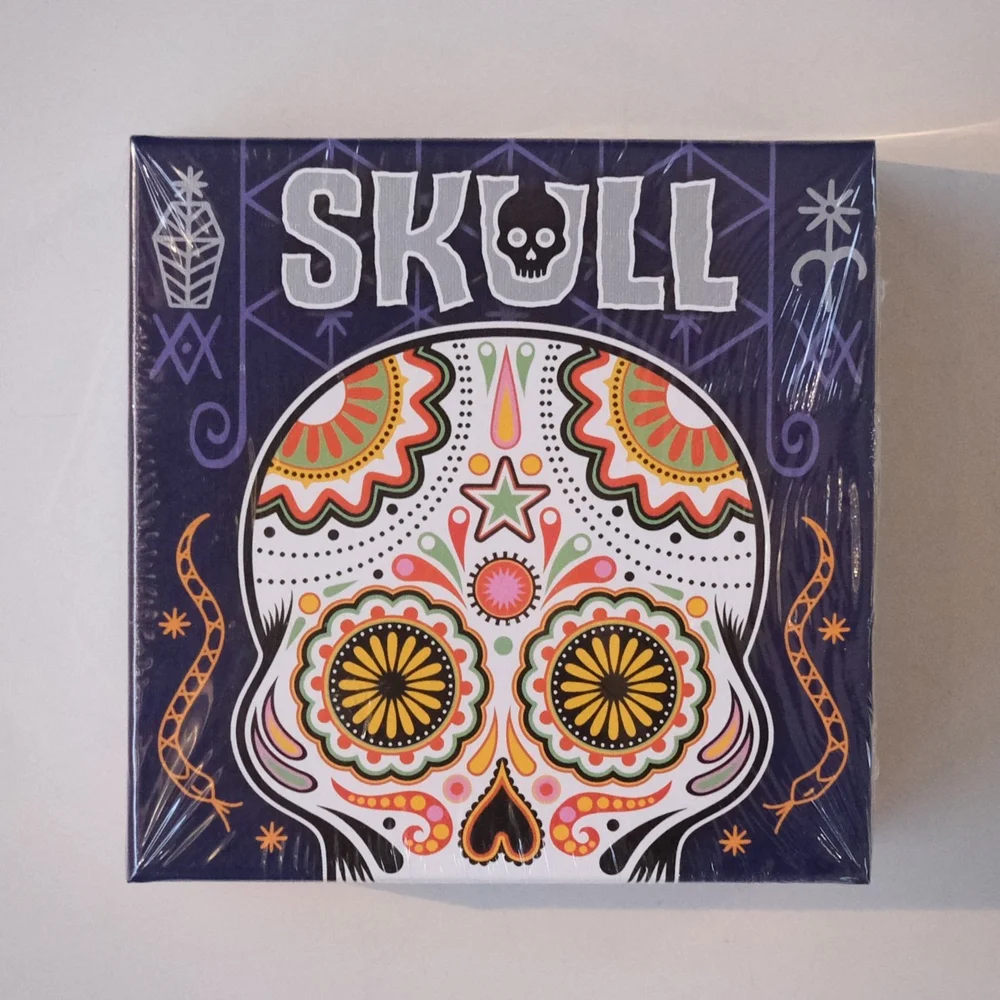
Flower? Or Skull? Are you feeling lucky?
Skull (3-6 players) is a bluffing and gambling game that requires a reasonably good poker face. Each player is dealt a hand that contains cards that can be either flowers or skulls. So far so simple. But then each player has to predict how many cards they can turn over before a skull is revealed (when this happens, you lose a card). If you lose all your cards, you’re out, and if you get two points, you win. It sounds too simple, but it is very entertaining. If you’re a fan of Tom Scott’s YouTube videos, you may enjoy watching this second channel video which features a fun demonstration of Skull in action.
So there you go - lots of fun card games to play, share and store on your tiniest board game shelf, buy for someone else, or come down to the Treehouse and play. They’re versatile, and sometimes overlooked or dismissed as too simple, but I hope you’ll see that’s not always the case!
Oh yeah - There are other games that come in small boxes that aren’t simply card games - I haven’t mentioned them here, but if you’re looking for other portable games, stocking stuffers or Secret Santa gifts that are not card based or which have extra components, Love Letter, Ghost Blitz, and Hive Pocket are all good shouts.
As we approach the holiday season, it’s also worth considering that they’re usually less expensive than bigger games, so they’re a bit easier on the budget, which means you can buy more of them.
I’m not going to say make a card game Advent calendar for someone, but I’m not going to not say it.
Have fun out there.
Chella Quint is a Treehouse staffer, board gamer, and author of the books Be Period Positive and Own Your Period.