
My Little Scythe Review – Tactics in a Tiny Kingdom
Disclaimer: My Little Scythe was provided for free by Stonemaier Games, although the writing and opinions of this article are my own.
It’s finally happened. My son has started showing an interest (or more accurately a tolerance) in board games. But that’s enough for me to punch my ticket and jump aboard the family board game train. Journeying far and wide to find games that we can enjoy together.
My Little Scythe promises exactly that: a kid-friendly reimagining of its grown-up counterpart, Scythe. Streamlined, lighthearted, and not a gun, mech, or dishevelled farmer in sight. It’s clearly designed with younger players in mind. But would it be too streamlined for my tastes? Or maybe still a bit too heavy for my seven-year-old son?
Let’s find out.

How to play
In the Kingdom of Pomme, you’ve been chosen as a Seeker to represent one of the seven animal kingdoms in the annual Harvest Tournament. Think of it as the Olympics, if the only events were collecting apples and diamonds, completing quests, and throwing pies.
Your goal is to earn four out of eight possible trophies to win the game. Multiple players can earn the same trophy, but you can never earn the same trophy twice…. that would just be greedy. The trophies include:
- Delivering four diamonds or apples to the castle in the center of the map
- Beating an opponent in a pie fight
- Gaining 8 friendship or 8 pie-munition
- Completing two quests
- Upgrading two actions on your player board
- Gaining three magical spells
If you’ve played the original Scythe, some of the terminology and structure in My Little Scythe will feel familiar. If not, no worries, you’ll pick it up whip-smart. I believe in you!
Each player gets a player board, which includes the three core actions you can take on your turn: Move, Seek, and Make. You’ll also have two adorable miniature characters (your Seekers) that start on the map in your home base.
On your turn, you’ll move your action token to a new space on your player board and carry out that action. Just remember: you can’t take the same action two turns in a row.
The actions are:
- Move: Move both of your Seeker miniatures up to two spaces. But only one space if they’re carrying apples or diamonds. If you land on a quest token during your move, you draw a quest card and embark on a side quest in Pomme. Each quest gives you two options to complete it: one that helps only you but costs resources, and one that affects other players and costs you friendship. There’s also a third option to skip the quest, where you might get a slight reward but it doesn’t help you complete the objective and earn a trophy.
- Seek: Roll dice to add resources (apples, diamonds) and quests to the map based on the results. If you place a resource on another player’s map space, you gain 1 friendship. And in my house, you’re officially labelled “A Cool Dude.”
- Make: Spend your gathered resources to upgrade actions, bake pies, or learn magical spells.
Using just these three actions, you’ll explore the board and work toward earning trophies. During your journey, if you end your movement on the same space as another player, it’s time for a pie fight.
Each player secretly chooses how many pies to throw and whether to play any spells. Then both reveal at the same time. The player who committed the most pies wins the battle and takes the space; the loser is sent back to their home base. Either way, both players lose the pies and spells they used in the fight.
Oh, and here’s a key detail: resources stay on the board. If you drop apples or diamonds, whether by getting knocked out in a pie fight or just leaving them behind, they remain where they were. Anyone can swoop in and grab them, assuming they’ve got enough pie power to hold the space.
As soon as someone earns four trophies, everyone gets one final turn. After that, the player with the most trophies wins and claims the throne at Castle Everfree for the rest of the year.

Power plays at the kids table
When it comes to games that streamline their larger siblings, My Little Scythe is one of the best. Sure, the mechanical similarities are there. You’ve got player board actions, a focus on completing objectives, and you use your action token to choose what you’ll do on your turn.
But what really impresses me is how similar it feels.
Just like in Scythe, there’s that slow, creeping sense of dread as players power up their military (or… pie-litary?) strength. Everyone starts spreading from their base camps, inching closer to the centre, and you just know a clash is coming. No one wants to start a fight, because of how detrimental they can be, but the threat of a pie-flinging battle is always there, simmering just beneath the surface.
Beyond how well it captures the feel, what truly surprised me was how deep the game actually was. I went in expected a puddle and ended up in a waist-deep pool without warning.
From the outside, with its cute artwork, colourful components, and family-friendly branding, I thought it was one of those games where every sharp corner has been sanded off. Leaving something simple and safe that kids would enjoy and adults would tolerate. So when, on my last turn, I pulled off a move that let me chain multiple actions together and complete two trophies and launch myself from last place to a win, I thought, well damn, there go my expectations.
A big part of that depth comes from how easy movement is. You’re never more than two spaces away from a teleporter, which means you can get back into the action quickly, even after taking a pie (or two) to the face. Whereas in big-daddy Scythe, losing board position can sometimes mean you’re benched for the rest of the game.
That movement flexibility feels like a window into the game’s whole philosophy. Trophies are relatively quick and achievable, and almost every action nudges you closer to one. As a result, I found myself plotting out clever turns and pulling off some seriously satisfying plays. Including at least one dramatic come-from-behind win.
Tears, tokens and toe custard
The gameplay, for me, was genuinely enjoyable. But for my seven-year-old son, this being his first board game involving direct conflict, it was a bit of a struggle. Strategy, timing, and planning ahead aren’t exactly in his toolkit just yet. So even though he managed to snag a win or two (mostly while mum and dad were busy pie-ing each other), he didn’t have quite as much fun as he does with more straightforward games.
He’s also at that delightful stage of life where emotional regulation is… a work in progress. So losing a pie fight may as well have been the end of the world. And let me tell you, there’s only so much comfort you can offer a child who’s dramatically declared their life is ruined by war pastry.
This is where I think My Little Scythe has thrown a pie into its own sandals. A metaphor that I hope conjures the specific discomfort of custard between your toes. But between a title that instantly evokes My Little Pony, cover art that skews very young, and a rulebook drenched in cutesy language, I had a lot of hesitation diving in. And I imagine plenty of other board gamers might judge the book by its cover the same way I did.
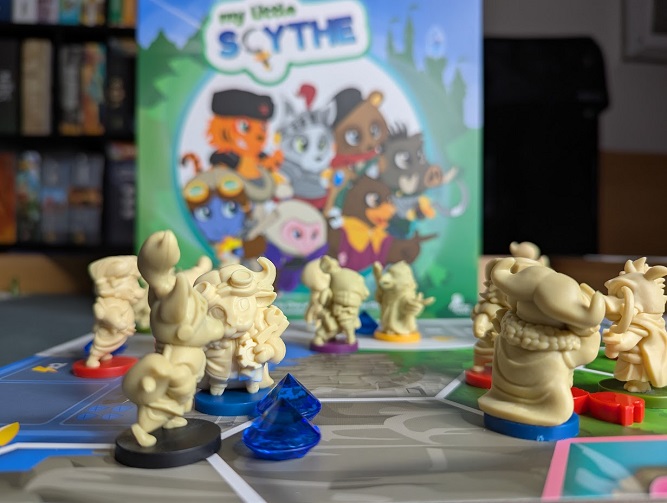
That said, another thing that really deserves a shoutout is the painting guide tucked into the rulebook. It’s such a thoughtful touch, especially when paired with the chunky, inviting miniatures. For kids (or adults!) curious about dipping their toes into miniature painting, My Little Scythe is kind of a perfect starting point. The minis are big, the designs are fun, and there’s no pressure to get them “perfect.”
And that’s really the heart of it: underneath all that sugary coating is a surprisingly solid, strategic game. One with enough depth to keep experienced players engaged, but just light enough to bring younger ones along for the ride… once they’re ready.
My Little Scythe
Players: 1-6
Playing Time: 45-60 min
Designer: Hoby Chou, Vienna Chou
Publisher: Stonemaier Games
I was skeptical at first, but My Little Scythe turned out to be the perfect stepping stone into more strategic games with my son. With plenty of room for advance strategy it was fun for both of us (custard meltdowns aside).
Pros
- Captures the feel and strategy of Scythe in a light and fluffy package
- Strategic enough for grown-ups without overwhelming younger players
- Streamlined movement and action design keeps things snappy and satisfying
- Great components and a painting guide that actually makes miniature painting feel approachable
Cons
- Might still be a bit much for kids, especially if it’s their first board game with conflict… or they’re not fond of pies
- The cutesy aesthetic can easily scare off strategy snobs before they even open the box
This site keeps going thanks to your support. When buying through links on this post, I may earn a small commission—without any extra cost to you. Full disclosure here.
More games to round out your family game night


How does it compare?
See where this game falls in our board game rankings.