
Designing within Combat Commander’s Scale and Scope
NB and I guided our design of Combat Commander: Vietnam (CCV) with the principle of “What would Chad do?” With only a map from Chad’s own version of CCV, we had to fall back on the enormous body of Combat Commander (CC) content produced over the last twenty years for inspiration. Chad, Kai, and others have left an invaluable legacy of materials for aspiring CC designers to study, including designer notes, strategy guides, deck manifests, and more.
Although the nature of infantry combat differed between World War II and the later wars in Southeast Asia, the CC series provides clear boundaries on the scale and scope of what the games can cover. We used those boundaries to decide on what aspects of our conflicts we could adapt to the CC series and which were better addressed by other systems. As I’ve written elsewhere in my designer notes for The Guerrilla Generation, disciplining one’s games to a specific scale and scope helps capture a historical decision-space better than trying to cover multiple scales or widen one’s scope through extensive abstraction (https://www.gmtgames.com/p-1032-the-guerrilla-generation.aspx Scenario Booklet, pages 25-29).
Combat Commander Scale and Scope
As wargamers, we discuss scale as the level of conflict being covered by a game, often discussed as tactical (battles), operational (campaigns), or strategic (wars). Games sometimes provide more specific definitions of the scale of the units, time, and geographic space. A game’s scope can be thought of as what dynamics of a topic a game tries to explicitly cover, and which it omits or heavily abstracts away. Defining a game’s scale also helps with articulating the scope of what a game covers. Not surprisingly, a game at a tactical scale doesn’t need to cover the broader war economy sustaining the units involved in the depicted battle or skirmish. However, even within a scale, designers must make choices about what is within a game’s scope and what is left out. One of the easiest ways to address a game’s scale and scope is to orient the design around a question that is the core of what the designer is trying to illustrate for players.
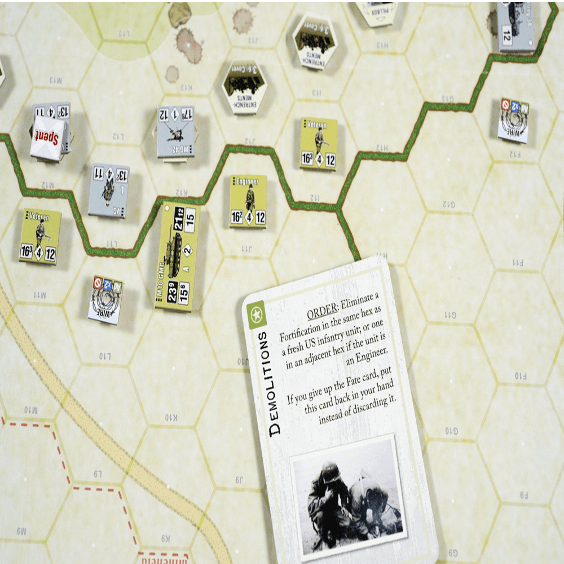
Chad’s design notes suggest that the question for Combat Commander was “What was the nature of tactical infantry warfare during WW2?” with the design illustrating the “chaotic” nature of infantry combat. The scale of CC is clearly tactical. Yet the design is more precisely limited to infantry engagements ranging from platoon to company level. Units generally represent Squads and each hex represents around 30 meters. Engagements larger than a company in modern warfare stretches into the grand tactical, shifting command decisions away from maneuvering combat units to managing maneuver units. Similarly, engagements below the scale of a platoon require more attention to modeling the individual participants of, say, a squad-size patrol. The CC system works well by constraining itself to the size of engagements relevant to a company commander’s decision-space.
Luckily, the Vietnam War is famously known as a “company commander’s war” marked by innumerable smaller scale engagements that perfectly fit within the range of platoon to company-sized engagements. Many of the most famous larger battles of the war (e.g. Ap Bac, Ia Drang Valley, Khe Sanh, Tet Offensive, Easter Offensive) consisted of a series of smaller engagements. Despite having an nearly endless list of engagements to inspire scenarios and our RSG dynamics, as we discuss below, the scale of the CC system did force us to omit some types of engagements.
Similarly, in terms of scope, the Combat Commander focuses on “tactical infantry warfare” that famously (or in the view of some players, infamously) omits vehicles from the game. Given the system’s scale, such an omission makes sense. CC-sized maps, with each hex representing 30 meters, provides little room for vehicles to maneuver. Likewise, such an inclusion would have quickly distracted from the system’s core topic: infantry combat. When Chad shifted the focus to combined arms tactics during WW2 in Fighting Formations, the scale of the game shifted up to include vehicles but at the expense of the richness of the infantry units depicted. Similarly, Combat Commander is scoped to depicting kinetic combat. Although the system models partisan forces in the Resistance expansion, the politics around the resistance movements of WW2 is outside the scope of the design.
We matched the scope of Combat Commander when applying the system to the Vietnam War and related conflicts in Southeast Asia, so vehicles have once again been omitted. Most small-scale engagements in Vietnam did not include vehicles and until later in the war only one side regularly had vehicles supporting infantry forces. We’ve found an alternative way of modeling one type of vehicle engagement: contested air assaults. Occasionally, Communist forces ambushed Free World Forces directly at the landing zone. These types of engagements required a new Air Assault posture and special rules, but players will not be placing Hueys directly on the map. Although politics heavily shaped the war in Vietnam, we only incorporated aspects relevant to infantry combat, such as procedures related to “rules of engagement” and the placement of civilian markers that block line of sight.
Dynamics Outside CC’s Scale and Scope
Given players’ diverse conceptions of the Vietnam War, it’s worth noting a few dynamics not included within the core Combat Commander Vietnam experience. First, any engagements below the scale of a platoon have been omitted from the game. Many of the patrols during the war occurred at a small-scale (squad or half platoon) and did not result in “contact”. Instead, many of these agonizing patrols faced casualties through booby traps, snipers, fleeting contact, or exhaustion. Although a common experience in the war, such “everyday” dynamics do not illustrate what occurred when contact did result in a sizable engagement. Likewise, the use of highly trained six-man teams by various special forces (Green Berets, MACV SOG, SAS, etc…) for reconnaissance falls well below the scale of a CC scenario. Given those units generally sought to avoid contact with larger insurgent forces, such dynamics also fell outside the scope of the CC system. In other words, engagements below the platoon scale would require a different system focusing on individuals, such as the “RECON” roleplaying game by Palladium.

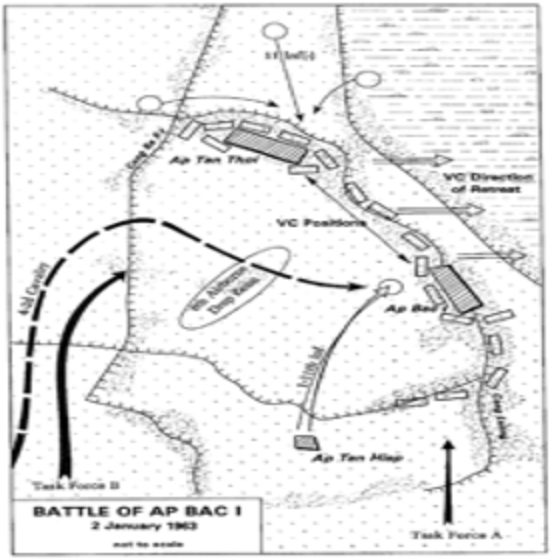
The scale of the CC system also required omitting or slicing apart engagements larger than the company level. Search and destroy operations that did achieve contact often involved multiple companies closing in on Communist forces with infantry support vehicles backing them up. For instance, one of our scenarios covers the northern part of the famous battle of Ap Bac (1963) in the hamlet of Ap Tan Thoi, but omits the more famous fighting to the south that became “too big” for a CC scenario. We also had to be careful when selecting attacks by Communist forces, who often sought to overwhelm special forces camps or government outposts with a much larger force. Although these larger engagements have become engrained in our memories of the war, such fights were rarer and less representative than the smaller infantry engagements that the CC system covers so well.

The main reason we included a “Campaign System” at the Battalion level for Combat Commander: Vietnam is to capture aspects of the war that fall outside the core CC experience. If part of the “Vietnam feel” is missing when playing individual scenarios, we recommend players quickly move along to Campaign scenarios. For instance, the Free World Force player must search for Communist forces in the Campaign to achieve contact and generate a CC engagement. Many searches will fail and sometimes result in attrition through traps. Yet, the Free World Force player also has access to Fire Support and Transport points, granting them vehicular support in the Campaign. The politics surrounding individual engagements becomes apparent through a battle over Garrisons that determines which side is winning the “Village War”, and through Campaign-level events.
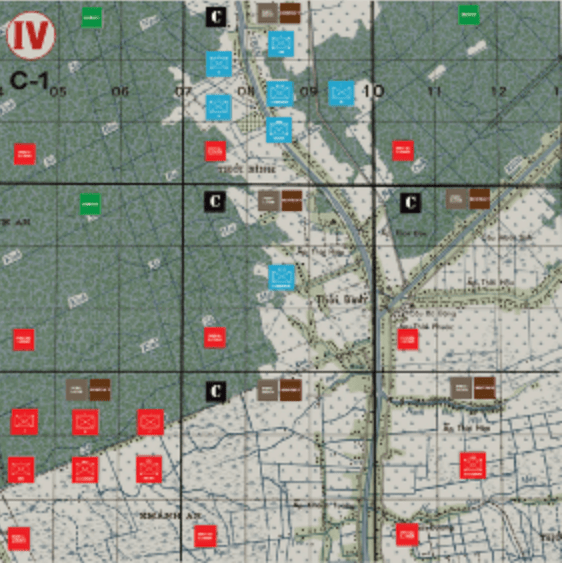
We’ve found the Campaign system lets players have the best of both worlds: a tightly defined and rich infantry combat game, with other aspects of the war still covered through the campaign mechanics.
Future Extensions of Scale and Scope
We first and foremost wanted to honor Chad’s tremendous legacy when designing Combat Commander: Vietnam by adhering to the scale and scope set by the original design. By offering the most comprehensive depiction of infantry combat during the Vietnam War to date, we’ve managed to replicate Chad’s vision for this new set of conflicts. A number of recognizable aspects of the war fell outside the CC system. We’ve mitigated their omission with the inclusion of our Campaign system in the base game box. Moving forward beyond the initial release, we’ll be aiming to push the boundaries of the CC system’s scale and scope in exciting new ways. For instance, inspired by the Epic expansions for GMT’s Commands & Colors series, we’re currently exploring the possibility of larger “Major Contact” CCV scenarios, enabling us to model larger engagements and better capture one of the most demanded features missing from the CC system. Additionally, to capture lower scale dynamics, we hope to release additional content for the Campaign system that adds more “RPG” elements, allowing players to track the fate of their individual platoons. Finally, parts of the CCV team have been working on adapting the deck mechanics and RSG principles of the CC system to other dynamics of the Vietnam War beyond infantry combat.
We hope you join us as we explore new possibilities for the CC system!