

Combat Commander: Vietnam Faction Spotlight — Free World Allies
Over the next few months, we’ll be periodically releasing several “Faction Spotlights” that cover lesser known factions in Combat Commander: Vietnam. Each article will cover the unique features of the faction’s play style, a few historical scenarios featuring the faction, and how the faction fits into the new Campaign mechanics. We use the more generic term “faction” for the six sides because Europe’s “nationalities” does not quite fit when you have Vietnamese on both sides. Similarly, the six “factions” cover multiple allies or minority groups and often span several nationalities, such as the Free World Allies (FWA), the topic of today’s article.

Events from GMT’s Fire in the Lake (2014) and Sovereign of Discord Expansion (2023)
The FWA faction represents the collection of countries who committed military forces to help the American and South Vietnamese war effort. In 1964, President Lyndon Johnson sought to bolster the legitimacy and resources of the United States’ commitment to South Vietnam by launching a “many flags” campaign to attract Asian and Pacific allies, particularly once European allies showed no interest in joining. Although a wider group of countries committed economic and other forms of assistance, such as the Philippine Civic Action Group, only four countries provided military forces: South Korea, Thailand, Australia, and New Zealand. These countries viewed their contribution as a way of defending the region from Communist expansion and attracting further aid from the United States.
At its peak strength, approximately 70,000 Free World Allies served in South Vietnam, with another estimated 20,000 Thai forces in Laos. Although dwarfed by the United States’ peak of 543,000 military personnel, the FWA’s contribution is significant when one considers that only around 10-15% of American troops served as infantry (another 14% served as artillery, engineers, and airmen), with the majority serving in combat support services. Backed by the United States’ enormous network of combat support, Free World Allies contributed a large portion of the infantry on the ground.
The Republic of Korea (ROK) committed the most forces, with two Divisions (Capital and 9th) and a Marine Brigade (2nd “Blue Dragons”) serving in the coastal areas of I and II Corps. Next, Thailand initially deployed their “Queen’s Cobras” Regiment in 1967, followed by a full Division (Royal Thai Army Expeditionary Division) known as the “Black Panthers.” Thai forces operated in III Corps, east of Saigon. Furthermore, Thai troops played a critical role in the Laotian Civil War, serving as advisors, artillerymen, and infantry known as “Unity Volunteers.” Finally, Australian and New Zealand forces jointly served as part of the brigade-sized 1st Australian Task Force (ATF), primarily operating in Phuoc Tuy province, III Corps. Between 1962–1973, the Australian Army Training Team Vietnam (AATV) also helped train the South Vietnamese military and territorial forces.
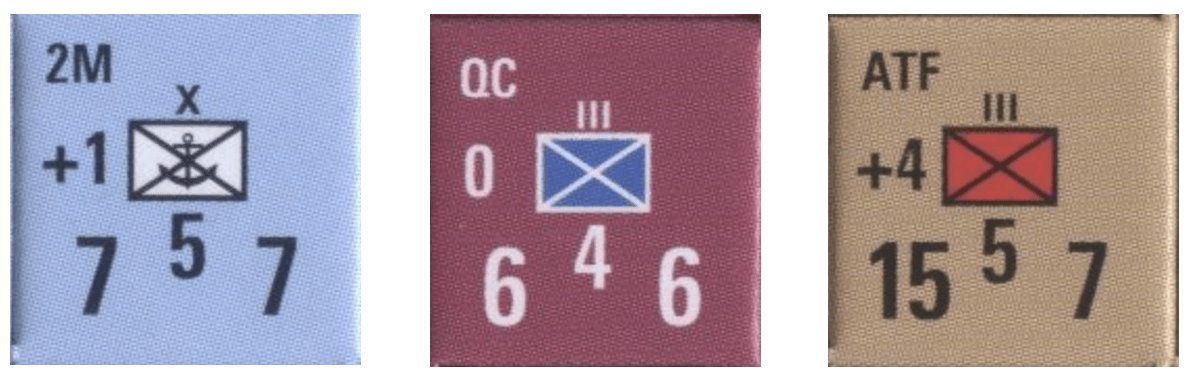
ROK, Thai, and ANZAC counters from GMT’s Vietnam 1965-1975(2022)
These forces made a major contribution to the South Vietnamese government’s defense and easily warranted a unique Faction to highlight their role in the war and distinguish their operations from American forces. Although other Vietnam War tactical games sometimes include the ANZAC forces, they often overlook the larger ROK and Thai forces. Here, each of the three “sub-factions” receive their own Orders of Battle (OBs) and historical scenarios (two per national military, for six total FWA scenarios in the base game).
ANZAC & ROK & Thai, Oh My!
The FWA Fate Deck operates differently than either the ARVN or US Fate decks. Unlike the ARVN, the Free World Allies do not have to deal with a large number of Command Confusions, nor do they have the new Advisor Action to mitigate such a problem. FWA militaries received considerably more training than their South Vietnamese counterparts, while also facing fewer organizational problems such as desertion. However, the Free World Allies also do not possess the awesome, if at times excessive, firepower of the US Fate deck, possessing fewer Fire Support Orders. Instead, the FWA deck represents a well rounded faction with a more balanced distribution of Orders, allowing them to effectively close with the enemy while still being able to rely on Fire Support in a pinch.

Prototype FWA Fate deck card #29 with ANZAC Deck Shift to Creep Order
The FWA deck also leverages a new mechanic of Combat Commander: Vietnam known as “Deck Shifts.” Deck Shifts alter the normal distribution of Orders under certain conditions, usually determined by which period of the war an engagement takes place. However, the FWA Deck Shift instead distinguishes the fighting approach of ANZAC forces from the other two militaries. When using ANZAC formations, the FWA Deck gains 3 Creep Orders (while losing two Moves and a Command Confusion). Creep is a new Order that allows forces to move effectively through concealing terrain and is more often found in the irregular decks (NLF and Special Forces). Additionally, the ANZAC Deck Shift replaces a Fire Support with an Advance, further heightening the deck’s mobility. These changes represent the ANZAC’s forces professional training and experience of jungle warfare in Malaya and Borneo. ANZAC forces often sought to “out guerrilla” the guerrillas, rather than relying on the heavy firepower approach of the Americans and other allied militaries.
As with other Combat Commander games (Europe, Pacific, Great War, etc…), each faction possesses a unique set of OBs for use with the Random Scenario Generator (RSG). The FWA OBs cover most regions: ROK in I and II Corps, Thai in Laos and III Corps, and ANZAC in III Corps, while no FWA forces served in IV Corps or Cambodia. In terms of specific formations, each military possesses an Elite one: Elite ANZAC, ROK Marines, and Queen’s Cobras. ROK standard Rifle Companies receive Early and Late versions, reflecting the less aggressive stance during the post-Tet period, but with more modern equipment. Similarly, Thai forces have different formations for the regular infantry that served in South Vietnam and the more irregular forces that served in Laos as Unity Volunteers. These diverse formations allow players to cover a wide range of engagements, including those covered by our historical scenarios.
Historical Scenarios
Combat Commander: Vietnam contains 24 historical scenarios, and six of those scenarios involve the Free World Allies. In this article, we’ll reveal two of those scenarios and leave the rest for you to discover! Let’s start with the famous one.
Scenario 7: “They’re Going to Attack Us!” covers the battle of Long Tan in April 1966 between ANZAC forces and formations of the National Liberation Front (NLF). Not expecting to run into such a large insurgent force, the scenario’s title comes from the shocked reaction that the forward ANZAC platoon radioed back to headquarters. The scenario description is provided below:
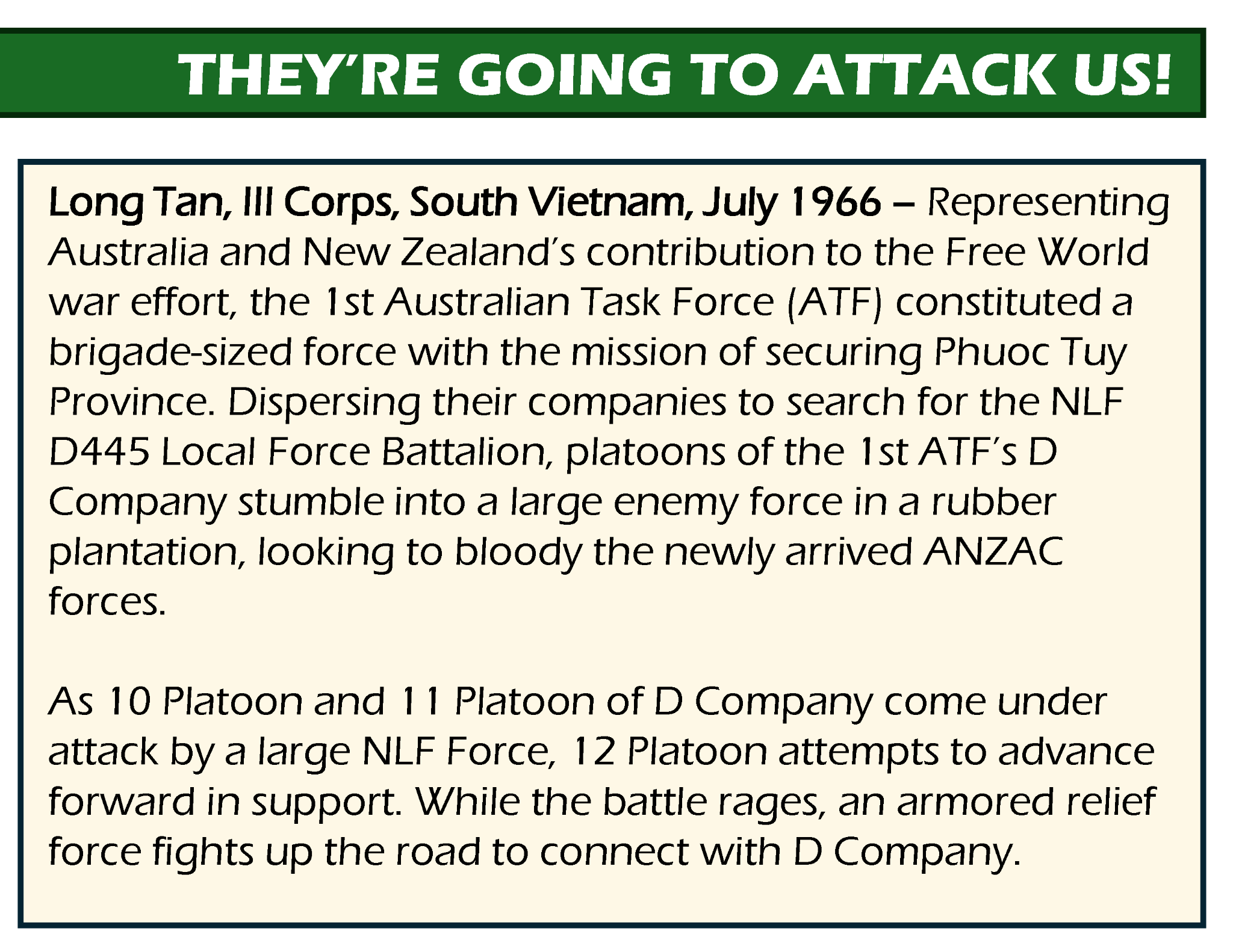
Excerpt from playtest Scenario Card for “They’re Going to Attack Us” featuring ANZAC forces
The scenario is one of the largest in the base game, with a full ANZAC company being ambushed by an NLF Main Force company supported by a detachment of local forces! It features a number of Scenario Special Rules to reflect unique aspects of the engagement, including the spread out deployment of ANZAC forces at the battle’s start, the heavy monsoon rains, and the arrival of the relief force. Furthermore, the engagement provides an excellent rubber plantation map for random scenario generation. Many clashes in III Corps occurred in similar rubber plantations in the areas surrounding the capital, Saigon.

Playtest art for Scenario 7’s map that features the Long Tan rubber plantation
Scenario 10: Unpleasant Welcome depicts an NLF assault on Thai forces shortly after their arrival in South Vietnam in December 1967. Once again, NLF forces attempt to overwhelm the Free World Allies, and a large-scale defeat could convince the country to withdraw their forces from South Vietnam (a similar attempt to overwhelm a ROK force is covered by scenario #8). Below is the scenario’s description:
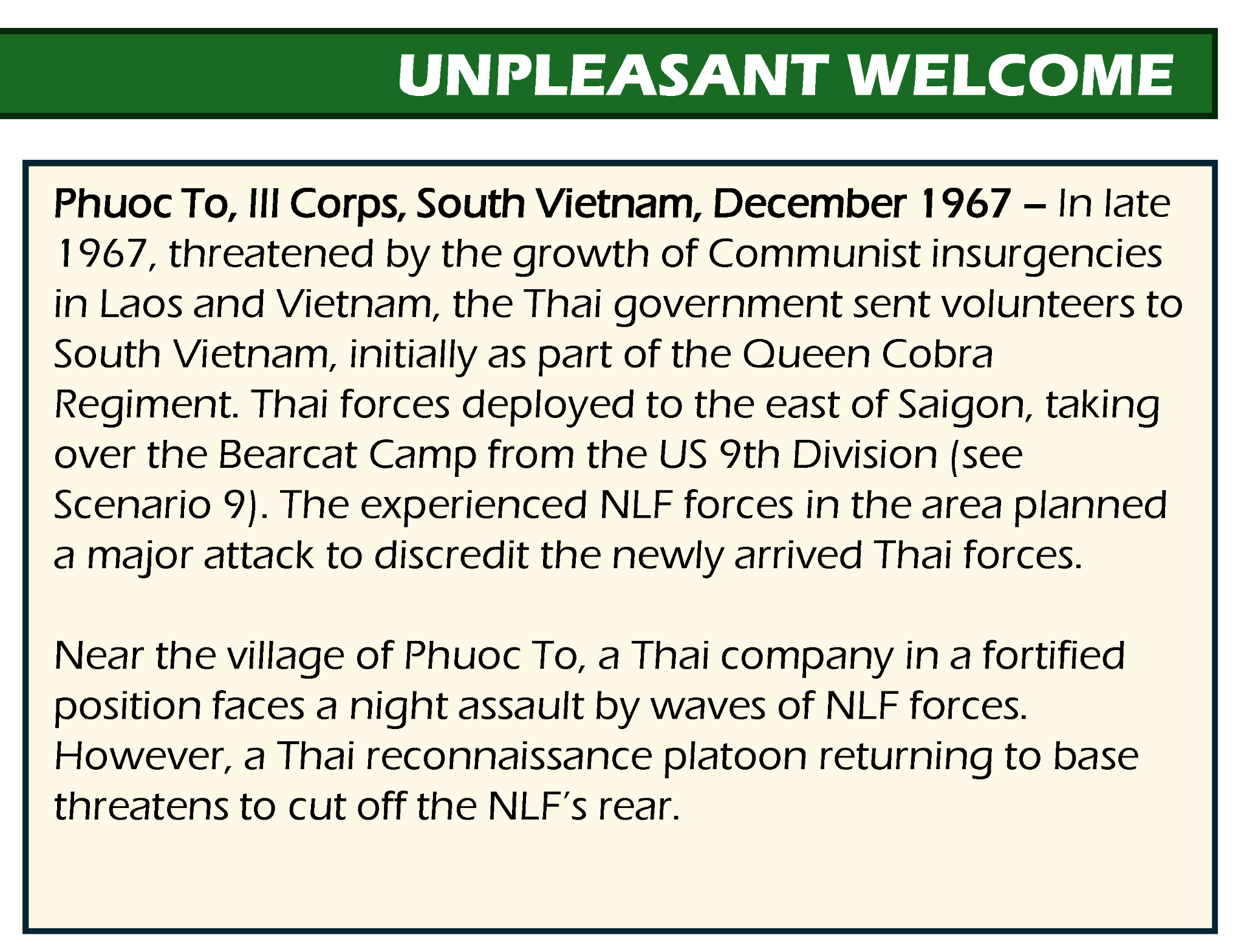
Excerpt from playtest Scenario Card for “Unpleasant Welcome” featuring Thai forces
However, unlike Long Tan, the NLF attack at Phuoc To occurred at night, a common tactic to mitigate the Free World Forces’ advantage in firepower. Borrowing from Combat Commander: Pacific, this scenario uses Night rules that hinders movement and visibility, and restricts each faction’s Discard Limit to 2 (conveniently matching the NLF’s normal limit). The NLF can use the Creep Order mentioned above more effectively at night, allowing them to stealthily approach Thai positions. However, a Scenario Special Rule gives the Thai forces access to an AC-47 “Spooky” Gunship, providing illumination and fire support.
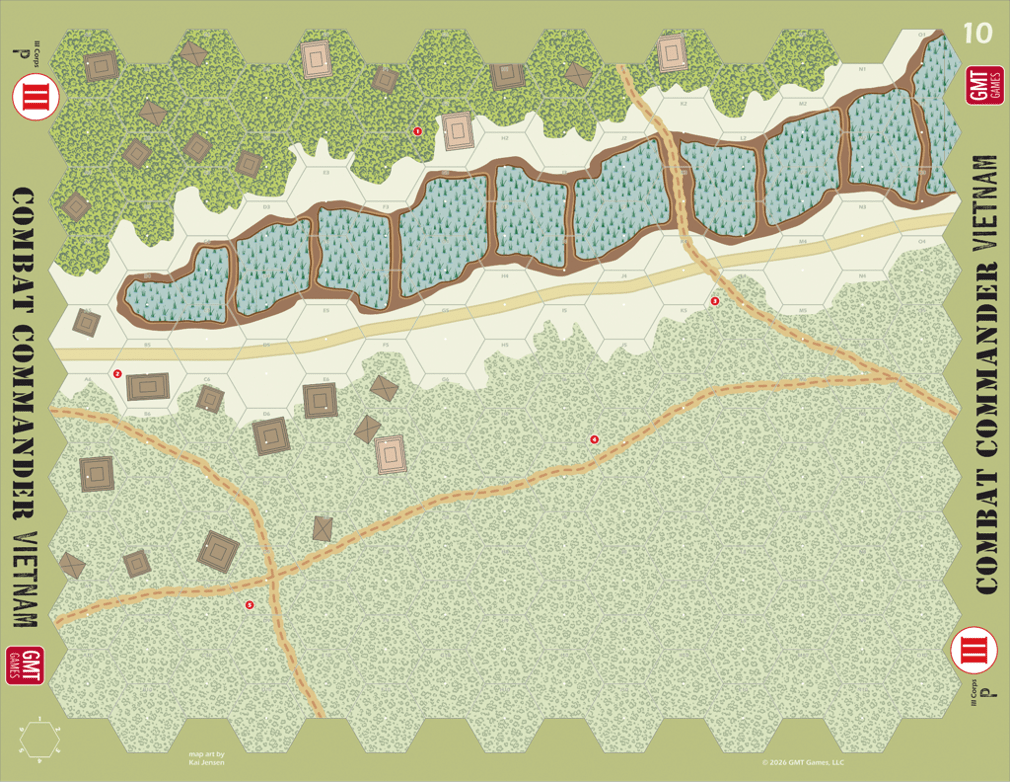
Playtest art for Scenario 10’s map that features the hamlet of Phuoc To
FWA Campaigns
In addition to the normal engagements covered by historical scenarios and the random scenario generator, Combat Commander: Vietnam also has a new Campaign system. Players may explore historical month-long campaigns or generate their own with a separate random campaign generator (RCG). The Free World Allies operate in two of the eight included historical campaigns, Operation Oh Jac Kyo (March 1967) with ROK forces and Operation Ivanhoe (September 1971) with the ANZACs. In this article, we’ll preview the former, which features a ROK battalion protecting government outposts in the lowlands of Phu Yen province from an NVA battalion descending from the highlands.

Excerpt from playtest Campaign Card for “Operation Oh Jac Kyo” featuring ROK forces
Each Campaign (whether historical or randomly generated) features weekly events modeled on the region and forces involved. For instance, Operation Oh Jac Kyo would require players to combine the Campaign events related to the Free World Allies, North Vietnamese, and II Corps together into a shared deck. Campaign events and special rules allow players to experience organizational aspects of each faction that occur at too high of a scale for inclusion into standard engagements (see the last InsideGMT article for a discussion of scale). For instance, ROK forces gained a reputation for brutality toward civilian communities suspected of sympathizing with the NLF.

Prototype copies of FWA Campaign Events
Related to the Deck Shifts mentioned above, the Campaign events also change to match the shift. In the case of the Free World Allies, two events are replaced with ANZAC related alternatives, such as the “Minefield” card above. The Minefield event references the large and controversial minefield constructed by the 1st ATF Brigade. In addition to failing to stop NLF infiltration, the insurgents managed to repurpose many of the mines, plaguing ANZAC patrols in Phuoc Tuy province.
Conclusion
The wars in Vietnam, Laos, and Cambodia featured a wide range of combatants, including many whose contribution to the wars has been overshadowed by American-centric accounts (don’t worry, we’ll have plenty of US scenarios too!). Collectively, Free World Allies suffered 6,000 killed in action in South Vietnam. Combat Commander: Vietnam strives to depict their involvement by giving them their own dedicated faction, Orders of Battle, and scenarios.
For those looking to learn more about the Free World Allies in Vietnam, the official US account of allied participation can be found free online, Larsen’s Allied Participation in Vietnam (1975): https://history.army.mil/Publications/Publications-Catalog/Allied-Participation-in-Vietnam/. Readers will not have trouble finding sources on Australian and New Zealand involvement. ANZAC forces have received substantial coverage in official histories, memoirs, scholarly accounts, and movies, particularly surrounding the battle of Long Tan. One example is Greg Lockhart’s book, The Minefield: An Australian Tragedy in Vietnam (2007), that inspired the Campaign event depicted above.
Luckily, for Thai forces, Richard Ruth’s In Buddha’s Company: Thai Soldiers in the Vietnam War (2010) provides a nice English overview. Finding sources on ROK forces during the Vietnam War is trickier. A fictional account based on a veteran’s experiences, called White Badge, by Ahn Junghyo is available in English. The account was even made into a movie in South Korea in 1992. Hosub Shim, who wrote a more comprehensive dissertation on the ROK experience, recently published an article in the April 2025 issue of Journal of Military History, which is more accessible and affordable than most academic journals: https://www.smh-hq.org/jmh/jmhvols/892.html.
The next InsideGMT article in our Combat Commander: Vietnam series will feature a note from our counter artist, who will explain the process of how the many different military forces, such as the three discussed here, are being drawn to match the classic CC style.