
Star Wars: Super Teams Review – So Apparently the Death Star Can Race Now
Disclaimer: Star Wars: Super Teams was provided for free by VR Distribution, although the writing and opinions of this article are my own.
Christmas season is upon us once again, and along with the eggnog and candy canes comes the inevitable run of family get-togethers. It’s the time of year when the big, complicated board games get put on pause, and you reach for something fun and approachable that just about anyone can pick up and play.
Arriving right on cue for the holidays, designer Max Gerchambeau brings us a new offering that blends fast-paced racing, a dash of teamwork, and, best of all, Star Wars. So if you’ve ever wanted to pit the Millennium Falcon against the Death Star in a race across the galaxy, this might just be the game you’re looking for.

How to play
In Star Wars: Super Teams, you start by choosing one of four coloured teams, each represented by a matching pair of ship miniatures. Among the options you’ll find X-Wings, TIE Fighters, and even Imperial Star Destroyers. Pick your favourites and head to the starting line, where you’ll play cards to move these ships across the board, dodging asteroids, hunting for hyperspace pockets, and racing to be the first team to reach the final planet.
That would be the whole story if the game were called Star Wars: Super. But the “Teams” on the end brings everything into a new dimension. This is a team game. With four players, you split into two teams, and to win you must get all four of your team’s ships to the final planet. In a two-player game, each player controls four ships instead of two, turning it into a tense head-to-head race across the galaxy.
Once teams are decided and all ships are placed on the starting space, shuffle the deck and deal everyone a hand of cards. Each card shows a team colour and a number. The colour tells you which pair of ships can move, while the number shows how far they travel.
Here’s where Star Wars: Super Teams gets a little cheeky. The deck contains cards for every team, not just your own. That means your hand will include cards for your teammate’s ships and your opponents’ ships as well, turning what could have been a straightforward race into a game of timing, interference, and just a bit of mischief.
On your turn, you play one card and move the corresponding ships. And while you’ll usually want to help your own team along, you must play every card in your hand before it refreshes, even if that means giving your opponents a helpful shove at exactly the wrong time.
Beyond the cards, the board features four special types of spaces:
- Asteroid Fields reduce any movement from that space to just one.
- Hyperspace Spaces double the movement of a card when a ship leaves that space.
- The Maw is a series of connected spaces that must be cleared in a single move, or your ship gets dragged back to the start of the Maw.
- Item Spaces work exactly how you hope they do. Think Mario Kart question mark blocks, but in spaaaaaaaaace.
Item Spaces are well worth chasing. They grant special cards that let you avoid negative spaces, boost your speed, or otherwise mess with the race. My personal favourite is the Grappling Beam, which allows you to latch onto a ship passing your space and hitch a ride along with them.
Once a pair of ships reaches the final planet, their movement cards become wild for everyone to use. The first team to land all four of their ships on the planet wins the race. And, more importantly, eternal bragging rights in a galaxy not so far away.

So… How does the Death Star even race?
Putting this game in front of my fellow Star Wars nerds was a bit of a roller coaster. The theme, of course, drew them in like space bees to honey (Apiary, anyone?), but the moment I explained it was a racing game involving both the Death Star and the Millennium Falcon, the confusion set in. They immediately started asking how a race between those two would even be close. One of them famously did the Kessel Run in twelve parsecs. And could the Death Star even reach hyperspace? A quick Google said yes, but that only raised more questions.
Unable to answer their questions, I did the only sensible thing and threw the rest of the miniatures at them like pocket sand. That bought me just enough time to explain the rules and get the game underway.
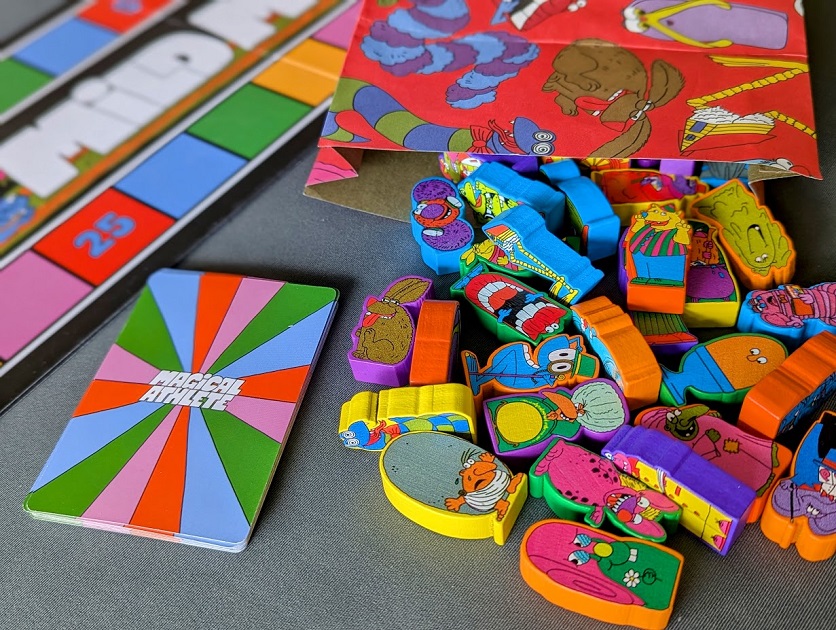
Racing board games are almost always a blast. There’s something wonderfully visceral about them, where every move has immediate consequences and you’re constantly measuring how far ahead, or behind, you are. Star Wars: Super Teams is no exception. While it doesn’t quite hit the same highs as some recent racing games I’ve reviewed (like Magical Athlete), it does a much better job of appealing to players who might bounce off that game’s very 80s board game aesthetic.
But Super Teams is more than a run-of-the-mill racer. Being dealt hands filled with cards that move both your ships and your opponents’ creates a steady stream of interesting, low-stakes decisions.
You’re not really deciding what to play, because you have to play all of your cards anyway. Instead, you’re constantly thinking about when to play them. That opportunistic timing is where the fun of Star Wars: Super Teams really lives. You’re always waiting, watching, and wondering if now is the perfect moment to pull the trigger.
In a perfect world, you’d wait until an opponent drifts into an asteroid field before slamming down their six-movement card. Or, just as they land on a hyperspace space, you “helpfully” play their one-movement card instead. In reality, though, those are best-case scenarios. More often than not, you’re choosing between bad and worse when it comes to playing your opponents’ cards.
While you’re looking for chances to sabotage the other team, you’re also trying to maximise your own movement. That means constantly taking in the board state, weighing your options, and deciding which card gives you the best overall outcome.
None of these choices are especially difficult, but they’re consistently satisfying. And with each team juggling two ships at all times, you’re rarely short on ways to either surge ahead or throw a well-timed wrench into someone else’s plans.

It’s a trap… Winning that is
As much as I enjoyed Star Wars: Super Teams, I was left completely flabbergasted when my teammate landed on the final planet and finished their race. Suddenly, their coloured cards became wild, allowing my opponents to use them to catapult themselves forward from well behind.
It led to a wild, exciting come-from-behind victory for the other team. But I couldn’t help feeling a little cheated by the outcome. We’d worked together beautifully to get my partner out in front, only for that success to be turned against us by a single rule. It felt like someone poked a lightsaber through my gut. Okay, maybe not quite that dramatic, but you get the idea.
This wasn’t the only moment that had me questioning the game’s balance. In almost every play, it took a deck and a half to get everyone from start to finish. Since the card distribution is evenly split between each colour, that extra half-deck often felt like a major factor in deciding the outcome, rather than the decisions made earlier in the race.
So no, this isn’t the most tightly tuned racing game I’ve played. But as a low-stakes, family-friendly experience, it doesn’t feel out of place. Unless, of course, you’re the kind of person who overanalyses card distribution and then writes a review about it.
Where Super Teams really earns back some goodwill is in its one-time-use item cards, which consistently feel great to play. The standout is the Grappling Beam, especially when it combos with a ship blasting through hyperspace to suddenly sling your team into contention. Because these cards appear at different times, every race felt dynamic and back-and-forth, with teams surging ahead or clawing their way back into the mix.
As a result, all of our races stayed close, and it always felt like you were in it until the very end, even with the balance quirks mentioned above.
Overall, if you’re looking to explore the galaxy of modern board games, or you need something to get non-gamers involved, Star Wars: Super Teams is a great fit. The familiar theme makes it an easy sell, and the rules are approachable without being boring. Even if I can’t help but feel it was a missed opportunity not to make this a pod racing game.
Star Wars: Super Teams
Players: 2-4
Playing Time: 30 min
Designer: Max Gerchambeau
Publisher: Zygomatic
Star Wars: Super Teams is a fast, friendly racer that shines in mixed groups. It’s not perfectly balanced, but the teamwork, timing, and playful interference kept every race engaging.
Pros
- Easy to teach and welcoming for non-gamers
- Team play adds constant interaction and table talk
- Playing opponents’ cards creates fun timing dilemmas
- Item cards, especially the Grappling Beam, feel great to use
Cons
- Endgame rule can flip the race in a way that feels rough
- Card distribution can matter more than earlier decisions
- Not the tightest racing design if you like precision
- Should have been pod racing
This site keeps going thanks to your support. When buying through links on this post, I may earn a small commission—without any extra cost to you. Full disclosure here.
More ways to see who’s fastest!


How does it compare?
See where this game falls in our board game rankings.