

Chalice of Poison: The Story and Setting Behind the Game
How this all started
The story of Chalice of Poison begins in early 2022, with a confluence of seemingly unrelated events. I had recently won the first-ever Zenobia Award for my first board game design (Tyranny of Blood) and realized that I needed a break from that project. I started looking for some other game projects I could use to improve my game design skills before returning to finish such a complex game.

Meanwhile, 5,000 miles east, Russia’s President Vladimir Putin decided to invade Ukraine, immediately revealing that he had drastically underestimated that country’s resolve to fight back, and similarly overestimated his own country’s military effectiveness. My colleague Kevin Woods, with whom I shared an interest in modern Middle Eastern history, started drawing some parallels with Saddam Hussein’s 1980 invasion of Iran. A similar mix of poor planning and hubristic expectations, based on a military command structure that prioritized personal loyalty and coup-proofing over competence, had similarly turned a war that was supposed to last a few weeks into a multi-year quagmire.

Kevin had an idea to co-write an article comparing the two, based on Dr. Caitlin Talmadge’s research on pathologies related to militaries from authoritarian regimes. As I helped research the article, I found the framework that Talmadge delineated in her book The Dictator’s Army: Battlefield Effectiveness in Authoritarian Regimes utterly fascinating. She clearly defines the trade-offs that make so-called “strongman” regimes ironically weak at fighting foreign adversaries, and how these regimes made (or didn’t make) the required reforms needed to win the Iran-Iraq War and the Vietnam War. My brain began racing, and I had a great idea to make a game on the Iran-Iraq War that employed the framework in a playable way.


That idea was NOT Chalice of Poison. It was for another game called Pillars of Fire, which would model the internal and external struggles of Iran, Iraq, and Saudi Arabia from 1979 – 1991, along political, social, security, and economic dimensions, and tell the story of the modern Middle East through the lens of this competition and conflict.
Around that time, some colleagues and I decided to start a microgame project, challenging our co-workers to design a quick, simple board game that fits on two sheets of paper or less. I decided to use this as an opportunity to try building a simple military module for Pillars of Fire. I failed at making it quick, simple, or a module for a larger game, but I (barely) succeeded in fitting it on two sheets of paper!

This game would become Chalice of Poison. I spent the next four years building it into a full game and playtesting it, until the game was ready to pitch to GMT! And that brings us to the P500 and where we are today.
Why this historical setting?
The Iran-Iraq War has been the subject of surprisingly few games, especially given how historically important the topic is, in terms of:
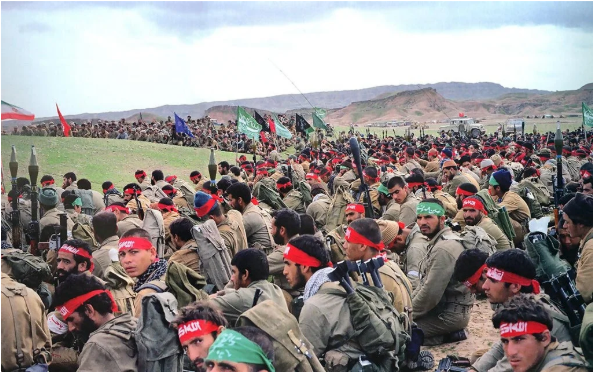
- Size. The war was the longest conventional conflict in the 20th century and the deadliest since World War II, and it involved more than two million soldiers.

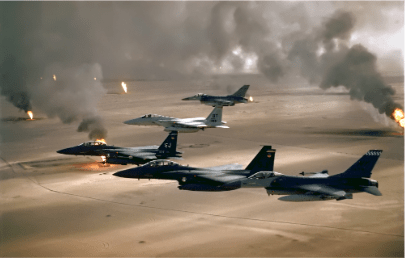
- International scope. Despite its name, the war was not just a conflict between two countries, but one that involved the (cynical) support of most major powers, who typically supported both countries to varying degrees.
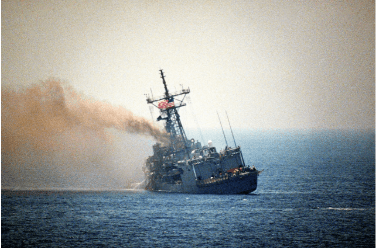
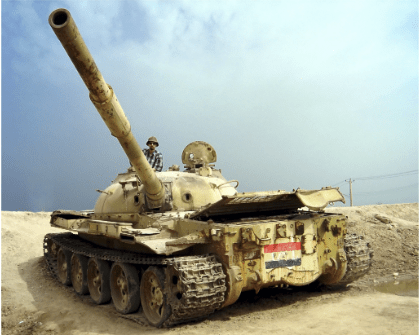

- Illustrative power. This war clearly illustrates the major shortcomings of authoritarian regimes at war. These lessons grow more relevant as countries around the world become more authoritarian, structuring their militaries around fervor and nepotism, rather than competence and professionalism.

- Important historical legacy. In many ways, the Iran-Iraq War delivered today’s Middle East and its relations outside the region. On the Iranian side, the war consolidated the Islamic Republic’s power over the country, built up the Islamic Revolutionary Guard Corps as a formidable military force, encouraged its use of regional proxies to gain power, bolstered the concept of martyrdom, and pushed Tehran to distrust the international community. On the Iraqi side, crippling debts from the war would lead Saddam Hussein to invade Kuwait a few years later, precipitating two US-led wars against Iraq that would change its government and reduce its regional standing. If Saddam had not invaded Iran in 1980, or if the war had gone differently, the region (and the world) would look very different today.
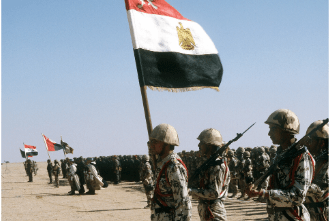
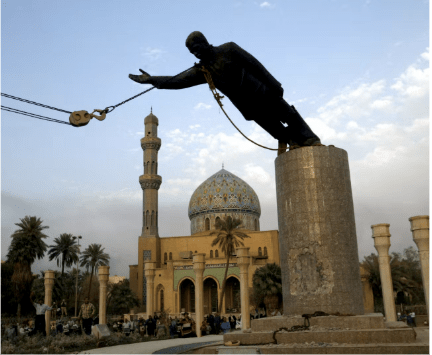
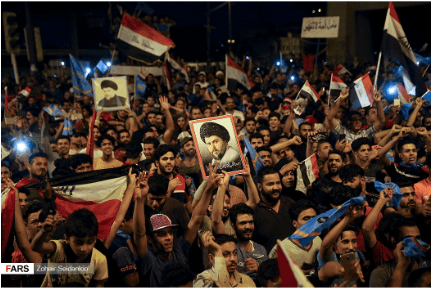
The war is also compelling from a ludic perspective. A number of factors make it interesting for gameplay:
- Tension and desperation. Both countries felt at various times that they were at risk of losing the war, and at other times that they were surely going to win.This high level of tension and desperation makes for engaging gameplay, where players are frequently close to both certain victory and certain defeat.
- Learning and experimentation. Both countries were unprepared for conflict at this size and scale. This lack of preparation meant that both countries needed to learn how to fight on the fly, experimenting to find the right balance of forces and strategy that could eke out a victory. This experimentation requires players to carefully consider strategy and tactics, and increases replay value for the game.
- Balance. The Iran-Iraq War lasted so long in part because both sides were well balanced. This balance came in through international intervention, which cynically supported both sides at different times. When it seemed that one side would win, the international community would balance its support by selling arms to the other side. This balance makes for slightly asymmetric but fair gameplay.
Given its historical importance and ludic interest, why is the Iran-Iraq War so undergamed, compared to most other major 20th century conflicts? I have some theories:
- Minimal territorial shifts. This war had extremely limited maneuver; instead, the fronts bogged down quickly and turned into trench warfare. Despite both countries being large, the amount of territory that exchanged hands was tiny; Iraq captured an area smaller than Massachusetts or Albania, and then lost it. A typical strategic wargame centered around a hex-and-counter map would have few changes from turn to turn, so a game about this conflict would likely require a point-to-point map and a focus away from the battlefield.
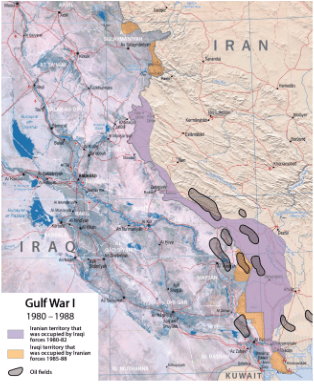
- Failure and miscalculation. A major theme of the Iran-Iraq War was failure: both sides underestimated the complexities and difficulties of the conflict, which led to large-scale operations that achieved nothing but bloodshed. In a traditional wargame, with a focus on units and engagements, such failure might be repetitive and unsatisfying. Conversely, if focusing on higher-level decisions and making the most of limited capacity, failure can create tension and suspense, and frustration can be a feature, not a bug.
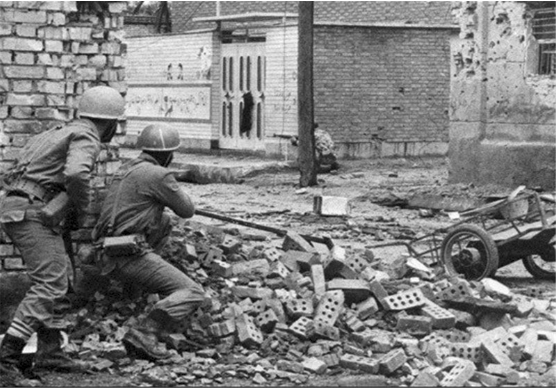
- Little direct Western involvement. The major markets for wargames are still North America and Europe, which tend to prefer simulating conflicts that included forces from countries in those regions. The direct combatants in this war were Iran and Iraq, which are smaller markets for board games today. The Iran-Iraq War had some small-scale direct involvement and considerable indirect involvement from the West, but probably not enough to garner as much interest as other conflicts.
Thank you for reading this article on Chalice of Poison! Stay tuned for the next article, about war mechanics and victory.
Previous Article: Chalice of Poison: Introduction to a New Game System
