
It’s all about the Cards: Exploring the Card deck of Ancient Civilizations of East Asia Part IV: Weapons and Warriors Cards for Competition
As with its predecessors Ancient Civilizations of the Inner Sea GMT Games – Ancient Civilizations of the Inner Sea and Ancient Civilizations of the Middle East GMT Games – Ancient Civilizations of the Middle East, or ASIS and ACME respectively, the cards quite literally “rule” the game. The game’s 110 Karma cards come in eight “flavors” (or types). The single largest block of cards by type is the one which a player may use to influence Competition. Although “Competition” is defined in the game system as being any kind of conflict or rivalry over an area – economic, social, political, religious or military, but let’s face it: Competition Cards are WAR cards.
In the previous article we looked at “Six for Sieges and Sudden Strikes in Competition”: It’s all about the Cards: Exploring the Card deck of Ancient Civilizations of East Asia Part III: Six for Sieges and “Sudden Strike” Competition Cards – InsideGMT. In this, the fourth part of the series regarding Competition Cards, we look at cards which have a common theme: weapons and the warriors who made use of them. These are cards which give a civilization a bonus in Competition – either by adding disks to their side or by removing them from their foe.
What’s good about Competition cards is that after all civilizations place their Growth Phase disks upon the map, the player(s) know which Land and/or Sea areas will have Competitions to resolve. That allows a player with one or more Competition cards in hand to plan accordingly.
Of course, additional Competitions can be initiated through Card Phase play… particularly those five nasty Barbarian Invasion Must Play cards. For ease of reference, this link will bring you to the InsideGMT article describing them: It’s all about the Cards: Exploring the Karma Card Deck of Ancient Civilizations of East Asia Part I: The Seven Deadly Events – InsideGMT.
Card #75: Warrior King

The rise or fall of a civilization can often be traced to the strategic brilliance of a martial lord. Such warrior kings have appeared throughout history all around the world, including East Asia. The Liu Song Dynasty, for example, was named after the great general who founded that kingdom. This card represents that “Great Person” effect by giving the civilization which plays this card two extra disks in one Competition and one more in a Competition in an adjacent area.
It should be noted this card not only provides its bonus disks on Land, but this Warrior King is also capable of nautically influencing Sea Area Competition. The choice of Land and/or Sea is that of the card player, which is quite a nice option to have.

Card #76: Legendary Swordsman
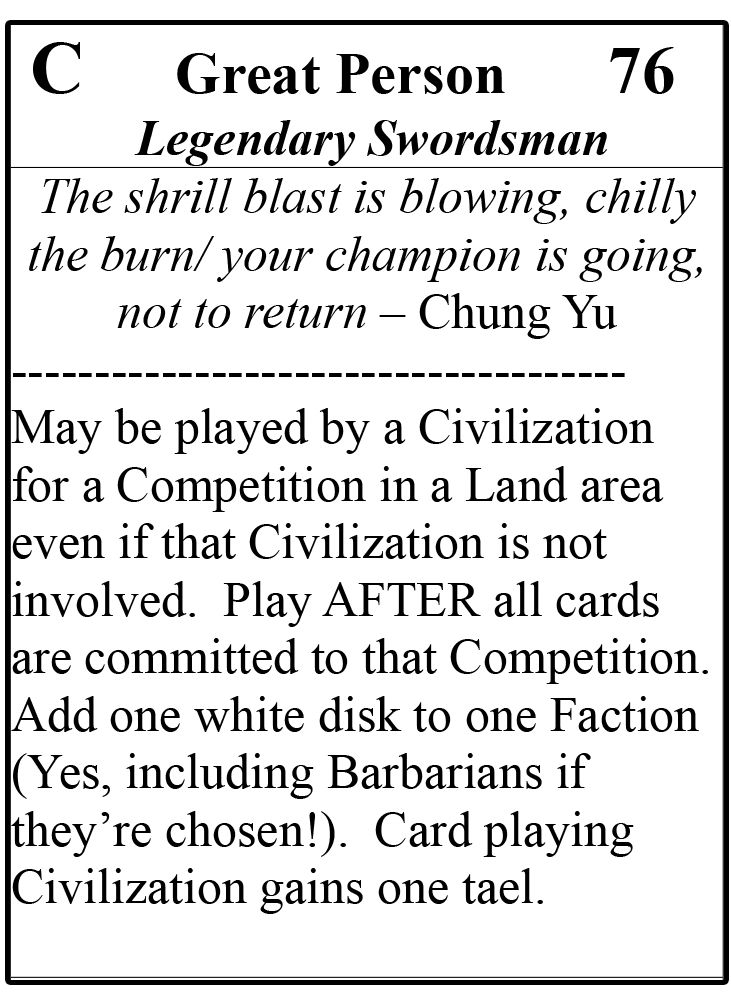
History is replete with stories of great heroes whose individual courage and prowess turned the tide of battle. These champions who inspire their soldiers appear in many of the tales of ancient China (and in the movies that have since featured such mighty warriors – notably Crouching Tiger, Hidden Dragon, The Swordsman, the One-Armed Swordsman and even The Blind Swordsman).
As such heroes are often wandering mercenaries, this card is unique in more than one way: it can be played not only in a Land area where a player’s civilization is involved, but even in one where none of its disks are present! This not only adds a white (temporary) disk to the Competition but also gains the player a tael (money), and finally, it is played AFTER all other Cards have been revealed for a particular Competition. That last benefit is perhaps the most important, as it is essentially a surprise attack.
There are times a single disk can influence who wins a Competition and that makes this card a potential tool of diplomacy! Ah, dear readers, think of the fun about the ACEA gaming table when The Legendary Swordsman may appear!
Card #80: Iron Weapons

The first two Epochs of an Ancient Civilizations series game take place during the Bronze Age. The combination of copper and tin to create bronze around 3000 BC was a game changer (pun intended) not only in the advancement of science and technology, but also warfare. Weapons forged from bronze, however, quite literally were shattered by those made of iron, which was introduced about 1100 BC in the Middle and Near East by the Hittites and Assyrians… two of the more powerful civilizations of GMT’s Ancient Civilizations of the Middle East game.
The Iron Age, as it became known, however, came later to East Asia. The various Chinese Dynasties, often conservative in nature, stubbornly clung to bronze and were slow to accept iron, and as a result the Iron Age came to East Asia several hundred years later.
But when it did, it came with devastating effect, as this card emulates. The civilization that plays this card gains a massive advantage in ALL its Competitions across the map board that turn, and one so devastating that their foes cannot buy off disk losses with cards from hand or taels (money). This card can, of course, appear again and again after the deck is reshuffled. Each time it does marks another advance in weapons development.
Therefore, this card is a fine opportunity for the possessor as it provides an unparalleled ability to achieve victories in as many areas a hyper-aggressive player can manage to initiate Competitions for. We know of players such as this, do we not?

Card #81: Chariots
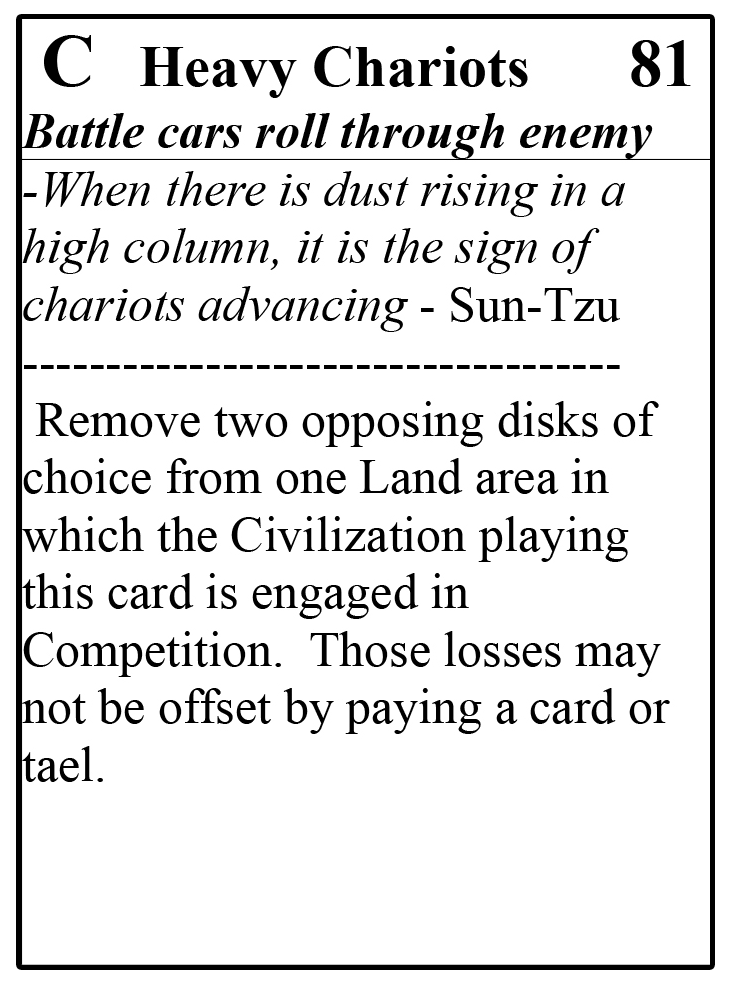
Chariots were both mobile firing platforms for missile weapons as well as a means of swiftly getting troops to, or from, battle. They dominated the early battlefields of East Asia just as they did the Middle East. Chinese kingdoms vied with one another to raise larger and larger numbers of these highly advanced mobile weapons systems. A king’s prestige and power was measured in how many of these fighting vehicles he could put on the field.
As with iron, chariot technology came to China several hundred years after it appeared in the Middle East, and as with bronze, was clung to far longer as well. The Qin and Han were both still using chariots in the third century BC, four hundred years after the civilizations of the Middle East had replaced them with various forms of battle cavalry.
This card represents the shock and surprise of a civilization introducing more advanced and more numerous chariots onto the battlefield. As such, the foe not only loses two disks, but cannot buy off these disk losses with either cards from hand or tael.

Card #85: Armored Warships
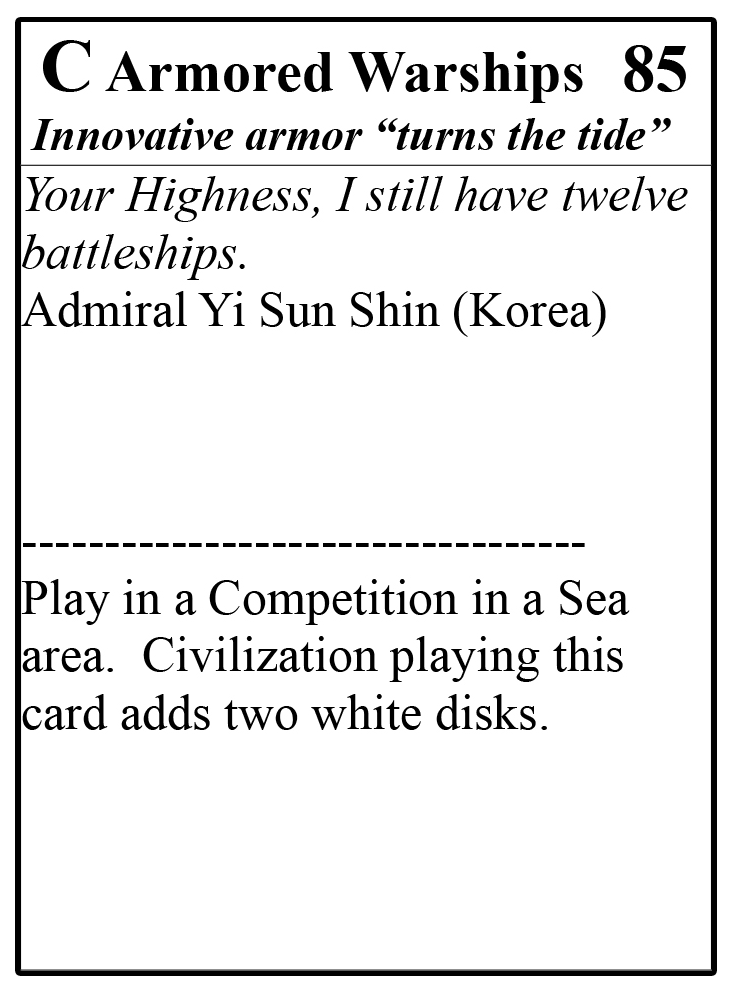
Throughout history the most advanced (and most expensive) weapons systems have been warships. Innovation often leads to victory. The armored warships of Korea in particular proved decisive in defending the peninsula from invasion. Thus, the civilization which plays this card gains not just one but two temporary disks in one Competition at sea.
No Sea Competition for this card to influence? Do not despair, Armored Warships is still useful as it can offset a disk loss under most circumstances or could be used as a Resource for a civilization acquiring a new Stronghold, Terrace/Improved Irrigation System, Workshop, or its Cultural Development Track disk’s advancement (and a Competition card is worth two Resources to purchase an advance on the Military-Political Track.
To learn more of ACEA’s Cultural Development Display, which is uniquely inherent to the series, see: An Overview of Ancient Civilizations of East Asia’s Cultural Development Tracks – InsideGMT

Card #95: Warrior Monks
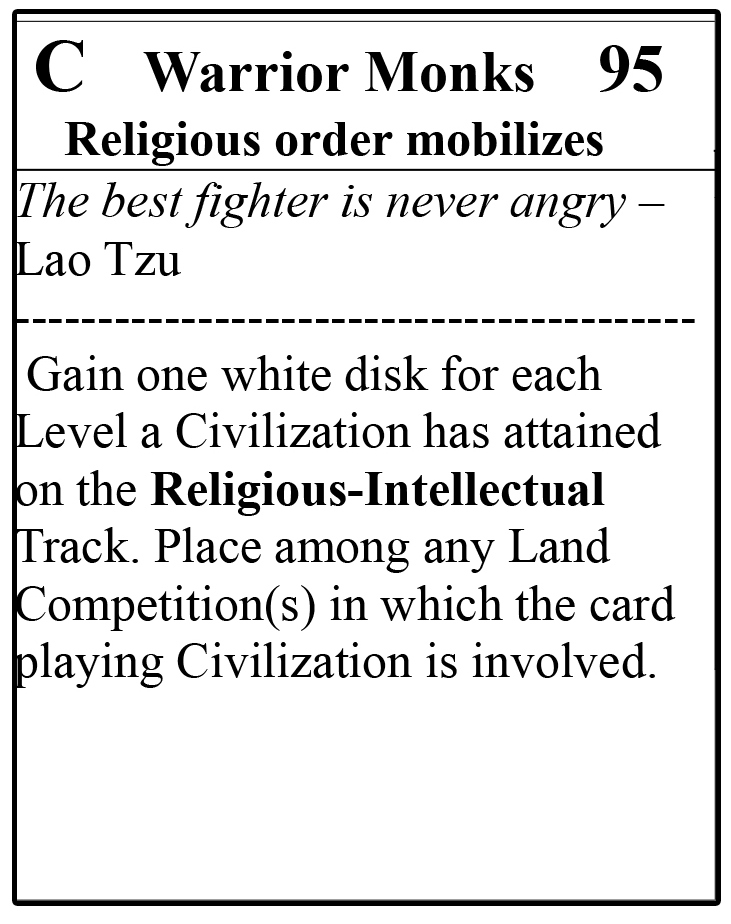
Not all religious orders are peaceful. Just as Christendom had its martial orders of Templars, Hospitallers and Teutonic Knights, so too did East Asia have holy men who were known as much for their skill with arms as they were for their devotion. These include not only the Sohei and Yamabushi martial orders of Japan, but also the famed Shaolin warrior monks of ancient China.
Not just any civilization, however, can make use of these holy warriors. To play this card for its white disk placement effect (potentially as many as four disks!), a civilization needs to have advanced on the Cultural Development Display’s Religious-Intellectual Track. The more advanced its disk is, the more temporary disks it gets to place and the more areas into which it has the opportunity to place them.
Next up is the final InsideGMT segment for Ancient Civilizations of East Asia’s Competition Cards: Part V: Force Multipliers and Tactics Cards. To learn more of this upcoming GMT P-500 listed game, see: Ancient Civilizations of East Asia. Thank you for your interest and patronage!