

Humans Versus the French Bot: An After-Action Report of a Prospective Official Variation for Playing Congress of Vienna (Part 3 of 4)
By Justin Penwith
Introduction by Assistant Designer & Editor, Fred Schachter: We now proceed to the next turn of this interesting Congress of Vienna game replay using an official and simple variant to afford the French Bot a better chance for victory (described below). The intent is to make the game more challenging, interesting, and fun for a contest’s human participants. It is now what is a regular game’s final Turn 10, March – April, 1814. To learn what transpired during the preceding Turn 9, January – February 1814, see: Humans Versus the French Bot: An After-Action Report of a Prospective Official Variation for Playing Congress of Vienna (Part 2 of 4) – InsideGMT.
With that, Justin continues his narrative, a tale which should not only hopefully entertain readers, but also provide insights regarding “how to” best play the Congress of Vienna game itself. For more regarding CoV, see: GMT Games – Congress of Vienna, 2nd Printing
When examining the board, at the start of this Desperate Times: The France Campaign 1814 (Playbook Section 17.5) scenario’s Turn 3, March – April, 1814, the players felt that perhaps the French Bot needed a “little” help since it was obvious to us France was likely going to lose the game this turn (or that’s what we enthusiastically believed). Prior to drawing the turn’s Initial Situation Card, we discussed how this additional help might be delivered, but with minimal changes to the rules and without adding additional rules, beyond the one key change we agreed to, which was:
Pg. 44, left column, Add red content: “21.1 Initial Phase (Step 1) The Initial Phase [10.0] is modified as follows: “In a game where one or more human opponents play against the French Bot, when resolving an Initial Situation Card during General War, if the French force pool has 8 or more French units, place the French Recruitment Issue on the French Chair.”
This modification is powerful, for it removes a large obstacle to the French Bot, human player manipulation of the French Recruitment Issue. Since the bot is programmed, it cannot further weight decisions or values that are not already established within its process and priority hierarchy. Thus, it cannot “decide” that since its own Recruitment Issue has been won by one of the Allies, that it will, in turn, Negotiate or Debate the Recruitment Issue of either Russia, Austria, or Britain. Meaning, it does not play “tit for tat,” talk smack, or remind its opponents that there can be only one winner. Furthermore, as this is a priority Issue for France, astute Allied players can provoke the Bot to repeatedly burn its cards with mandatory Debates… a nasty program vulnerability, eh?
Consequently, we players were mostly satisfied that the above quoted rule change would solve this otherwise seemingly insurmountable problem.
Yet, as we looked at the board, in our collective opinion, France was “toast” this turn.
As the Initial Situation Card revealed both Blücher and Wellington being added to their respective player’s hands, and with the British Army of Portugal also receiving a +2 DRM for any upcoming battle in Spain, our previous assessment seemed solidly confirmed.
Turn 3 Initial Phase
My Austria (gleefully) gained the bonus card from the first Initial Environment Table die roll, but aside from 3 US Militia being added to the War of 1812 Box, there was no other effect.
Even with –2 DRM Allied modifiers for Fronts A and B, placed through the turn’s Initial Situation Card, Austria and Russia were confident of success, as their combined military units’ strength was 17 to 5, in favor of the Coalition… a considerable disparity!
Turn 3 Diplomacy Phase
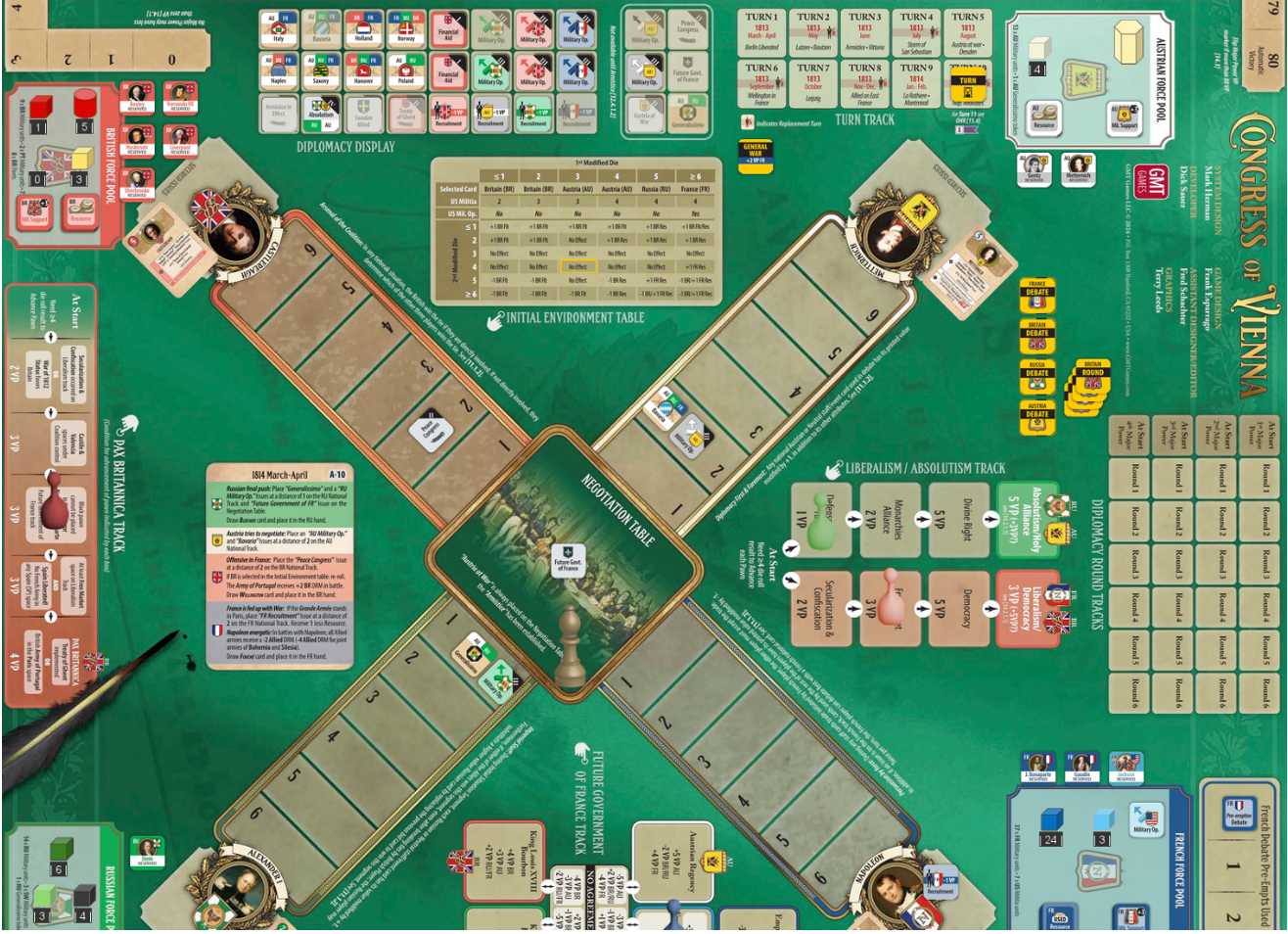
The Allies intended to again press beleaguered France on all fronts, with Austria more hopeful than before in expecting success on the Italian Front F. The advantages of the human players on all but one front (F!) was palpably obvious to us.
Our only question was whether Russia could secure enough VPs to gain the game victory or would Great Britain coast to an easy win?
Great Britain initially won the wager, breaking a tie with Russia in her favor (by playing Trauttsmandorff!). Both Austria and Russia wagered valuable French Military cards (Eugene and Soult) to avoid unduly benefiting France through a forced trade. However, rather than let the British player win, the Russian player decided to use his “Imperial Staff” National Advantage and played von Hardenberg instead, to win the wager for the turn. Russia chose its Recruitment Issue and placed it on its Track’s two space.
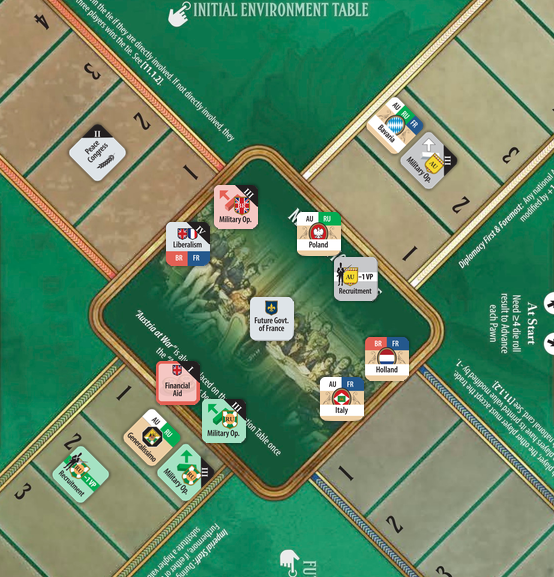
Figure 2: The board’s Diplomacy Section After the Major Powers selected Issues: With but a single BR Military Operation, “on all fronts” does not have the same meaning for Great Britain as the rest of the players, apparently. Note use of the “Imperial Staff” National Advantage allowing Russia to win the wager and place its Recruitment Issue on Track space 2.
The selection of Issues, by the Allies, were intended to put an end to the threat of Napoleonic France, once and for all. Alas, Great Britain appeared to have other concerns more closely related to it becoming the dominant power in Europe, as their choice of the Liberalism Issue, rather than a second Military Operation, would seem to indicate.
Great Britain started off Round 1 of the Diplomacy Phase by solidly showing its so-called commitment to beating France by playing Huskisson for Liberalism. Austria, already miffed by being in last place on the VP Track debated the Issue back to the center of the Table.
As Austria, I had several military cards in hand and wanted to avoid using them for negotiation or debate. Therefore, a series of judicious trades was my intended course of action for most of the Diplomacy Phase.

Figure 3: Russia wins the turn’s Diplomacy Phase for 2VP. The scheming Brits are denied Liberalism by Austria: A good thing since any Liberalism VP would have gone to France as well! Absolutism resides in the Austrian Track’s seat.
The fight over Liberalism/Absolutism went back and forth between Great Britain and Austria, until the latter finally secured that valuable Issue within its Seat (see Fig. #3).
The French Bot very nearly won the Generalissimo Issue during Round 6, but the Tsar was not having it. However, since the Tsar was personally involved in winning this particular Issue, his meddling will force a potentially decisive -2 DRM on upcoming Russian Military Operations for both Fronts A and B.
Smarting over the loss of the Liberalism/Absolutism Issue to Austria, Great Britain decided the three-way tie in Russia’s favor. It is also possible that Austria playing Jackson to deny Great Britain VP from the War of 1812 had something to do with it.
Austria elected to not fund its AU Recruitment Issue, given that its VP situation was already dire, and could be somewhat alleviated by instead financially supporting Bavaria, in return for 1 unit and 1 VP. Further, a successful Absolutism die roll added 2 more VP for both Russia and Austria. “In your face Britain!”, I was ever so tempted to shout.
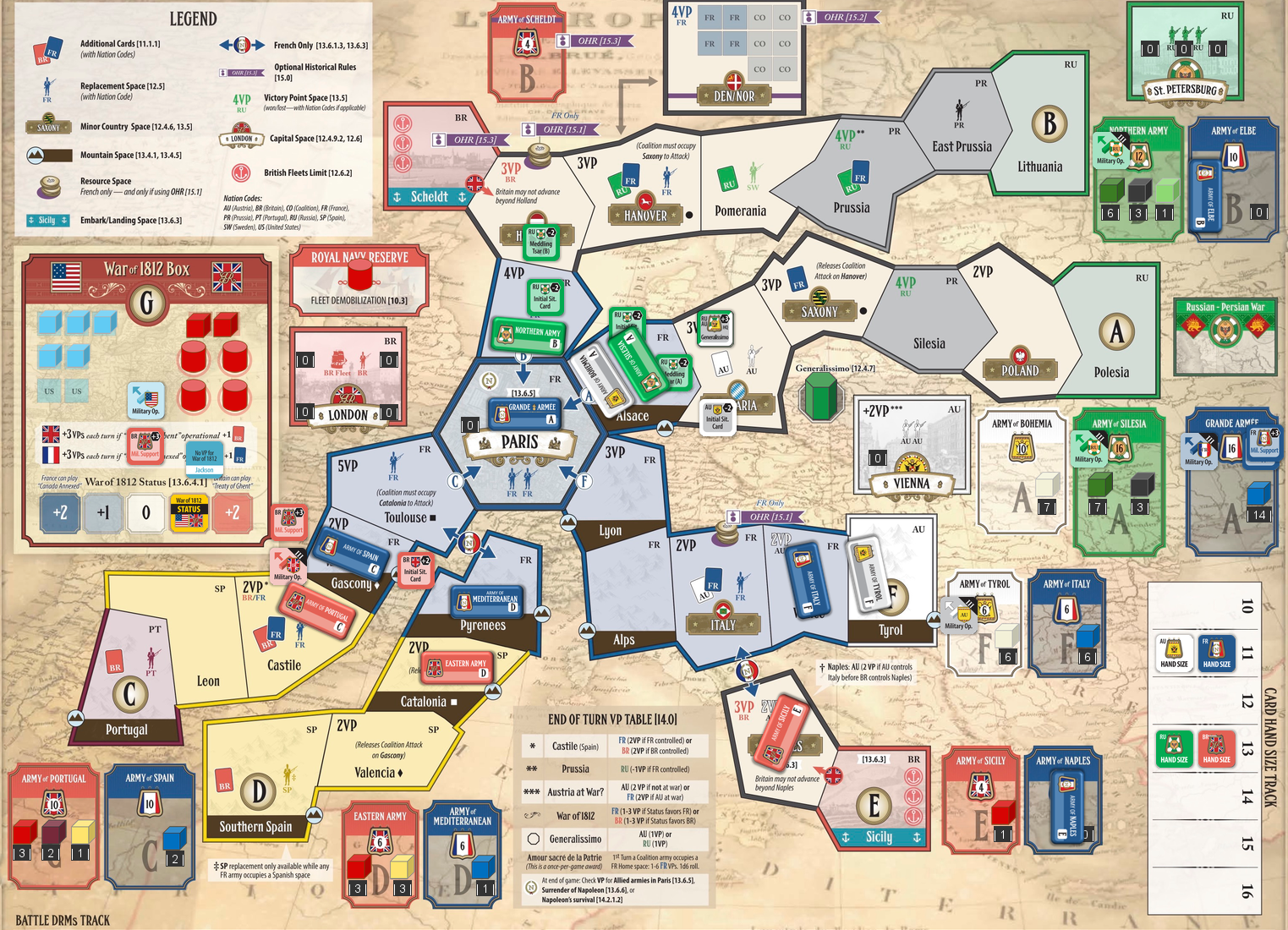
Figure 4: The Upcoming War Turn 10 Phase: Other than Front F, where the full-strength French Army of Italy and Austrian Army of Tyrol face off against each other, the situation does not look good for France. It looks dire indeed… but looks can be deceiving!
Anticipating success, now with the Government Phase complete, the players were eager (in Austria’s case, hopeful) to get on to resolving battles.
With France winning the Future Government of France Issue and paying a Resource for it, Napoleon was once again back on the throne as Emperor. This precipitated France gaining 2VP and each of the Allies, to our collective concern, losing -3VP each.
Turn 3 The War Phase
But that optimism for the War Phase soon turned dour as the French Bot, with reinforcements, FR Recruitment, and Berthier’s Strategic Movement ability brought Napoleon’s Grande Armée up to an impressive and formidable total of 14 French units
Thus began the War Phase. On Front A, the Allies, for their first attack on the Grande Armée in Paris, played Radetzky, Blücher, and von Bülow, along with Battle Card #64. France countered with Napoleon, Berthier, and Oudinot. The Allies rolled a 7 and France an 8. France won by but a single Battle DRM Track pip to inflict 4-unit losses on the Allies.

Figure 5: Napoleon strikes again! The Turn’s first Battle for Paris with the dice dictating a fickle fate blow to Allied ambitions! This French Major Battle victory with Napoleon in command gained them +2VP while inflicting -2VP penalties on each of Russia and Austria.
“Where did we go wrong?” the Russian and Austrian players moaned, as the British player tried not to gloat. It was the Tsar having to intervene in the affairs of mortals, to secure the Generalissimo Issue from the French Bot’s clutches, that resulted in the battle being an Allied defeat rather than a draw. The “Meddling Tsar” rule’s -2DRM, combined with that -4 DRM from the Initial Situation Card (-2DRM for each Allied Army), was enough to cost us the battle. This meant that the Allies’ position on Front B was not as advantaged as they previously believed and that was the next battle to resolve.

Figure 6: The Second Battle of Paris: Napoleon remains his old self once again! The Initial Situation Card’s “Napoleon Energetic” effect with its “Meddling Tsar” -2DRM inflicted upon the Russians along with all the other negative DRM effects, make the difference between draw and defeat.
For Rule 13.6.5, its twelfth bullet-point, allows if Napoleon is available for the War Phase, he can be used for every battle that occurs in Paris. The Allies faced calamity.
The Front B battle did not go at all like the Russian player had planned. Instead of a victory, or at worst, a tie, France won the battle outright. The dice were again decisively unkind, to the point that the “Meddling Tsar’s” -2DRM and Initial Situation Card’s -2DRM made no difference to its outcome.
More than a few balloons burst with that result. The Allies’ after-victory party was cancelled and the guests huddled in their gloom for safety. Uninvited Great Britain unsuccessfully hid the grin spreading across his face. Those two Paris battles collectively gained France +4VP (+2VP each for a Major Battle with Napoleon) while costing Russia -4VP and my own Austria a -2VP. Disaster!
The action now moved to Spain. On Front C, Great Britain looked forward with great anticipation as he played Wellington, Castaños, Morillo, and two battle cards. France countered with Soult, and Suchet, (the French “dynamic duo” for such a Spain battle). France rolled a 10, but Great Britain pulled out a remarkable dice roll of 11 for a second dice roll, after rolling a 5 with the first. Wellington’s ability, to choose the best of two dice rolls, saved the British player from having egg on his face, which further increased his glee to a level of giddiness not usually seen in mature adults.
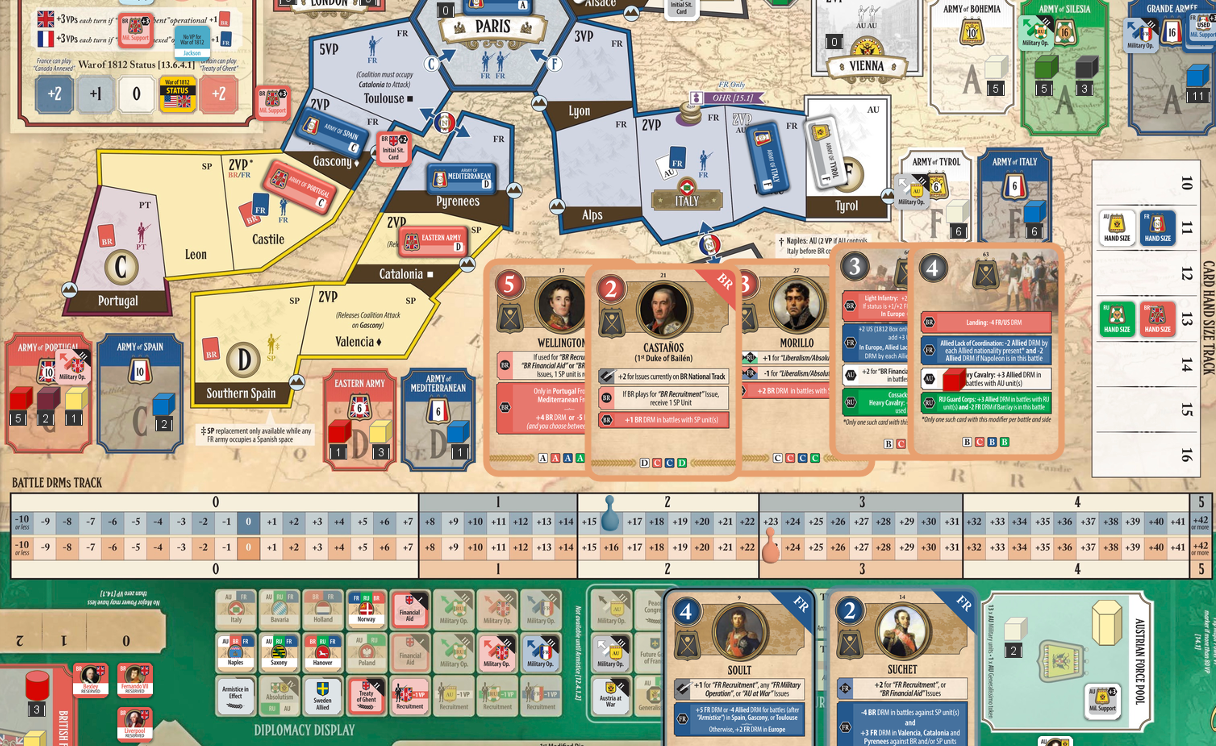
Figure 7: Despite playing five (5!) military cards, without Wellington’s card ability to choose between two dice rolls along with a remarkable roll of eleven, this battle on Front C would have ended in a draw.
This “eked out” victory opened the door to France for Great Britain as its Army of Portugal advanced into Gascony with the French Army of Spain, an empty husk with zero units, was forced into 5VP worth Toulouse. Ah, the future seemed bright for Britain!
On Italian Front F, Austria played Bellegarde, Gyulay, Reuss-Plauen, and von Klenau, but France had both Murat and Marmont to deploy. It seemed close, until the dice rolls, with Austria’s a paltry 5, and France’s 10, ending the battle in yet another French victory for +1VP to France with a -1VP inflicted upon Austria. Again, the Army of Tyrol could not get out of its Track’s starting gate!

Figure 8: Curses! Austria’s cunning plan of Italian Front Track F military conquest is foiled once again! The indicated losses of two Austrian and one French unit have yet to be removed from their respective armies (these losses are reflected in Figure #9).
On Front G, The War of 1812, Great Britain had a slight advantage, even more slightly increased by the play of Tecumseh (who did not survive his “death die roll”). France rolled an 11, but Great Britain rolled a jaw dropping 12 (box cars!) and thus Great Britain scored an important victory to end the War Phase. Its Front G VP marker moved one space right into the +2 BR space.

Figure 9: The end of Scenario Turn 3’s Military Map. Allied victory was not fated to be. France held on by a single Victory Point! I, as Austria, denied Britain victory having played Jackson to prevent that player gaining +2VP for the War of 1812 and a British game victory by a single point! Readers should note the French Bot wisely began this turn’s War Phase with the Paris located Grande Armée having 14 units (see Figure 4), thereby, with but two Russian Military Operation markers directed against Paris from Tracks A and B, it became impossible, even had the Allies won both battles, to inflict sufficient losses to drive the Grande Armée to under four units and forcing Napoleon’s game ending abdication.
Turn 3 Wrap Up, Observations, and on to Turn Four!
Was this a game against a human French opponent, that player would have won the game and achieved victory by a single VP! Therefore, the French Bot, with but that one tweak to the rules, beat three human players in a wildly dramatic (oh those dice rolls!) three-turn scenario.
Aside from the aforementioned cost of playing the Tsar on Generalissimo, which triggered the “Meddling Tsar” rule, which was done out of pure necessity (the battle outcomes could have been even worse otherwise), I do not believe we could have done any better than we did considering the fickle fates of dice rolling luck encountered.
Had Austria (me) chosen to not pay for Bavaria or Absolutism and instead purchased a Military Support marker, the +3 DRM would not have changed the outcome of the battle on Front F, or even Front A, for that matter.
The human player winner of the turn (big time!) was, of course, Great Britain, having succeeded militarily, where Russia and Austria simply could not pull it off. All in all, Great Britain played well. Little did I realize when I Diplomacy Phase played Jackson to deprive Britain of its War of 1812 VP for the turn that it would lead to a French game victory.
The French Bot handled itself nearly as well as a human player could have done in a similar position.
But…
We three human players agreed, at the start of the game, that if we had not beaten the Bot by the end of Scenario Turn 3, we would continue this game with CoV’s optional rule 15.4, Scenario Turn 4 or Turn 11, May 1814, of a Full Campaign Game.
Therefore, please tune in for Part 4, to see how that turned out. Oh, the anticipation!
Closing Remarks by Assistant Designer & Editor, Fred Schachter: As the preceding narrative amply indicates, Congress of Vienna is a game involving “luck with the cards and luck with the dice”: but tempered with a high degree of player agency. For example, what if Justin, as Austria, had not received the Jackson card (luck) which he choseto play and deprive the British player of the turn’s War of 1812 Victory Points (agency)? That decision cost Britain 2VP and a game victory at the end of this article’s Turn 3: see Figure 9 dramatically showing those 2VP the British player was denied.
But what fun everyone had! Ultimately, that’s why we play games such as Congress of Vienna. Furthermore, while this article was being prepared, the CoV Team was gratified to learn how many of our fellow gamers also enjoy what Designer Frank Esparrago created. Go to 1:19:25 of the below YouTube video link to learn that both Alexander (left) and Grant (right) of the hobby renown Players’ Aid Team agree Congress of Vienna is the best game of 2025! https://www.youtube.com/watch?v=mZql0Ko358c&t=13s
Additionally, Congress of Vienna has been selected as a contender for BGG’s “Golden Geek” award as 2025’s Best Wargame: 2025 Golden Geek Best Wargame Nominee | Board Game Honor | BoardGameGeek.