

1867 Big Wyoming — Development Update

As 1867 Big Wyoming continues to work its way through the P500 queue, I’ve been hard at work tinkering with and playtesting parts of the design with the intent to bring players the smoothest and most dynamic gameplay experience possible. I’ve been fortunate in the last few months to put these experiments through a gauntlet of testing and, now that the design has settled, I thought I would take some time to share the highlights of these changes with you.
Refinery Cubes
In earlier versions of 1867 Big Wyoming, refineries were represented by disks on the map; as the status of those refineries changed, those disks would be either flipped or replaced. While this was a workmanlike solution for the shifting status of refineries, it could feel a bit fiddly and required deft fingers. To solve this problem, I’ve introduced a new component: the refinery cube. Each side of the refinery cube is unique and shows the value of delivering resources to its location at its center. Each side of the cube has up to 2 markings on its edge, indicating how to rotate the cube when a resource is delivered (black) and how to rotate the cube during the refinery management step of each operating round (red). The result is that players no longer need to exchange refinery tokens during play and that, to change a refinery’s status, it need only be rotated in place in the appropriate direction. Additionally, having 6 sides to work with instead of 4 (2 sides on each of 2 disks) allowed me a bit more room to play with the design. On one of the new sides is a mnemonic, reminding players to remove the refinery if it went 2 successive operating rounds without a delivery. On the second (and “last”) of the new sides, the refinery only confers a $20 bonus per resource delivery (such that latecomers get a smaller bonus) but awards players with a station token on that tile a free upgrade on or adjacent to that tile at the end of the operating round. This has been a fun development, as it intensifies the boom-and-bust cycle of some cities and allows players to engineer free upgrades at opportune moments.

Competitor Cubes
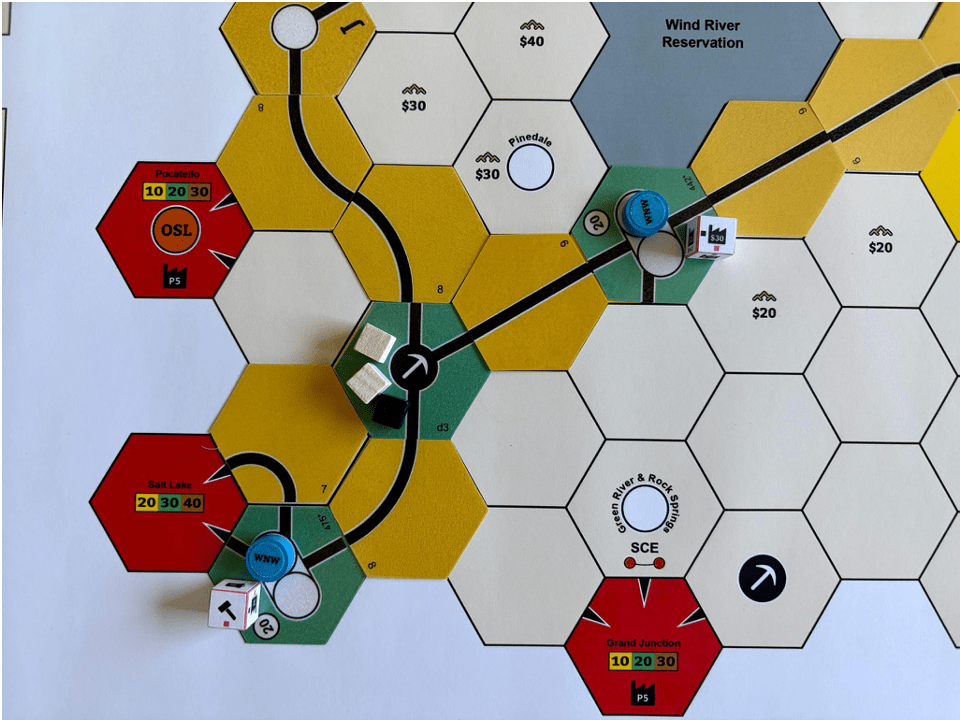
Competitor cubes are a new way to manage the concept of “outside competition,” particularly that introduced by the Union Pacific and Burlington Northern lines. Previously, this competition manifested itself in the “export” system, where deposits that went unused or that were connected to an acquired corporation would export a number of its resource cubes each operating round. That never felt entirely right to me, as the competition was treated as a one-time event rather than ongoing pressure, which is much more historically accurate. My solution to that was to introduce competitor cubes, which are white instead of black. These cubes are placed on deposits at these moments of outside competition, permanently occupying one of the “slots” that would otherwise be occupied by resource cubes. Over the course of play, a deposit that can hold up to 5 cubes might become home to 3 or 4 competitor cubes, reducing its resource production to a mere 2, putting additional pressure on players to get to those cubes first or to do what they can to protect their primary deposits from competitors. This system feels much more organic and is much easier to manage, simplifying gameplay, making the board more legible, and forcing players to grapple with longer-term consequences should the Union Pacific and Burlington Northern encroach on their business.
Player-Driven Deposits
One thing that occasionally confused players in earlier versions of 1867 Big Wyoming was that the number of resources a deposit produced was not related to its color–it was determined by the phase of the game. Players would sometimes forget that a yellow deposit produced just as many resources each operating round as a green deposit. While thinking of ways to address this problem, it occurred to me–why not do the more intuitive thing and change it so that deposits produced more resources as it was upgraded? The problem here was that, at the time, deposits could not be upgraded past green, which severely limited the potential of this system. So, I went ahead and added brown deposits. Now, yellow deposits produce 1 resource per operating round, green deposits produce 2, and brown deposits produce 3. This has several effects. First, players must actually dedicate tile actions to increase resource production and must balance that need with the need to upgrade cities or develop new routes. Second, the brown deposit tiles open up the map a bit toward the end of the game, giving new corporations a chance to get a piece of the pie and increasing the potential of diesel train runs. Lastly, because upgrading a deposit immediately awards it a resource cube, it gives players a third opportunity to “force” a resource cube onto the tile, which can be a critical tool for players fighting for that last refinery or trying to find a couple extra bucks for a double-jump on the stock market.
Diesel Train Costs & Runs
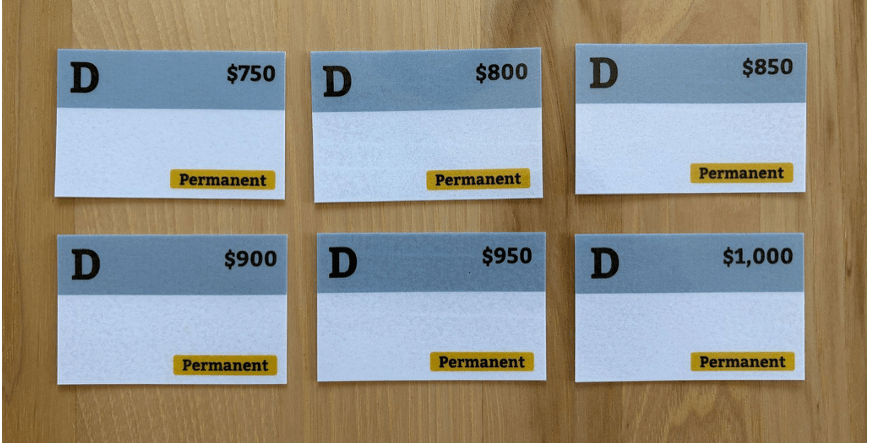
In most (but not all) games of 1867 Big Wyoming, diesel trains make an appearance–however, creating a high-value route for those diesel trains is not easy. Often, the couple of diesel trains that were purchased during play might not make substantially more money than a 5- or a 6-train would. While I don’t mind asking players to think ahead if they want a good diesel run, more often than not it was prohibitively difficult to engineer. I approached this problem from 2 angles. First, diesel train prices have changed; while they were originally $900 each, they now start at $750 and each successive train’s cost increases by $50. This makes the first couple of diesel trains much more affordable and, for those players with an interest in gaming the stock market and corporation acquisition systems, an appealing target for well-timed shenanigans. Second, some tweaks to the way the map develops (including brown deposit tiles, an alternate gray city tile, and free tile upgrades for qualifying refineries) give players more tools to work with when building that big diesel run. It’s still hard work to really maximize your diesel profits but now it’s more squarely in the hands of players who want to take up the challenge.
More Privates!
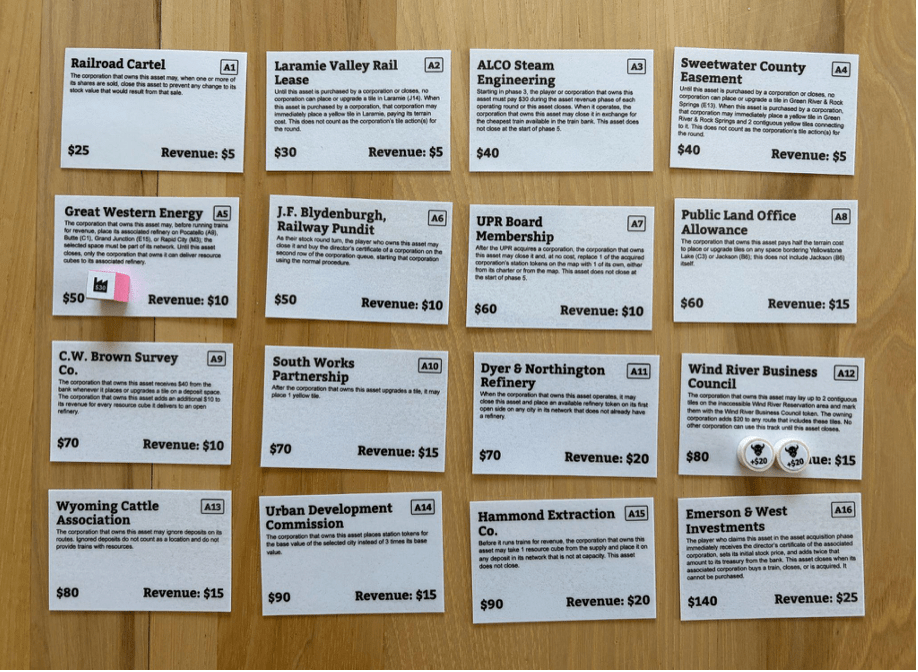
One of my favorite features of 1867 Big Wyoming has always been its extensive roster of private companies and the different texture they can add to each game. So this one was easy: let’s add more! I’ve also started calling them “assets” to reflect the varying natures of what each one represents. There are now only 2 assets that are required to be available in each game, which means you’ll now be adding between 5 and 7 random assets from a pool of 14. Among the new assets are the Railroad Cartel, which allows you to prevent a corporation’s stock value from dropping during a sale; ALCO Steam Engineering, which puts its owner on the hook for $30 each operating round until it decides to exchange the asset for a free train; and the Wyoming Cattle Association, which allows the corporation to ignore any deposits on its route and focus on building revenue exclusively from cities and off-board locations. Many of the existing assets were also tweaked to make their effects even more enticing. My favorite is the UPR Board Membership asset, which allows the owning corporation to steal a station token belonging to any corporation being acquired.
There are probably a half-dozen smaller changes in addition to the ones above but this should give you a good idea of the game’s direction. As I’m sure you can tell, I’m very pleased with the effects these changes have had. By and large, they give players more control over how the game develops while making gameplay smoother and more intuitive. They also foster even more variety from game to game–which was something 1867 Big Wyoming already had in spades.
