

The Geek and I
I suspect many of us have gained a deeper appreciation for certain everyday things since COVID struck. For me, one of those things is BoardGameGeek, long-standing epicentre of the global online board gaming community, which to be honest I’ve always taken somewhat for granted.
Since I first started exploring the hobby in earnest, “The Geek” has always been there in the background, regularly wowing me with both its useful insights and its off-putting visuals. I’ve always treated it simply as a useful reference tool - a quick way of checking on a game’s credentials before investing time or money. Recently, I’ve been spending a lot of time hanging out with The Geek while making improvements to the Treehouse website (you can see some of the results here - pretty much every title in our library of 670+ games now links to its BGG profile), and as we get to know each other better it’s been slowly dawning on me that it’s a genuine wonder of the online world.
For the uninitiated, BGG is effectively board game Wikipedia combined with elements of TripAdvisor, Ebay and Reddit, resulting in a site which does an astonishingly good job of containing everything you could possibly want to know about board games. For those of you ready to geek out a bit harder, here’s some trivia for you. BoardGameGeek was set up in January 2000 (a full year before Wikipedia), had over 1.6 million registered users at the start of 2018, and topped 5 million unique visitors in one month over three years ago. The number of games listed on the site is frustratingly hard to pin down, but is somewhere between 115,000 (the approximate number counted by these enterprising nerds in 2016) and 333,000 (roughly the listing number of the most recently added title), which either way I’m sure we can all agree is a LOT.
A brief, EVEN GEEKIER aside: the game listing numbers are partly what started me down this path of deeper Geek-appreciation. I started noticing them as I trawled through retrieving the links for all of our games, and it occurred to me that they would let me discover which game was the first one ever to be added on the site. The somewhat unexpected answer is Die Macher, a heavyweight German game in which players manage political parties through seven sequential elections, which I had never heard of before in my life. Game number two is an even more obscure fantasy-themed, trick-taking card game, and then game number three is Reiner Knizia classic Samurai (pictured below), which appears in the Treehouse library. What struck me is that the first few games added seem to be a random snapshot of someone’s personal collection: they’re certainly not in order of release date or popularity, and that made me want to know more about how BGG came about and whose games these were. If you are similarly intrigued, this BGG thread offers a nice summary into how the site developed, as well as some insights into the person that collection belongs to.
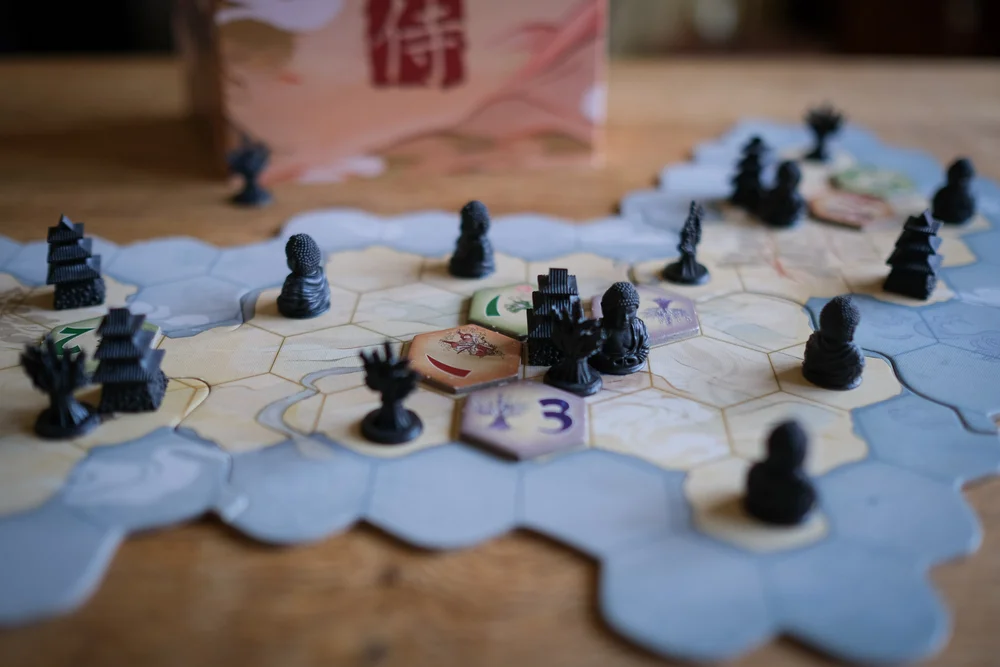
The earliest game added on Board Game Geek that appears in our collection is Reiner Knizia’s classic Samurai (BGG game #3)
OK, time to reverse slowly out of the trivia rabbit hole and tell you more about why I think BoardGameGeek is so great. Since ranked lists have become a big part of what BGG is all about, it seems appropriate to put this in the form of a Top Three…
#1: SO MUCH data
The content on BGG is all community-generated, and that community is HUGE, it’s engaged and it’s extremely knowledgeable. The sheer amount of (generally) bipartisan data supplied by this community means that BGG can offer pretty trustworthy answers to highly subjective questions like “is this game any good?”, “how complicated is it to play?”, “does it work with two players?” and “would a five year-old be able to manage it?”. The flip side of this is that with so much information available on every game, you have to be able to find your way around each listing or it can be seriously overwhelming. Check out the image below to see the first things I look at when I’m viewing the entry for a game and some things to bear in mind as you explore.
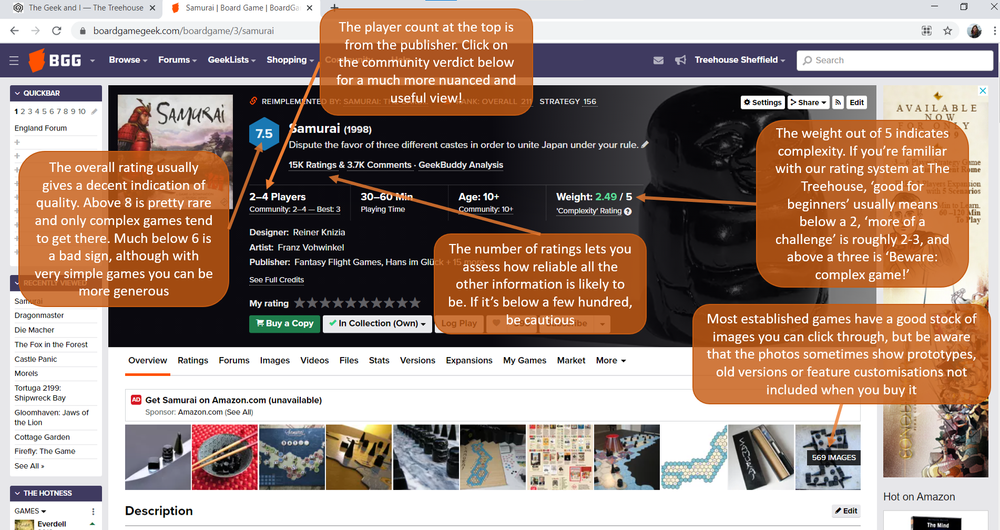
Some key things to look for on a BoardGameGeek game listing and some pointers to keep in mind as you interpret them
For those already familiar with the above, here are a couple of smaller things you might not have stumbled across yet:
Right up at the top of the entry above the game’s title, you can find ‘reimplements’/ ‘reimplemented by’ links, which make it easy to find earlier versions or sequels of the game you’re looking at.
On the right-hand side lower down the entry, there’s a grey box headed ‘classification’. In it you can find the game’s key mechanics and theme(s) listed. Clicking on them will take you to a selection of the highest-rated games which feature that mechanic/ theme - an easy way to explore other titles that share a characteristic you enjoy.
If you click into the search box in the top right of the screen, before you start typing you’ll see an ‘advanced search’ option appear in the drop down. Clicking on this unlocks a seriously powerful box of tricks. For example, if you know our username (“Treehouse Sheffield”) you can use this to filter The Treehouse’s collection by play time, player count, complexity, minimum age and even specific mechanics. What you’ll get back is a neat list of all the games in our library that meet your criteria, with the most highly-rated ones at the top. Nifty, huh?
#2: One central hub
According to its Wikipedia entry, way back in 2010 BGG was given an award for being “a resource without peer for board and card gamers, the recognized authority of this online community”. It feels to me like this has only become more true over time, which means that if you are a board game designer or a board game-related content producer, you are pretty much guaranteed to have a presence on the site. So, if you know how to find it, the BGG entry for a particular game acts as one central point for creators to post their YouTube reviews and ‘how to play’ videos, for fans to share their photos and rules summaries, and for the designer(s) of the game to answer questions and issue rules clarifications.
“If you know how to find it” is a pretty big “if” though where BGG is concerned - it certainly took me a while to find my way around the myriad different aspects of each listing, and I’m sure there’s plenty more I haven’t discovered. The key to finding the sort of content described above turns out to be the horizontal menu just below the top banner. Here are some highlights:
Under ‘forums’ you can find discussion threads about the game, which can be filtered to show just rules questions, often with answers straight from the designer.
Under ‘videos’ you can find video content complete with user ratings that again can be easily filtered by language and type (reviews, instructional, interviews, even ‘humour’ specifically about that game… if you dare to go there!).
The stuff stored under ‘files’ can be particularly useful - there’s often a .pdf copy of the rule book, plus all kinds of helpful player aids and cheat sheets created by users (the Twilight Imperium 4th Edition files section contains 25 pages of listings!). Some of it might be poor quality, but as ever on BGG, users can (and do) rate the content that’s added so it’s easy to sort the wheat from the chaff.
#3: A generally wholesome vibe
Given what a powerful force BoardGameGeek has become in the tabletop gaming industry, I think it has done a pretty remarkable job of staying true to its community focus and creating a wholesome atmosphere.
Something that stood out when I was delving into BGG’s history is that it’s still run by a surprisingly small team - just half a dozen or so people, with founder Scott Alden still at the helm. In interviews Alden talks about resisting calls from games production companies to step in when ratings on the site go south, with the exception of some back-end algorithms to stop people setting up accounts specifically to trash/ hype large numbers of games. He does also mention the impossibility of imposing any meaningful moderation on the site given the resources at his disposal, but I’ve seen very little unpleasantness between users either on the site itself or on its lively and supportive Facebook group.
One aspect that I now see in a different light after watching the interviews is the user-friendliness of BGG. Alden repeatedly mentions that the question ‘what would I want from this site?’ is never far from his mind, which I must admit surprised me slightly given that usability has never been top of my list of BGG’s best qualities. It all makes more sense now that I know that BGG has mostly been coded by Alden himself plus one other programmer: you get the impression that adding extra functionality to enable shiny new content has tended to take priority over polishing the user interface. Progress has been made recently though, with the new homepage finally making its appearance late last year as part of a significant facelift slowly making its way across the vastness of the site.
Another area where BoardGameGeek has recently made long-overdue progress is in the area of promoting diversity and inclusivity. The uncomfortable significance of the fact that the BGG logo was a white man right up until 2019 only dawned on me recently, but at least a change has now been made, and features like the recent series celebrating Black contributors for Black History Month provide hopeful signs that the changes are more than skin-deep.

The new (as of 2019) BoardGameGeek logo alongside the original version
Overall, although BoardGameGeek isn’t perfect, it plays such a fundamental role in board gaming that it’s hard to imagine the hobby without it. Trying to do so is an interesting thought experiment: would the board game community have the same feel without BGG? The site’s friendly, unglamorous enthusiasm for sitting round a table doing something fun and nerdy together seems to get right to the heart of what board gaming is all about. I for one am glad that we’ll never get to find out how the hobby would have evolved without it.