
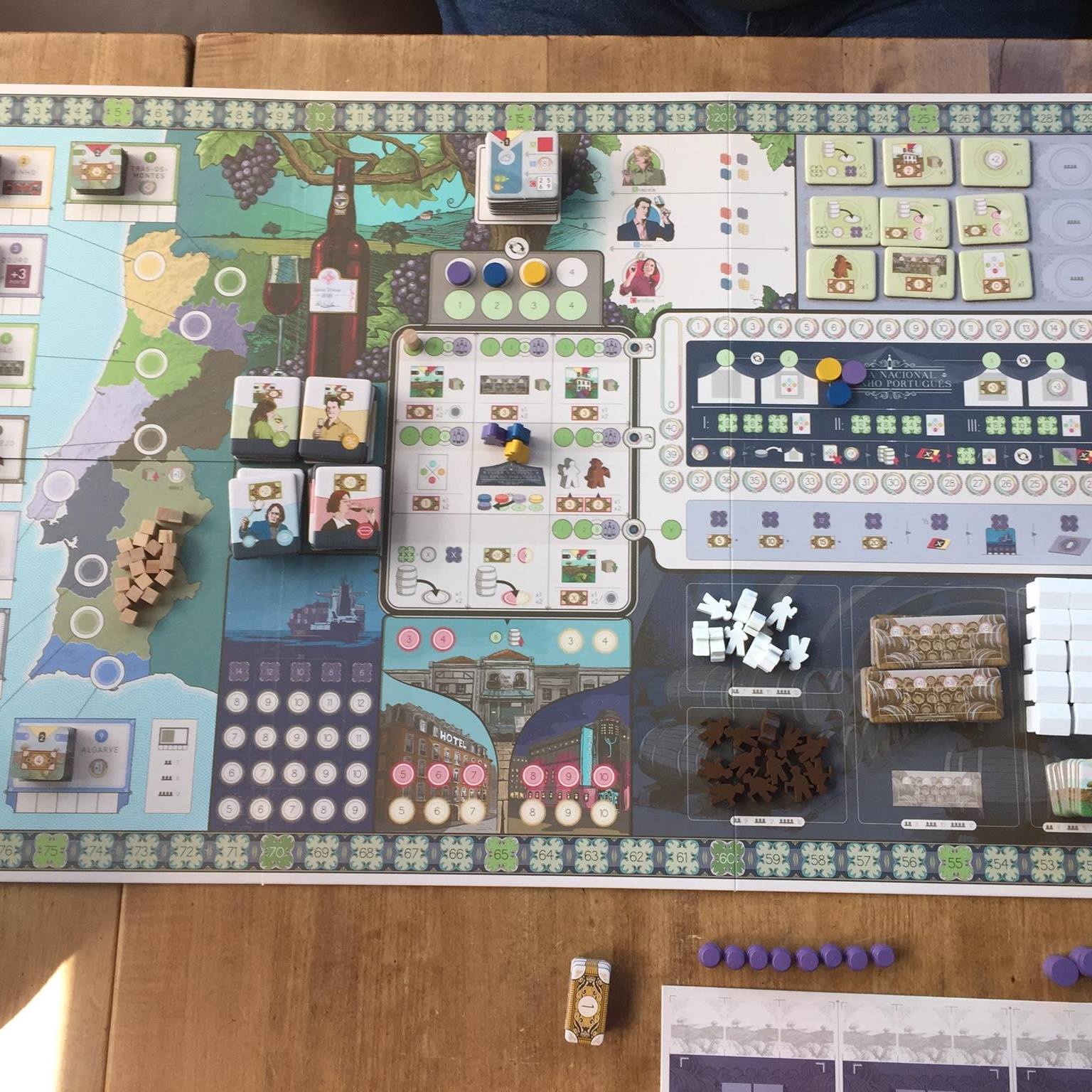
New to Me – August 2025
I love playing games that are new, even more when they’re older but still new to me!
You know what I love even more?
Having reviewed a bunch of them already so I don’t have to try and condense a description of them for this post.
Yes, August was a great month for new to me games, with a wide variety of interesting subjects and mechanisms and a couple of major highlights.
It’s always so satisfying, learning something new.
Members of the Cult of the New to Me weren’t exactly happy, though, since the oldest game was from 2022 and there were too many from 2024 and later.
They got quite irate!
Thankfully I organized a pool party and they were all having so much fun that they kind of forgot about it.

Quick thinking!
If you’d like to join the cult, I am a benevolent cult leader.
And there’s cookies!

You can’t beat that.
Anyway, without further ado (all of my ado was traded away for peace in our time anyway), let’s begin!
The Bell of Treason: 1938 Munich Crisis in Czechoslovakia (2025 – GMT Games) – 3 plays

Designer: Petr Mojžíš
Artist: Not listed on BGG
Players: 1-2
A great 2-player game in the “Final Crisis” genre of lunchtime wargames.
Love it to pieces, but why don’t you check out my review instead?
7 Empires (2024 – Rio Grande Games) – 1 play
Designer: Mac Gerdts
Artist: David Roterberg
Players: 2-6
7 Empires is a confusing game when you open the box.
“I’m green!” James says, as he always does.
But there is no green.
There is no yellow, no red, no blue, no anything!
Let me amend that.
There are no colours that are your player colours.
Instead, 7 Empires has players exerting influence over the titular 7 empires (Great Britain, France, Spain, Russia, Prussia, Austria, Ottomans) by influencing the people (namely the aristocracy, but others as well) in that empire.
When you have the most influence with that empire’s ruler, you get to act for it.
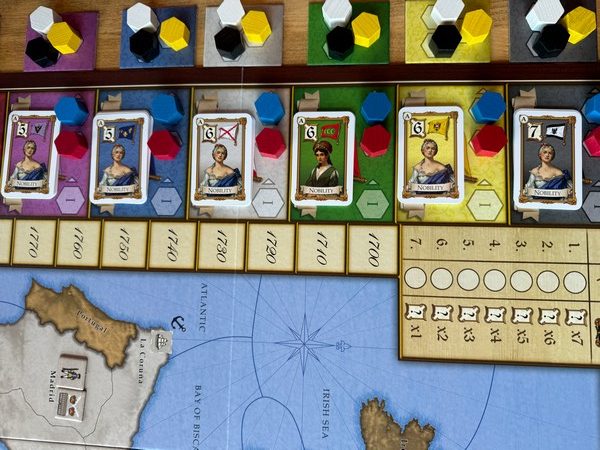
Ah, that’s where the colours come in!
In each decade of time, monarchs take one action and it can be building and deploying their armed forces, moving them and fighting with them, just attacking another empire by deploying two units (of any type) and then move and fighting with them, Palace (build a palace and then score all the crowns they have on the board) and Empire (just get 1 VP per their flag on the board).
If you control multiple monarchs, you choose who to use first and then use the next one on your next turn.

If you don’t control any monarch (or somebody has already done an action for your monarch already), then you take an action for a monarch where you have at least 3 influence and who hasn’t taken an action yet.
If neither applies, you choose an empire that hasn’t acted yet, but whoever controls that monarch actually chooses what action to do.
You do get to deploy a unit for any empire you choose as compensation, though.
New Influence cards are chosen between each decade, so control can change before the next round happens.
That’s the push and pull of this game!
Empires will be gaining points as actions are taken, so you want to make sure that you are gaining as much influence as you can with the factions that are pulling ahead.
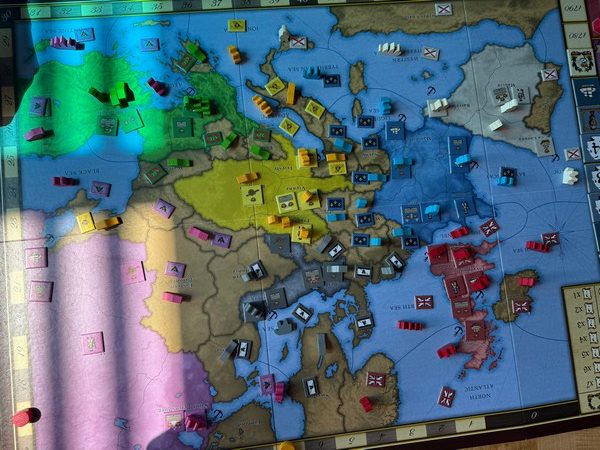
Flags will ebb and flow as attacks are made and territory is gained (or lost) by each empire. Judicious use of the Empire action before other empires start to take over their territories can be quite important.
The trick with the actions is that there is a cool-down time of two decades before that monarch can take an action again.
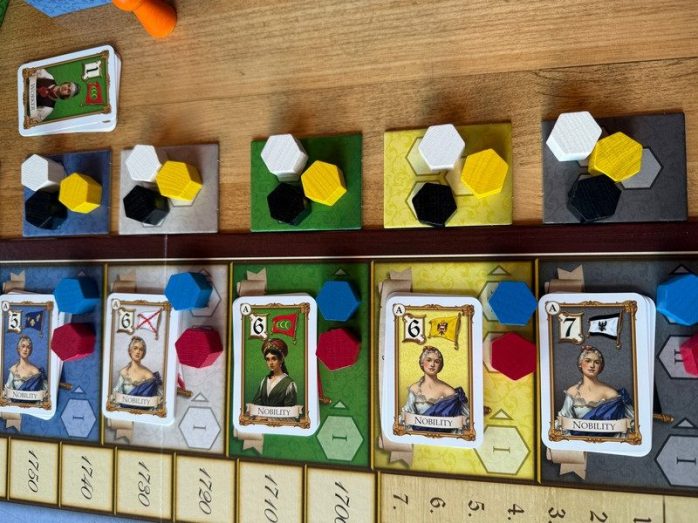
If they’ve built and deployed, they won’t be able to build and deploy again for another three rounds.
So you have to be careful with that, and the fact that you may lose control of that monarch at some point!
At the end of the game, whichever empire is ahead in points goes to spot 1 on the power track.

Each player who has influence with that empire totals up their influence and multiplies it by 7 and that’s how many points they get.
The same goes for the other 6 empires, with decreasing returns (the 2nd place empire will give six points per influence, all the way down to the 7th place empire in points will only give one point per influence).
Hope you bet on the right horses!
This was an intriguing game. It is apparently a reskin of Imperial (which I haven’t played) and it’s a pretty fun game.
Hard to wrap your head around at first, but it becomes more intuitive as you go.
It’s not a game I’m dying to play again but I wouldn’t turn it down if it was offered.
Shackleton Base: A Journey to the Moon (2024 – Sorry We Are French/Pandasaurus) – 1 play
Designers: Fabio Lopiano, Nestore Mangone
Artist: David Sitbon
Players: 1-4
Shackleton Base is a game that I’ve been dying to play since I saw the Heavy Cardboard playthrough a few months ago.
Thankfully, I made my Wisdom saving throw and resisted Edward’s pull to actually buy the game myself.
But I still wanted to play it!
Thankfully a friend bought it and it made it to the table in August.
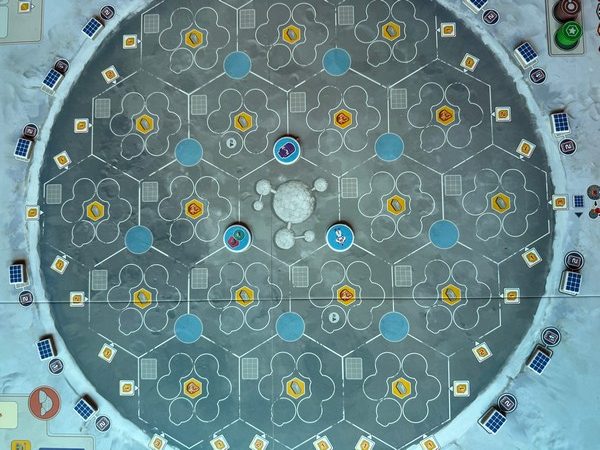
Shackleton Base is a game about is about building a permanent base in a huge crater on the moon. Factions are vying for space in the crater on the base, as well as trying to fulfill the desires of three corporations who also have their own agendas.
You are establishing yourself on the base with various buildings as well as funding corporation projects for them that will get you beaucoup points!
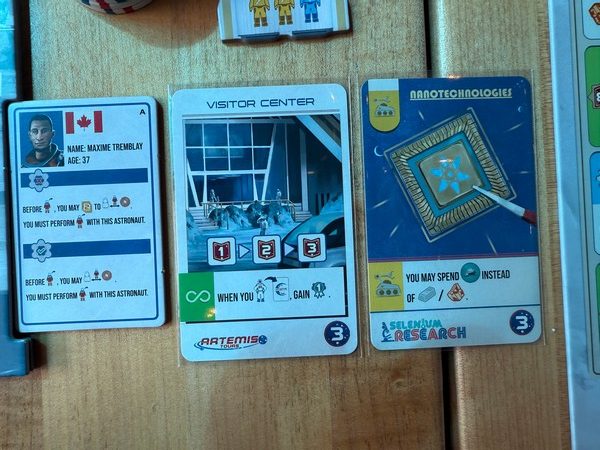
The action selection system, the turn order system, and the gaining of workers is all really interesting.
Each of the three rounds, ships arrive with various colours of workers as well as resources for the next round.

You draft which ship you want to take.
However, the ships that will have you go first or second in the round have fewer than the ones that have you go later.
Do you want to go first?
Or do you want a bunch of useful stuff?
Each player has their own player board with the buildings they can build out on the crater as well.
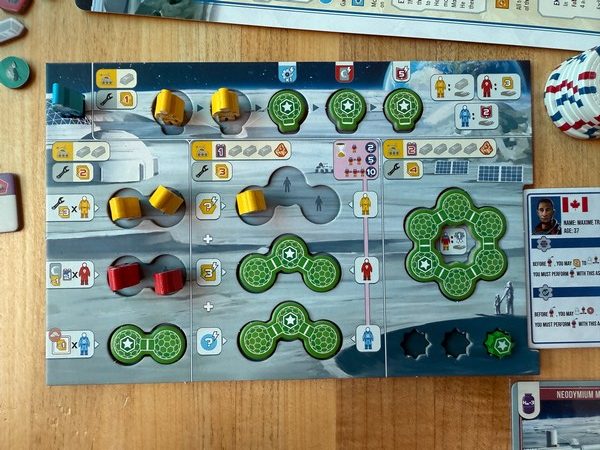
I really love the worker placement options in this game. They’re just so juicy.
One of your action options is to place an astronaut on one of the spaces circling the crater.

You then activate every sector on the row the astronaut is on.
The yellow astronaut in the bottom left can activate each hex it’s facing.
If the player has a building in that hex, then activation is free.
If they don’t, they have to pay the player who has the most circular spots filled in that hex.
So to activate the second hex, the red player would have to pay green because green has three spaces filled compared to two and one.
What do you get for these?
Depends on the colour of astronaut!
Yellow astronauts get resources. Red astronauts get money. Blue astronauts (scientists) will activate the corporation tokens to get those corporation-specific resources.
There’s also Command actions that you can take (which I didn’t get a picture of! The hazards of not owning the game).
You can use any colour astronaut for the action, but if you use the appropriate colour then you get a bonus action as well.
This is how you build buildings in the crater, fund corporation projects, or take corporation actions.
There are three corporations in the game (I believe you have five to choose from without the expansion?) and each one has specific goals and projects.

Maybe there’s space tourism!
Or maybe there’s extensive research going on.

Funding these projects and doing the corporation actions can be very lucrative for points.
Once all the astronauts are played, then it’s maintenance and things like that (costs money to maintain all this crap!) and then on to the next round until you’ve completed three rounds.
Everything is quite intricate and too much to explain in a short post like this, but the variety of actions and options, depending on the colours of your astronauts, is just amazing.
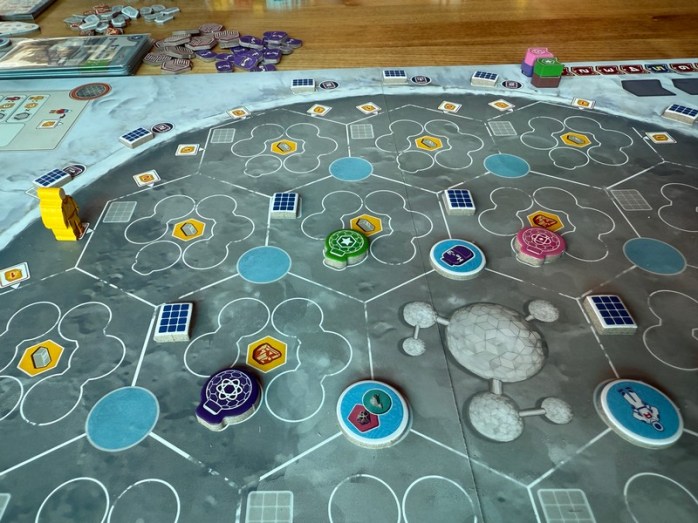
The graphic design on the board and all of the cards and everything is also really good.
I really want to play this one again.
My first play, I was once again guilty of trying to do a little of everything and got smoked.
It was finally starting to click so another play is a must.
Witchcraft! (2023 – Salt & Pepper Games) – 3 plays
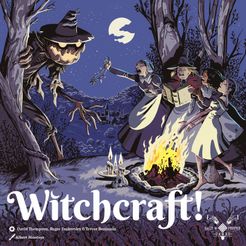
Designers: Trevor Benjamin, Roger Tankersley, David Thompson
Artist: Albert Monteys
Players: 1
Another phenomenal game that I won’t talk about here.
Because you can read all about it!
Every time you click a link, a puppy gets its wings.
Seers Catalog (2024 – Bezier Games) – 1 play
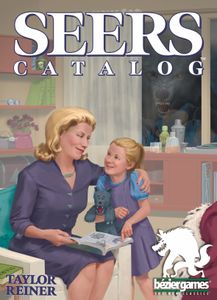
Designer: Taylor Reiner
Artists: Ted Alspach, Rob Loukotka, Christine Mitzuk
Players: 2-5
Another re-implementation, Seers Catalog is a reskin (with a couple additional rules) of Of What’s Left, a card-shedding game that I actually played and enjoyed a couple of years ago.
Seers Catalog is kind of a card-shedding game, in that you are trying to get rid of the cards in your hand as much as possible.
However, you don’t want to actually be the one who gets rid of all your cards and ends the round.
That’s because you get zero points when you do that.
And you want points!
Instead, if you have cards in your hand when somebody else goes out, you lose one point per card.

The goal is to have fewer than six cards in your hand. Then you’re in the “Bonus”.
If you do, then you will also get the value of your lowest card as points.
So if you have one card in your hand when I go out, and it’s a 10, you will gain 9 points (10 points minus the one point for the card being in your hand).
So it’s an “almost shedding” game.
There are also artifact cards that will be in play, two per player.
Each player also has a Wild card.
These all count as cards in your hand.
The artifacts are redistributed every round, so you won’t have the same ones each time.

These artifacts can affect how the round is played, or maybe just straight up give you 5 points if you still have that one in your hand at the end of the round (and you qualify to score).
The lead player puts down a meld of one or more cards, either a run of the same colour and sequential numbers, or a set of numbers, or maybe just one card.

The other players have to play the same type of meld with the same number of cards, but a higher value.
A single card can just be beaten by a higher card.
A set of three 3s can be beaten by a set of three 5s. A run of 3-4-5-6 blue can be beaten by a run of 4-5-6-7 red.
You get the picture.
The game goes four rounds and then points are totaled up.
Whoever has the most is the winner!
This was a fun game. The artifacts make the game even more interesting because of the things they can do, or they can just be played with a meld (for the most part, but not always!) just to get it out of your hand.
This one is sticking in my collection for now and we’ll see how multiple plays go.
It’s definitely a fun game, though.
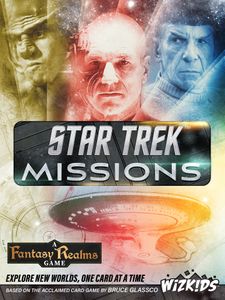
Star Trek: Missions (2022 – Wizkids) – 2 plays
Designer: Bruce Glassco
Art: Who knows? Not BGG, but I think every card is a photo from the series, so maybe none?
Players: 2-6
The quick card game Fantasy Realms has had a couple of updates and reskins, with the latest (that I’m aware of, anyway) being Star Trek Missions.
The basic format is the same.
Each player is dealt 7 cards and always has 7 cards in their hand.
On your turn, you either draw a card from the deck or take one of the discarded cards.
You then discard your own.
When the discard area is full at the required number, the game ends and you total your hand points!

Star Trek Missions adds a couple of wrinkles to this formula.
There are two decks: Missions and Galaxy cards.
You’re dealt two Missions and five Galaxy cards initially.
When you draw, you can draw from either deck or either deck’s discards, but you must always have seven at the end of your turn.
You can actually draw two Missions from the top of the Mission deck, but then you have to discard two cards.
You also have to have one or two Missions in your hand at the end of your turn. You can’t discard them all and you can’t have more than two.

All of the cards have icons on them as well as types of cards (Captain, Location, Entity, Personnel, etc) and each one will tell you how it scores points.
Usually it’s by being combined with other types of cards, like Mysterious Plague getting 5 points for each Medical card.
Once the Mission discard has 12 cards or the Galaxy discard has 8 cards, the game ends immediately and you total up all of your points.
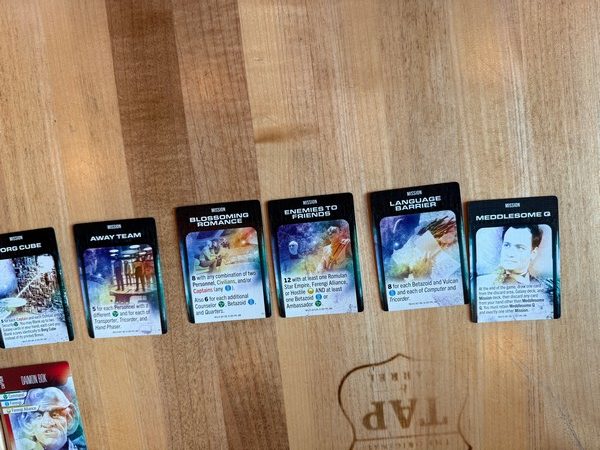
It’s a slightly more complex version of Fantasy Realms, which can be a good thing because that game isn’t complicated at all (other than trying to figure out what to discard because at some point every card you discard is going to cost you points or help one of your neighbours).
If you like the Star Trek theme, then this game will be great for you as well.
The game works as a good filler at the beginning or end of the night, or in between games.
There you go.
A nice selection of new to me games, ranging from brain-burning to light and fluffy!
I’ve already played five new to me games in September, so next month’s post might be LOOOOOOOOONG!
What new to you games did you play in August?
Let me know in the comments.