
Excalibur Review – Winner, Loser, or Ultimate Loser?
Excalibur
Players: 2-8
Playing Time: 15-20 minutes
Designer: Manny Trembley
Publisher: Roxley
I had a great time with Excalibur. It leans fully into being silly and unpredictable, and while it’s not deep, it’s the kind of game that creates stories you’ll be laughing about afterwards.
Pros
- Light, breezy gameplay that’s easy to get into
- Constant laughs thanks to wild chip effects and unpredictable moments
- Plenty of player interaction with stealing, swapping, and peeking
- Encourages cheeky plays and reading the table
- Works well with larger groups and keeps everyone involved
Cons
- Can feel a bit too chaotic depending on the chips played
- Hard to stay subtle if you’re not good at masking reactions
- Less satisfying if you prefer deeper or more strategic games
You have got to forgive me. Everything I know about Arthur and the Knights of Camelot comes from ‘Monty Python and the Holy Grail’. So if you’re hoping this review of Excalibur doubles as a history lesson, you’re out of luck. The only take away I got for you is that strange women lying in ponds distributing swords is no basis for a system of government.
Thankfully, you don’t need any of that background to jump into this recently released party game by Manny Trembley. This isn’t really about crowning the next king of England anyway. It’s about figuring out which one of your mates is secretly holding onto that blasted sword.

How to Play
Excalibur is a party game where you can finish as a winner, a loser, or if things really go off the rails, the ultimate loser. Across the game you’ll be picking up, stealing, and swapping character chips with other players, all while trying to track down Excalibur and avoid getting stuck with the Cursed Blade. Which, thanks to the game, I now know is Clarent, the so-called sword of peace. Feels a bit misleading, honestly.
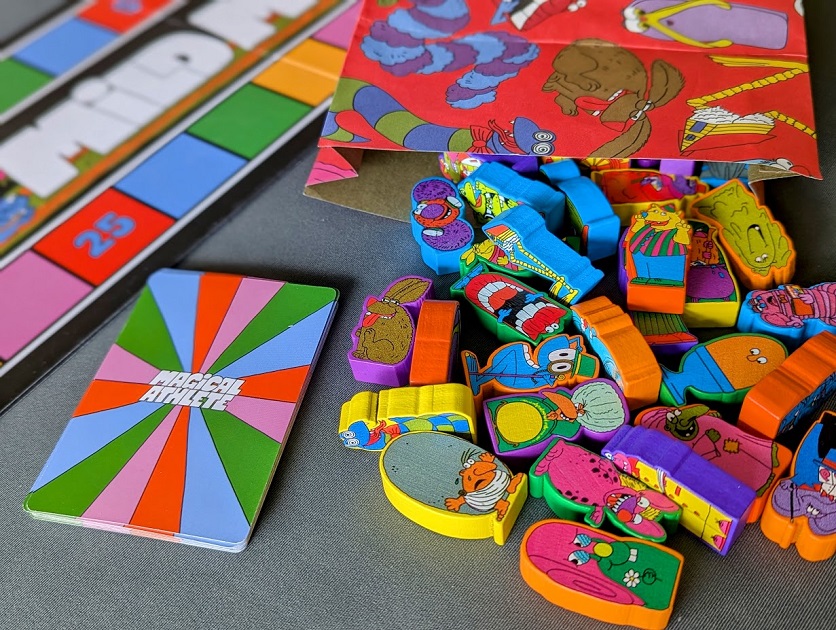
At the start, Excalibur and the Cursed Blade are dealt out along with a handful of other chips to each player. The rest of the sixty-odd chips are scattered face down across the table, with three interlocking cardboard swords dividing them into separate regions. Together, these regions are known as Avalon.
Players start the round by drawing up to a hand of four chips from Avalon, from any region. Then everyone secretly chooses one chip to play, holding it in a closed fist once they’ve locked it in. When all players are ready, hands open and the chaos begins.
Starting with the first player, you go around the table resolving the chips that were played. There are 27 different types, each with its own effect. So I’d be crazy to list them all out, but here are a few examples:
Baroness: Draw two chips from Avalon, then remove one from the game.
Peasant: Draw one chip or steal one chip, then return a chip from your hand to where you took it from.
Thief: Steal two different chips from two different players.
Once everyone has resolved their chip, all used chips are removed from the game, and a new round begins.
This keeps going until one of the Avalon regions runs out of chips, which triggers the final round. At the end of that round, whoever is holding Excalibur wins. Unless, of course, they’re also holding the Cursed Blade, in which case they crash straight through first place and land firmly as the ultimate loser. Everyone else ends up being a middling winner or middling loser depending if you’re a glass half-full or half-empty type of person.

Don’t Take It Too Seriously
Excalibur really nails that sweet spot where social deduction meets just having a good time. It’s light, a bit loose, and happy to let things get a little silly. The chips are unpredictable enough that you’re constantly riding these swings of “yes, I’ve got Excalibur” straight into “you’ve got to be kidding me” when the Cursed Blade shows up.
Yet it still maintains that social deduction core of accusing people and being coy about what’s in your hand. However, it goes beyond just wild accusations, because it also gives you the tools to confirm or deny your suspicions. If you think someone is hiding something, you can use a power to see their hand. You’re trying to hide something? Well you can equally use powers to hide your hand. That’s of course if you manage to draw them.
Another big plus in Excalibur’s favour is that it allows you to be cheeky. In one game, I managed to sneak Excalibur back into Avalon and just sat there while the table descended into madness trying to work out who had it. Meanwhile I’m internally panicking and making faces every time someone reaches in to draw.
That kind of thing is what makes the game work. You start picking up on little behaviours. Someone keeps drawing from the smallest pile? They might be trying to end the game early. Someone plays a chip to look at a hand? Good chance they don’t have Excalibur. It’s not deep deduction, but there’s enough there to feel clever when you call something right.
And importantly, it’s not just about finding Excalibur. A lot of the time, the real game is making sure you’re not stuck holding the Cursed Blade. It becomes this secondary equally fun objective that splits your attention. As you try to avoid interacting with who has it, or if you got it, figuring out the best way to offload it.
I had one game where everything lined up perfectly. Hid Excalibur in Avalon, grabbed it right before the final round, felt like an absolute genius. Then someone played a chip that had everyone steal a random card from the player to their right. Watched one steal miss me and thought I was home free… and then immediately picked up the Cursed Blade. Straight from winning to ultimate loser in seconds.
That’s Excalibur in a nutshell. It’s not trying to be serious, it’s not trying to be overly clever, it just wants to create those moments. The accusations, the panic, the table talk, the sudden reversals. And because it plays a bigger group without dragging, it’s very easy to get to the table. It is exactly the kind of party game I want in my collection.
Silly Sessions: Favourite Games for a Laugh
I’m a big fan of party games that err on the silly side, and these are some of my favourites.


How does it compare?
A score tells you if it’s good, but the leaderboard tells you if it’s worth the shelf space. See the full board game rankings to see the true pecking order.