

Foxes and Lions (Part 1): The Machiavellian Moment
We are thrilled to share the first of many pieces on Foxes and Lions: Renaissance City-States in the Age of Machiavelli, now on P500. Co-designed by Liz Davidson and myself, with the excellent Joe Dewhurst as our developer, this game is in the same series as Here I Stand, Virgin Queen, and Tanto Monta. Compared to other games in the series, Foxes and Lions zooms in on Italy during the crucial period, 1494-1527. While many games on the Italian Wars focus on European great power dynamics, this one puts the emphasis on player experiences with five Italian powers (Venice, Milan, Naples, Florence, and the Papacy) as they struggle to navigate their intense and often shifting rivalries with one another, as well as contend with invading forces from non-player great powers (France, Spain, the Holy Roman Empire, and the Ottoman Empire) that threaten collective defeat of all players.
Games in the DNA of Foxes and Lions include a wide range of older and contemporary classics, such as Avalon Hill’s Republic of Rome with its vicious politicking and prospect of all players losing in Rome’s collective defeat by external forces. Inspiration was also found in the pre-modern entries in GMT’s COIN and Irregular Conflicts Series with their emphasis on vastly differing political systems, asymmetrical conflict, and the dynamics of popular support and opposition. Of course, the Here I Stand series itself (and especially, Ed Beach’s Virgin Queen) showcased a way to integrate the rich tapestry of cultural pursuits into the cutthroat world of political and military maneuvers in the era. The mischievous joy of Paolo Mori’s Dogs of War also informs our game, and it is certainly indebted to Avalon Hill’s Machiavelli, a classic Diplomacy variant. We wanted to revive and enrich the chaotic environment and often paranoid psychology of the venerable Machiavelli game in a design that would find a natural partner in a CDG framework.

Yet for all those game influences, the historical Machiavelli is the “secret sauce” of Foxes and Lions. Machiavelli graces the cover of our game for many reasons. As a cultural historian who has spent many years teaching, researching, and writing about the period known (not without controversy) as the Renaissance, I have always been drawn to this complex and sometimes contradictory political thinker, who keeps commanding attention in my writing projects over decades now, including a book in progress on Machiavelli’s Florentine Histories. Not only was Machiavelli helpful in identifying the five key Italian players in our game, but he also affords us an interpretive key to this era of enormous cultural, political, and military upheaval. We may want to speak here of many Machiavellis, plural.
There is of course the Machiavelli of The Prince, a book that has caused consternation over centuries, most especially among those who haven’t bothered reading him carefully, if at all. That is the Machiavelli writing to a Medici prince and recounting (however ironically) the exploits of Cesare Borgia; the Machiavelli who seems most taken with the kind of ruthlessness and faithlessness that surely plays a role in our game. Yet many forget that the Machiavelli of The Prince also celebrated the tenacity and resentment of republics who have lost their liberties, much as his beloved Florence did to the Medici upon their return from exile. That love of republics looms large in Machiavelli’s Discourses on Livy. The Discourses champion republics as the political form wherein virtù (Machiavelli’s notoriously pliable term for everything from force of will to military strength and political acumen) can be something achieved communally and not simply by an individual ruler. Communal virtù is something to sustain over centuries, not just in a single lifetime spent in the pursuit of fleeting power. In that book, it is not temporizing princes, but rather founders and lawgivers who are the real figures to admire.
There is also the Machiavelli of The Art of War and the Florentine Histories, books written well after the calamitous fall of the republic that Machiavelli served for fourteen years. Featuring a dialogue on warfare led by Fabrizio Colonna (one of the condottieri captains featured in our game), The Art of War was just as interested in how militarization can impact a civilian community for better and worse as it surely is in the logistic and tactical sides of warfare. The Machiavelli of the Florentine Histories is less the theorist and more the sanguine narrator of centuries of his tortured city’s many internal and external conflicts. Lastly, we have the outrageous and playful Machiavelli of Mandragola (The Mandrake Root), a sex comedy for the ages that is still performed today and that blends serious political insights with scandalous, biting satire.
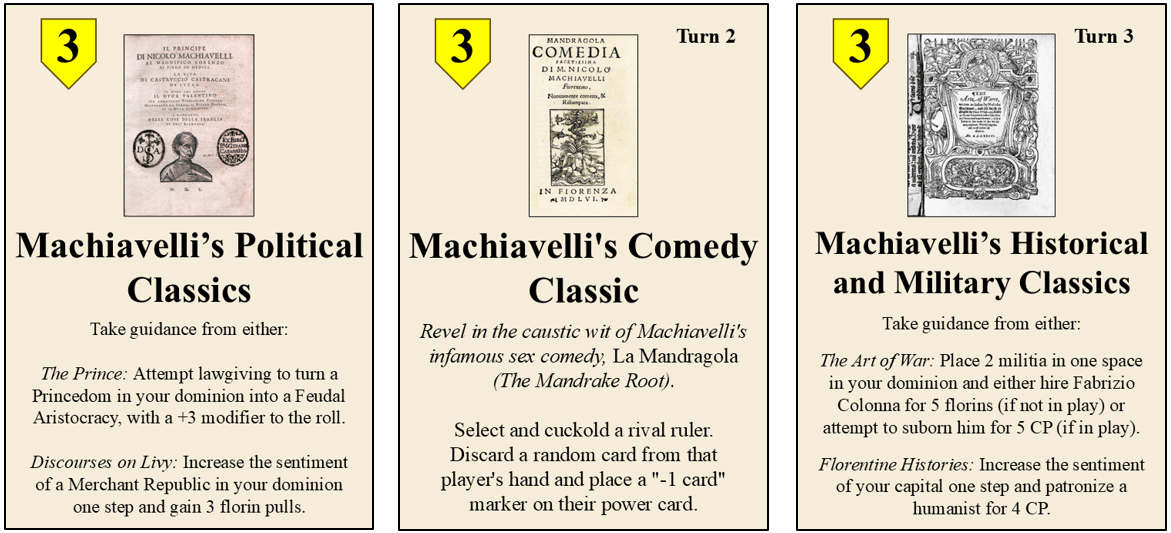
We honor this multifaceted Machiavelli in our game with three event cards (sampled here in draft form) that allow players to draw on his insights in his wildly different books for varying effects. Yet well beyond these nods, the game is rooted in Machiavelli’s rich understanding of how political forms, popular sentiment, economics, and military affairs are profoundly intertwined. Alongside essential Italian authors like Federico Chabod and Gennaro Sasso, one of the finest English studies of Machiavelli is John Pocock’s still essential book, The Machiavellian Moment. The “Machiavellian moment” is when a state (particularly a republic) becomes acutely aware of its own fragility in time and space, as well as the precariousness of its hallowed institutions. Pocock traced classical republicanism in Machiavelli’s Renaissance to “Atlantic” traditions of republicanism in a 17th century England wracked by civil war, then eventually to the republican traditions of the founding of the United States. It is this Machiavelli, the man of ideas and not merely the avatar of treachery, that our Foxes and Lions game most seeks to bring to life. We do not think that this truly dynamic, vivid Machiavelli has been adequately addressed in a serious historical game before. This is why Foxes and Lions exists.
We do not engage with Machiavelli in any simple hagiographical vein, nor do we take all his premises and conclusions at face value. We hope our game to be an historical sandbox in which to test Machiavelli’s many ideas. Whether it is his thinking on the dangers of mercenaries, the demanding nature of republics, or the risks run by any prince conquering new territories, the game endeavors to explore Machiavelli’s concerns and allow players to see the virtues and shortcomings of his perspective on his tumultuous times.
Next week, we will begin an in-depth exploration of crucial game concepts and mechanics. We will begin with the interplay of three crucial elements in reading the game state of any space and player dominion in the game. First, the political traditions of a space, which reflect its current and past government (ranging from merchant republic to princedom, feudal aristocracy, theocracy, vassal, and tribute state). Second, the sentiment of a space, reflecting the populace’s relationship both to its local government and to any player power counting that space in its dominion (ranging from Hated, to Feared, to Feared & Loved). And lastly, a space’s trade value, reflecting its economic prosperity and trade potential that support the collection of florins in the game’s unique parallel economy to the CP economy of most classic CDG titles.
We look forward to getting in depth on these and many more subjects in the weeks and months to come.
