

The Primal Struggle? Sandbox and Simulation in Foxes and Lions
Inside GMT Article on Foxes and Lions, Part 6
This is the sixth of many articles to come on Foxes and Lions: Renaissance City-States in the Age of Machiavelli, now on P500. This game is in the same series as Here I Stand, Virgin Queen, and Tanto Monta. See part 1 for a thematic overview of what makes Foxes and Lions unique; subsequent parts have explored many thematic and mechanical distinctions from the series. Most recently, part 5 featured my exploration of new patronage systems in the game. In today’s installment, we delve into a classic conundrum facing any designer of historical games, as well as how Foxes and Lions both confronts and exploits that conundrum.
Readers will have already noted in the title that I have opted not to frame this question as “sandbox versus simulation.” There are many reasons for this, including design and historiographical principles that extend well beyond the specific needs of Foxes and Lions. First, the default notion of simulation as historical verisimilitude has long since been challenged in the game design community. In what is now a modern classic, the anthology Zones of Control: Perspectives on Wargaming (MIT Press, 2016) features numerous pieces interrogating the very notion of simulation. In one such piece, wargame designer Tetsuya Nakamura writes, “In my experience of game design, even if the gaps created by abstraction and hindsight could be completely resolved, the one between a simulation and the truth never can be. … Any particular game might be a better or worse simulation compared to another game, but neither could be called truer.”
This concession that simulations—however detailed and rooted in historical record—cannot make absolute (perhaps only provisional) truth claims should be understood most generously as a feature, not a bug, in historical game design. Whether one games mainly for pleasure, historical insight, or a deep dive into a design’s “baggage” of operating premises, I think at heart no one wants a game experience that is so much “on rails” or so much of a simulation that it merely rehearses a seemingly established historical account. Since historiographical accounts are themselves continually in a state of contest and reimagining, giving one’s allegiance to the notion that any historical game will perfectly capture things “as they really were” is perilous at best, intellectually dishonest at worst. Yet rather than simply throw up my hands in some relativist despair, I have continually foregrounded historical games in my classroom for decades now because I view them as dynamic historiographical interpretations of their own that ought to live in dialogue with other written accounts and other games. Again, this is the feature, not the bug, of great historical games, precisely because they encourage in us a hunger for more—more accounts, more details, more interpretations, more books, more films, and of course, more games.
Foxes and Lions was born out of two crucial convictions dating back at least a decade; namely, that games on the Italian wars generally ignore the Italian experience of those conflicts in favor of great power narratives, and that historical games invoking Machiavelli have failed to appreciate the far more complex, nuanced, and compelling figure whom Machiavelli scholars have spent careers unearthing. These concerns can be illustrated with a few examples of otherwise terrific games.

Machiavelli and Machiavelli
The out-of-print 1977 Avalon Hill classic, S. Craig Taylor and James Wood’s Machiavelli, is a wonderful Diplomacy variant, an achievement I mean not to diminish in any way by identifying it as such. It adds so much more to Diplomacy-style shenanigans than simply a new map of Renaissance Italy on which to scheme; it features unit diversity (including mercenaries and citizen militia) as well as a money economy and some dastardly tricks to play on your rivals. Clearly some key inspirations for Foxes and Lions were found here, and I have often stated to veteran gamers that our new game is meant to bring back the backstabbing glory of that old title, married to the CDG mechanics of Here I Stand and its successors. Yet for all its richness as my own preferred alternative to the original Diplomacy, Machiavelli had always felt lacking to me in important areas that left the historical Machiavelli disenfranchised, despite his name gracing the box cover. The Machiavelli who theorized about a variety of governmental forms and political cultures was nowhere to be found in Machiavelli. This is why Foxes and Lions leans so heavily into political traditions, sentiment, and their impact on both economics and warfare—see part 2 of this series for more there. In other words, as with so many other designers’ journeys, my own began with endeavoring to make the game I wished Machiavelli had been. For me at least, this is never intended as a repudiation of other designs I have admired; rather, a course correction suited to my own perspective as a cultural historian. If both Machiavelli and Foxes and Lions are in part simulations of their historical subject era, they must be so provisionally, as Nakamura stressed.
Some more recent design efforts are also illustrative here. The late Richard Berg’s monumental Men of Iron series for GMT (and of course, especially Arquebus on the Italian Wars) affords a granular and highly instructive perspective on battlefield formations and tactics in the late medieval to early modern period. I have also admired Brien J. Miller’s underappreciated Fornovo 1495, which does an amazing job showcasing one crucial battle as the prism through which to view the evolution of medieval warfare at a critical juncture in military history; it also has the virtue of foregrounding Italian contributions to the battle as opposed to an exclusive great power focus. Yet for all their military detail and historical grounding, these titles have always left me hungry for the political, cultural, and economic conditions that gave rise to those battles. By shifting the scope and ambition of Foxes and Lions from battlefield tactics to grand strategy, a host of other aspects of the period came to life—from governmental turmoil and regime instability to nascent capitalism and the contributions of artists, scientists, and humanists to the sea-change underway in Italy in this era.
As a final example, Pascal Ribrault’s Virtù (2022) is another Renaissance Italy game that I have greatly enjoyed. Using a host of Eurogame mechanics (including area majority, action selection, and clever use of the rondel), Virtù has much of what I want from a game on the period, including a focus on Italian player powers. It is a relatively short and streamlined experience, but for me, lacks all the historical detail that I crave from GMT games and that only a CDG approach could have afforded Foxes and Lions. Because Virtù also lacks the real asymmetry among player powers that I think essential to treating Italy in this period (including the political and cultural heterogeneity of dominions), it became another example of a respected effort and comparison point that inspired a very different direction for Foxes and Lions. Again, which better simulates the period? Is this even the right question given Nakamura’s caution above?
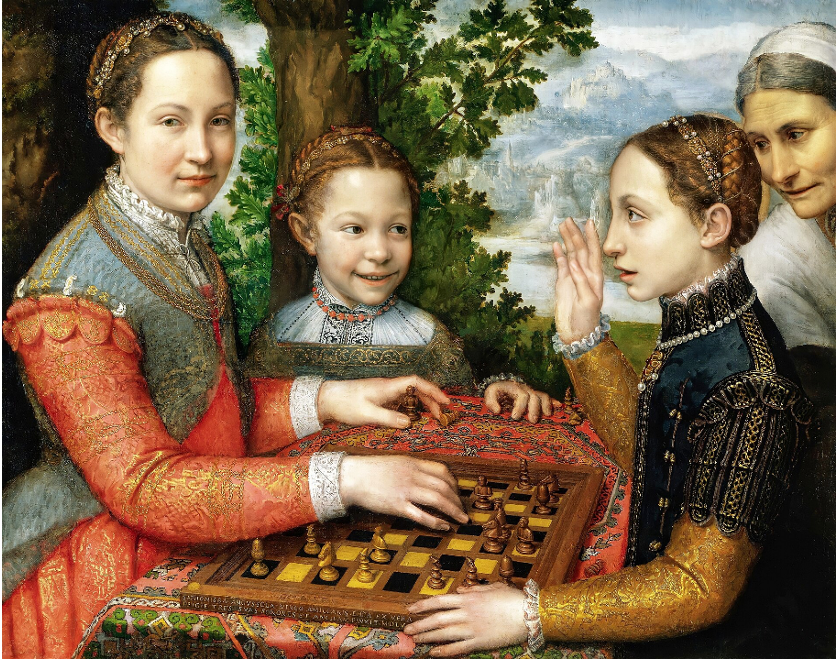
Chess Game (Sofonisba Anguissola,, c.1555)
This leads at last to the other half of our article title—games as sandboxes. I confess, as I suspect most gamers will too, that the opportunity to explore counterfactuals is a major reason I play historical games. To be sure, I want those counterfactuals to be (or in Machiavelli’s terms, at least to “seem”) believable outcomes based on the historical conditions of a game’s setting. For all my love of counterfactuals, I also need to understand why things happened as they actually did; the best historical games can often teach us that not in spite of, but because of, the counterfactuals a game enables.
As an educator who has taught in universities and at the secondary level, I am a board member of the “Reacting to the Past” national consortium of historical role-playing games used in colleges and high schools in the U.S. and abroad. RTTP Executive Director Nick Proctor always rightly stresses the need for a “plausibility corridor” in historical game design of any type. If you are to play in the sandbox of an historical world, the counterfactuals are to be encouraged, but they must also be justifiable and instructive in a game’s historical debrief. This comparison of what happened in game and what (to the best of our limited knowledge) really happened is essential when using RTTP role-playing in a history class. I think this is every bit as important to discuss when finishing play of an historical board game, and the best GMT titles afford ample opportunity for this in rich designer notes, historical contexts, and timelines. This is where GMT really shines as the premiere publisher of historical board games. The “Game as History” sections in the Here I Stand series titles are especially relevant here and will be a model for a similar approach in Foxes and Lions; refer to the scenario books for any title in the series to see some wonderful examples.

The Allegory of Simulation (Lorenzo Lippi, c.1650)
So the kid in each of us rightly revels in the sandbox, but at the end of our historical game experience, we are well served to reflect, however briefly, on the messes we have made—on where the simulation aspect veered off into uncharted historical territory. If the divergences marched through that “plausibility corridor” (however tightly cramped it might have been), then we have an experience that, to paraphrase the ancient Roman poet Horace, both delights and instructs. In a recent game ending of Foxes and Lions that will be recounted in detail in a future article, a standout moment was the utterly delicious “what if” of Holy Roman Emperor Charles V bringing his landsknechte troops against the mercenaries of Cesare Borgia. Cesare had proven far more resilient than he was historically in that game, surviving deep enough to find himself hunted down through the Romagna by the non-player imperial forces commanded by Charles. The confrontation had every player standing for most of an incredibly eventful turn that saw Naples triumph despite the original target of the league to which Naples belonged being a near-victorious Papacy—all just before what seemed certain to be a looming collective defeat of all players to the great powers (the subject of a future article).
Discussing how and why this unlikely clash of Renaissance luminaries occurred at all was a highlight of the post-game kibbitzing, which led to a richer discussion of the history depicted in the game overall. Stirring counterfactuals typify why the design of Foxes and Lions explores variability in the rollout of patronage figures, captains, and even some player power rulers. Not only does this afford variability across plays of the game (alongside the variability of event draws of course), but it also allows players to ponder situations where important historical developments play out in very different yet plausible ways. As with the “what if” above, players can discover a Savonarola who outlasts the pope’s enmity, a cultural landscape where Michelangelo is very late to the party, or a Giovanni delle Bande Nere who simply fades into obscurity before having a chance to be fatally wounded on the battlefield and mourned. These are but some of the many counterfactuals the game may throw at you.
These unexpected outcomes are where sandbox meets the simulation, and where the enforced choice between them is proven to be a false dichotomy. Games that allow for both elements to be explored are most attractive to me when paired with a heady cocktail of player agency and the contingency of historical events beyond player control, especially as captured by true “forks in the road” afforded by multiuse cards—a design debt still being repaid ever since their emergence in the work of Mark Herman 33 years ago now. Sandbox versus simulation is a stark and ultimately misleading choice that too often results in games obsessively championing one element above the other. Sandbox and simulation is an approach that suggests something far more interesting—what philosophers might call a dialectic, a method of reasoning that puts contradictory ideas and interpretations into dialogue. We have designed, tested, and developed Foxes and Lions with this understanding front and center.
As Rob MacDougall and Lisa Faden remind us about wargames in another piece from Zones of Control, “The playful stance—neither hostile nor deferential, but creative, curious, actively seeking to learn and be amused—is crucial. Playing … is a smarter and healthier thing to do with simulations than either submitting to them as oracles or rejecting them as lies. … Play, as long as it is critical and reflective, is the cure for simulation fever. It is the first step toward simulation literacy.” In this light, find your ludic sandboxes and start messing around in them. We trust Foxes and Lions will be a worthwhile stop on your itinerary.