

Making six rule: great party games for small groups
There’s no getting round it: this week’s new ‘rule of six’ has been bad news for party plans across the UK. But fear not - we’ve arrived on your doorstep half an hour early, clutching a big bag of board games to make everything better! Because everyone wants that person at their party, right?
Slightly awkward though the circumstances are, we genuinely believe that board games offer the perfect solution to the small party problem - that is, how to create an atmosphere conducive to letting off steam with only the number of people you can fit in a taxi. We’re here to tell you that there are SO MANY great party games that work for six or fewer players that it was seriously hard to whittle down this list to a sensible number.
We recommend beginning your quest for the perfect party game by thinking about what sort of night it is you’re looking for. Here are some ideas to get you started.

Good, silly fun
So… you’re after the sort of night where everyone laughs so hard they cry and you discover that your mate’s new girlfriend has a surprisingly filthy mind. Here are some games to get you started!
Scrawl
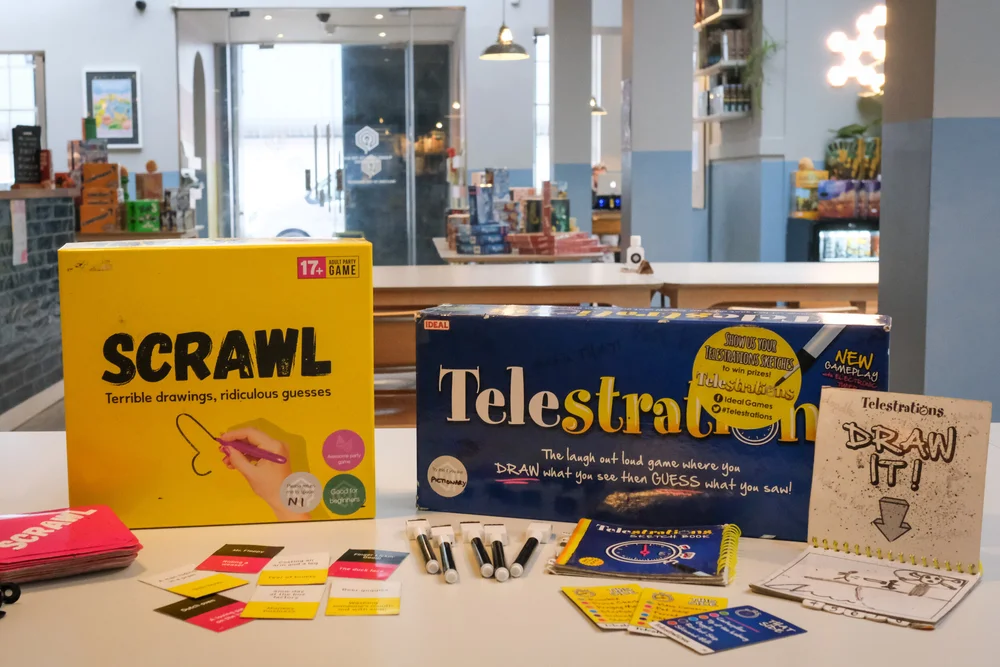
It’s been our experience that whenever we hear a group at The Treehouse actually howling with laughter, there’s around a 90% chance they’re playing Scrawl, or possibly its older and somewhat less bawdy cousin Telestrations. Both of these games are effectively Pictionary meets Chinese whispers: drawing games in which an initial word or phrase provides the starting point for a succession of alternating pictures and descriptions that inevitably get dafter and dafter as the drawing pad makes its way around the table. You’ll need 5-6 players to really make the magic happen, but it’s workable with four in a pinch. Go for Scrawl if you’re happy for the tone to be lowered immediately, or for Telestrations if you want a family-friendly game to be at least a possibility!
Stay Cool
Hey evil geniuses! Fancy putting your friends and family in an insanely stressful situation and seeing how they react? We thought so! But… do you like the idea enough to sign yourself up for the same treatment in the process? Great! Here’s a set of dice with letters on. I’m going to ask you questions and you use them to spell out the answers as quickly as you can. Meanwhile, your friend over there is also going to ask you questions but you answer hers verbally, OK? Don’t worry too much about the timer yet – that’s a surprise for round two. Go!
This game is new to The Treehouse library but has already made it on to our taster menu. Just hope the food doesn’t arrive during your turn so you don’t end up having to answer a THIRD set of questions along the lines of ‘did you order a grilled cheese?’
Word Slam
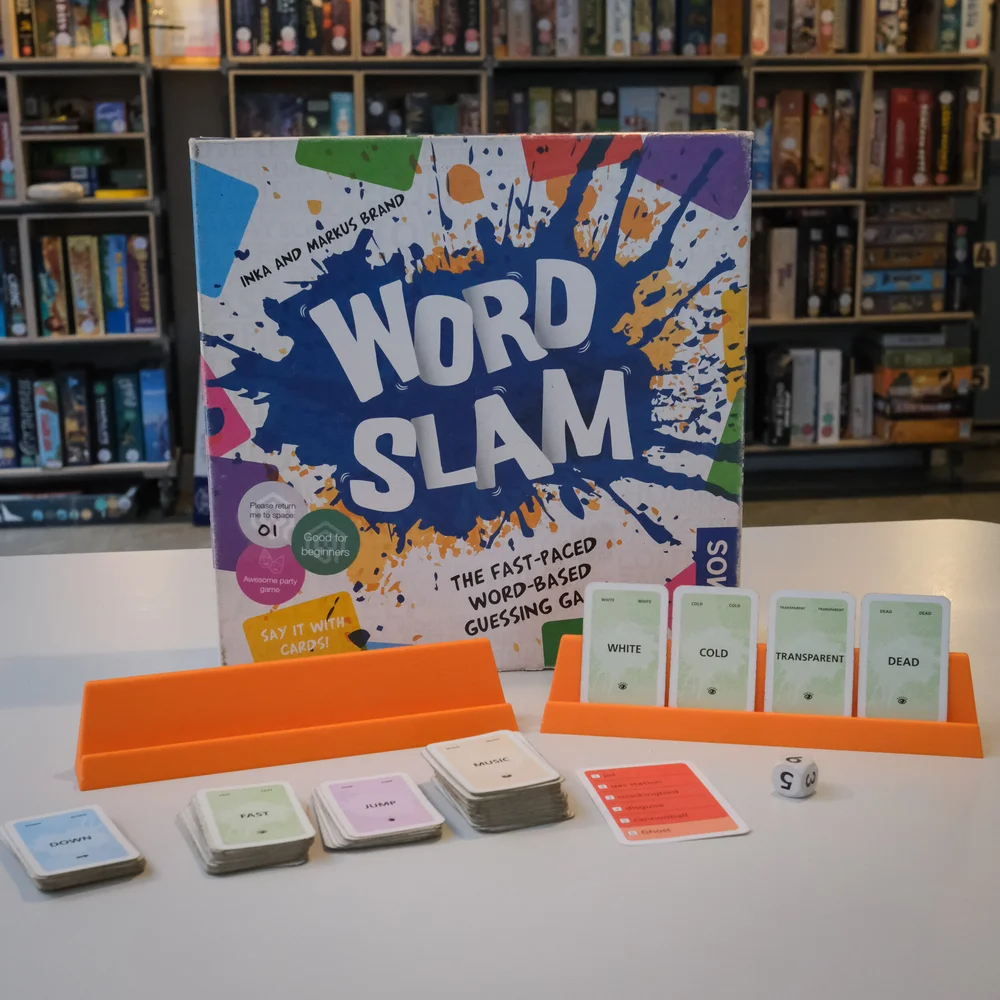
If you’ve ever played Anomia or Taboo, the format of Word Slam will feel familar: one person gives clues while the rest of their team try to guess the word on their card. The first catch here is that the clue-giver can’t talk – instead they communicate by picking word cards from a deck. Time to find out if your team can guess ‘Smurf’ from only the words ‘small’, ‘blue’ and ‘fictional’! The second catch is that they have to get to the answer before the other team, who are trying to guess the same word at the same time and will be listening with interest to your team’s guesses.
Word Slam works a treat with four or more players, and is pretty much guaranteed to generate both nail biting and air punching. We’d strongly recommend proceeding straight to the trickier clues after the first round or two to really get things moving.
Anomia
Under normal circumstances, it’s hard to believe that you could ever find yourself unable to come up with an example of a dog breed, or a fast food restaurant, or simply a run-of-the-mill COLOUR when put on the spot. But… inevitably that is exactly what happens when this game gets you in its clutches!
Anomia consists solely of a deck of cards each showing a symbol and a category. Players simply flip over cards from the pile in front of them, and look for symbol matches with other players. In the case of a match, it all kicks off: both players race to give an example of the category on the other player’s card, often finding that every single fact they ever knew has mysteriously vanished from their minds.
This game was recently described by our favourite reviewers as a ‘white-hot giggle furnace’, which pretty much says it all, plus it works beautifully with player counts of three and up.
Bringing the drama
Perhaps you fancy the sort of night where you get to accuse your partner of being a lying scumbag, but everyone still goes home as friends? Here are some games to get you where you want to go…
Coup
This simple, beautifully-paced bluffing game casts players as nobles in an Italian city state, vying to earn riches and retain influence. Players start with two character cards face down in front of them, with each character granting the holder certain aggressive or defensive powers. On your turn, you either take coins from the Treasury, use a character power to gain extra coins or launch an attack, or spend seven coins to coup against another player, forcing them to turn a character card face up.
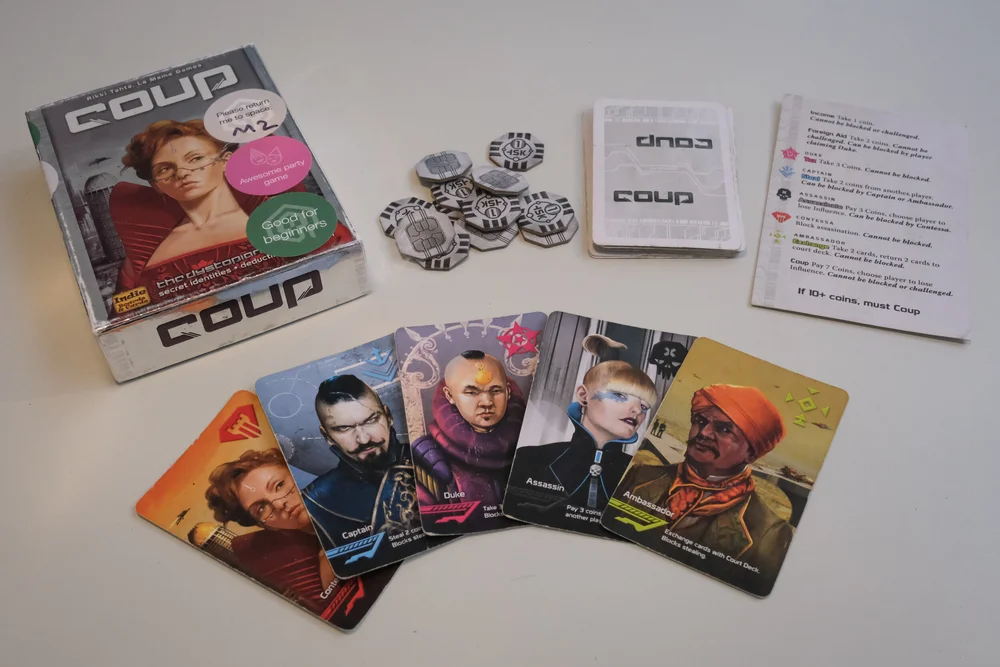
The deceptively powerful little engine that runs this game is that you don’t have to reveal a character card, or even actually have it, to lay claim to its specific power. If another player is sufficiently convinced you don’t have the character in front of you they can challenge your claim, and if you can’t reveal it you must turn a card face up. But… if you do reveal it, they must turn one of their cards face up, and you swap yours for a shiny new secret one. The last player with a face down character card wins, and what a sweet, satisfying victory it is!
This game is at its absolute best with 4-6 players, packing a greater punch in terms of tension and drama than many a higher-player-count option. If bluffing is your bag, you could also check out Cockroach Poker, which offers an insane amount of fun in a tiny box – check out this review to see why.
One Night Ultimate Werewolf
Be warned: this shorter, neater version of the classic game Werewolf, aka Mafia, is SERIOUSLY addictive. Each game lasts only 15-20 minutes, but we’re willing to bet you won’t be able to stop at one, and before long there’ll be scores to settle!
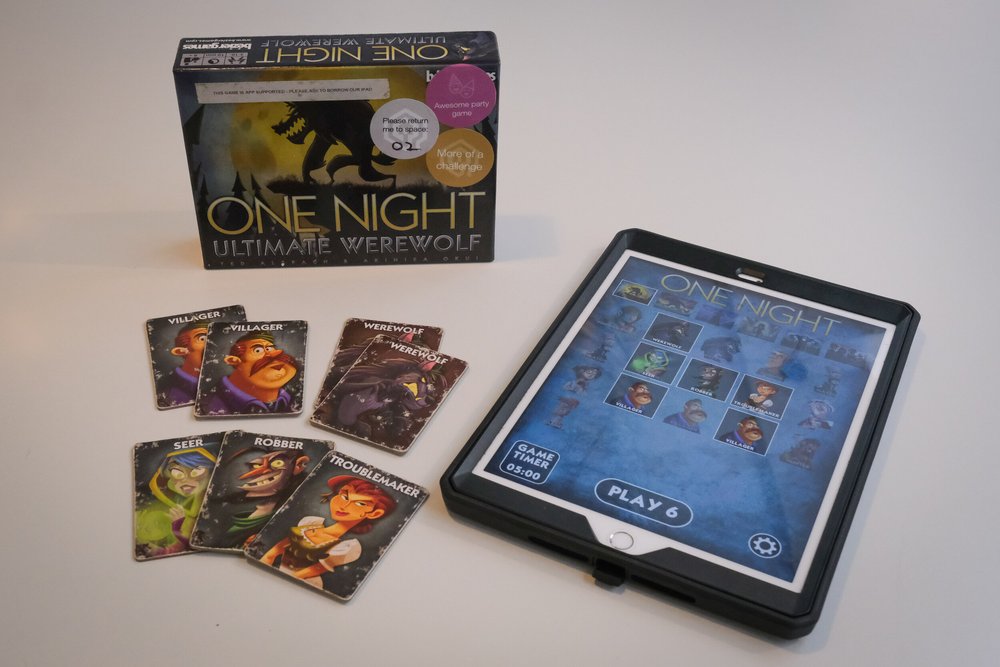
The game begins with players receiving their secret role card, determining whether they’re on team villager, trying to track down a possible werewolf in their midst before it’s too late, or team werewolf, trying to lie low and avoid detection. Certain village team roles come with special powers, giving players nuggets of information to help put them on the scent, while others act as instruments of chaos adding extra layers of intrigue.
Cue the night time phase: all players place their character cards face down in front of them and close their eyes. The various roles then trigger one at a time, letting the relevant players peak at other cards around the table, swap roles around, or perhaps lock eyes with a fellow werewolf. The game comes with a handy app to talk you through the steps, complete with (optional) spooky disco soundtrack. Then daybreak arrives, giving players a matter of minutes to exchange information, hurl accusations, and finally… decide who to lynch! If the majority vote for a werewolf, it’s victory for the villagers, but if not, the werewolves win the day.
This game needs 5+ players to shine, and the range of roles in the box leaves you with plenty of options for switching things up.
Codenames
If you haven’t yet played this absolute blockbuster of a modern classic, consider your party plans sorted! There are no hidden roles here, just plenty of tension and occasional opportunities for feeling like a genius… or the opposite.
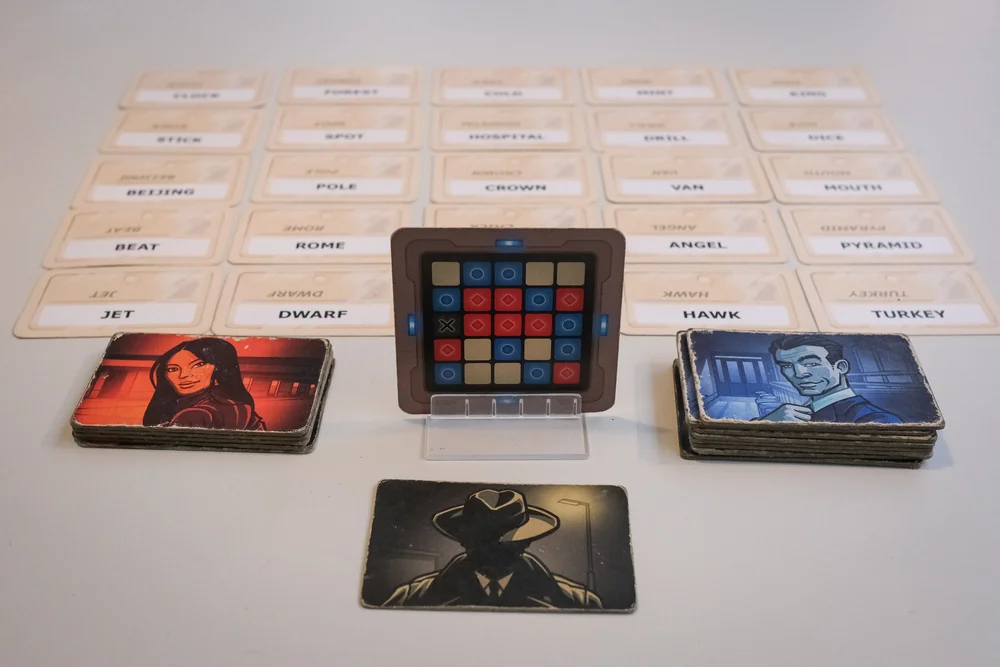
The game set-up is a five by five grid of word cards in the centre of the table, selected randomly from a sizeable stack. Players form two teams, red and blue, then each team selects a ‘spymaster’ who will be their clue-giver for the rest of the game. The two spymasters sit where they can both see a card which allocates each word in the central grid to either the red team, the blue team, a decoy beige category… or one final option which I’ll come back to.
Spymasters take turns to provide a clue to their teams in a specific format: a single word that relates to one or more of the words of their colour in the grid, plus a number which indicates how many words the clue links to. Coming up with the clues is fiendishly tricky, but once that’s done, spymasters simply sit back and maintain a poker face as their team members decide how to interpret their new information, and make a guess at which word(s) in the grid the clue relates to. Each word guessed correctly is covered by a card of the team’s colour, bringing them one step closer to victory. Incorrect guesses either end the turn (beige words), give points to the other team (words of the opposing colour) or, possibly… LOSE THE ENTIRE GAME, in the case of the one black word on the grid: the DEADLY ASSASSIN.
With so much at stake, there’s no shortage of tension here, and few moments in gaming are as satisfying as thinking up or cracking a particularly great clue… or as nerve-wracking as watching your team confidently take hold of the wrong end of the stick. This game works well with four players and brilliantly with six, and if you can’t get together in person there’s an awesome free online version here.
If you’ve mastered Codenames and aren’t put off by the idea of getting your head around a few more rules, we’d strongly recommend Decerypto – check out the review here to find out why.
Games to relax with
We get it - sometimes all you really want from a party is the chance to hang out and enjoy the company of other people, a pleasure many of us have recently come to appreciate like never before. Here are a few more relaxed games that might just add the final cherry to the cake…
Wavelength
There was a phase in the not-too-distant past where Wavelength was the only game we wanted to play, and to be honest we’re not completely sure we’re over it. This is the game that’s got it it all as far as we’re concerned: great starting points for creativity, insights into your fellow players, dramatic reveals, and plenty of laughs. Among its other achievements, Wavelength is about as close as you can get to a party game for just two players. With four+ players, the game can be played as a team game in which two teams race to ten points, but the more relaxed way to play (and our personal preference) is cooperatively, which also makes it work beautifully at even small player counts.
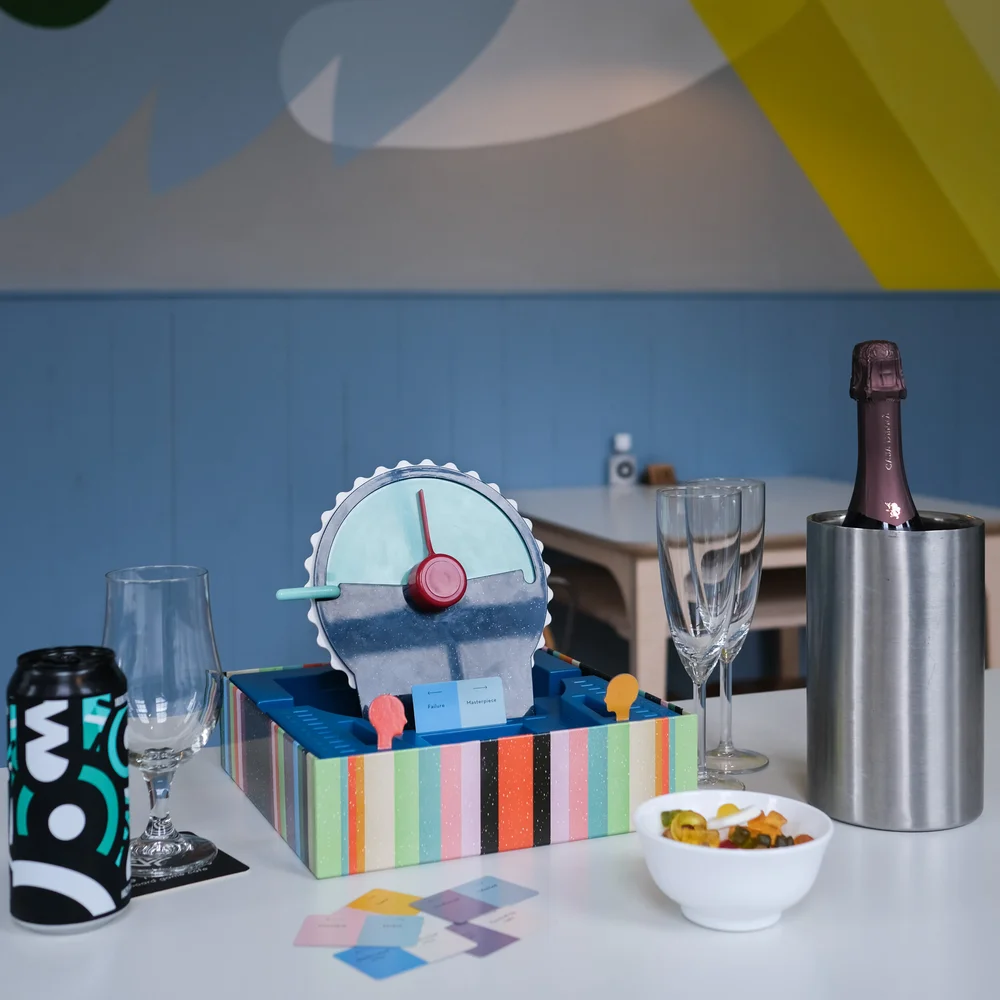
The premise of Wavelength is simple: the clue giver draws a card which defines a scale - popular to unpopular, say, or round to pointy, then secretly look to see where on the scale the target lies for this round by peeking behind a sliding plastic screen. They must then come up with a simple clue to help their team mates guess where on the scale the answer lies. Let’s say you were lucky enough to get a target right at the ‘round’ end of the ‘round to pointy’ scale. You might say ‘an orange’ and your team would probably get the answer pretty much spot-on. But what’s in the middle of the scale? Or just slightly towards to the pointy side… but not too far? Your team mates (all the other players in the cooperative set-up) discuss your clue, and adjust the position of a needle to define their guess. Time for the big reveal… if the needle lands within the coloured segments on the target, you get the corresponding number of points. If not… onto the next clue giver who picks a new scale and re-spins the target.
Wavelength is one of those games that easily transitions into a fun group activity without a definite end point, but so much the better for a fun, relaxing evening we reckon! There’s only one catch, but it’s a fairly big one: Wavelength is currently completely out of stock in the UK, but we’ll be snapping up and many as we can as soon as that changes. In the meantime, you can always come and play our copy at the cafe. (2021 update: this is no longer true - hurray!)
Just One
Occasionally a game comes along that’s so brilliant yet simple that it feels like it’s been discovered more than designed. Just One is one such game: you can teach it in under a minute and has very few components, but yet somehow there’s enough fun there to keep you going for hours, and the fact that it’s completely cooperative pretty much guarantees a nice chill time.
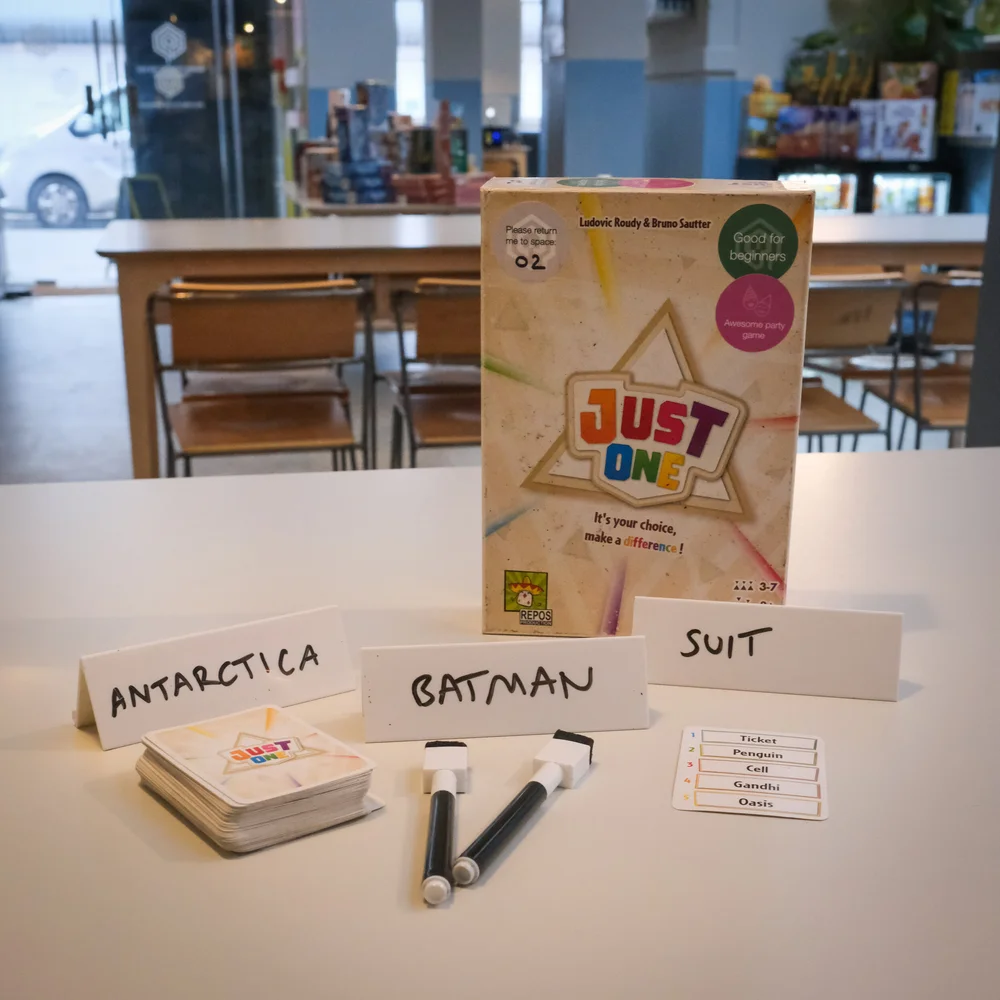
To begin, everyone gets a mini whiteboard that doubles as a card stand and dry-wipe marker (and in our experience, already they’re almost inexplicably delighted!). The guesser for the round draws the top card from a deck without looking at it and places it in their stand facing away from them, then picks a number between one and five. The number determines which of the five words on the card is now the clue for this round. Everyone else then secretly writes JUST ONE (see what they did there?) word on their whiteboard that will help the guesser get the clue. When everyone is ready, the guesser closes their eyes while everyone reveals what they’ve written, and if any words are the same, they are eliminated from the game. The guesser then opens their eyes and tries to work out the starting word from the remaining clues. If they get it, great - that’s a point for everyone. If not, it’s onto the next player. After 13 rounds, you tally up your points, and check the rules to see if you did well… or, you just carry on playing because you’re having a good time and it’s not about winning anyway!
An added bonus of this game in the current climate is that it’s perfect for playing via Zoom, etc - folks in other locations just need some scrap paper and a pen, and you’re good to go. Check out our previous blog post for more inspiration on gaming via video link.
Dixit
Dixit isn’t for everyone: if competitive strategy games full of numbers are your happy place, this might not be your thing. But, if you’re a sucker for gorgeous artwork and like games that give you an insight into the strange workings of other people’s minds, Dixit might be right up your ally.
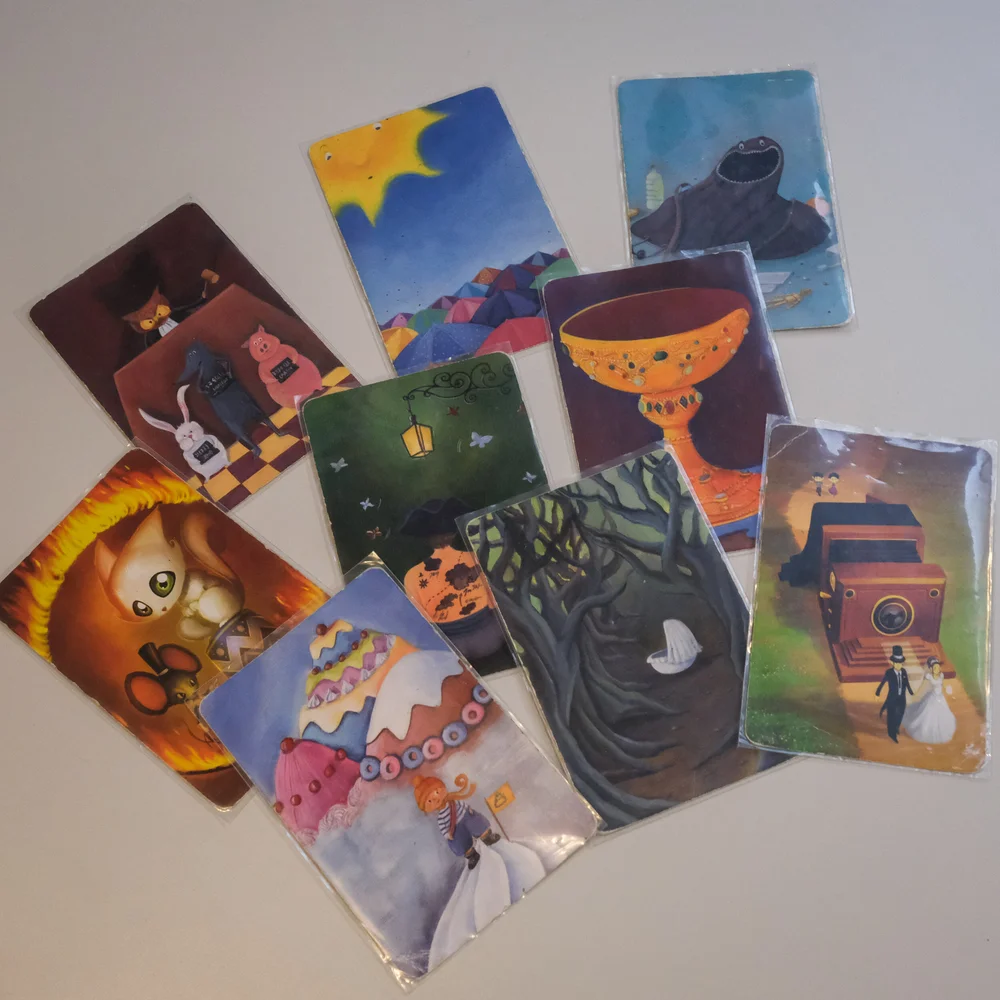
Everyone begins with a hand of cards full of beautiful pictures that all look like something a fairy tale character would dream about (and then possibly need to discuss in therapy). On your turn, you pick a card from your hand and place it face down on the table, and give a clue inspired by the card, which can be anything you like - a word, phrase, song or even just a noise. Everyone else then secretly chooses a card from their own hand that they feel links to your clue in some way. All the cards are shuffled and placed face up in the centre, then everyone votes on which card inspired the original clue. The clue-giver gets points if some players BUT NOT ALL get it right, so it’s important not to be too literal, and everyone else gets points for voting correctly and for anyone who picked the card they choose.
With the right group, Dixit can really be the magic formula, and you’ll just want to play on and on. If it hits the spot with your group, you might also love the similar but team-based game Muse, the more complex and richly-themed Mysterium, and recent release Obscurio which adds a hidden traitor mechanic for extra spice.