

Duos Review – A Fun Card Game That Won’t Steal the Spotlight
Disclaimer: Duos was provided for free by CMYK, although the writing and opinions of this article are my own.
Duos is the third entry in CMYK’s Magenta series, a collection of games designed to bring card games back to the board game table. I’ve already reviewed Fruit Fight and Figment, both great games, but more like opening acts rather than the main event.
Duos, though? This one’s different. It’s the kind of game you can gather your friends around for, and waste the afternoon away. Playing round after round while effortlessly catching up on life.

How to play
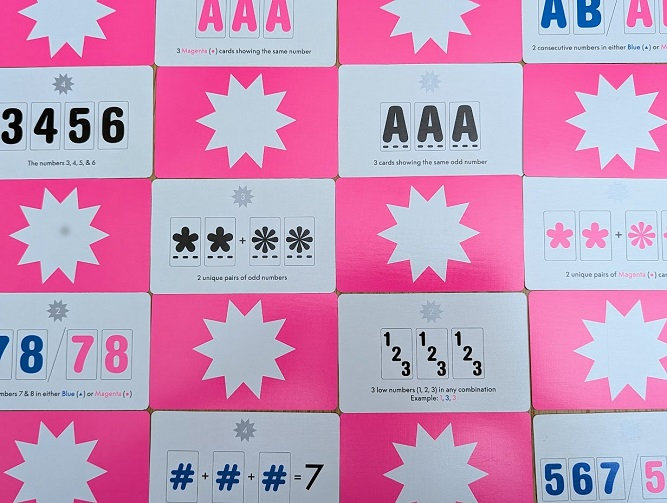
Duos, as the name suggests, is a team-based game where pairs of players work together to complete objectives and score points. Throughout the game, you’ll collect and pass numbered cards, aiming to complete objectives that range from a simple gathering of three same-numbered card, to more complex challenges, such as assembling four blue cards that add up to 12.
At the start of the game, each player receives a few cards and a personal objective that only they can complete. If you’re not happy with your objective, you can take a mulligan—discarding it and drawing a new one. However, you must keep the second draw, for better or worse.
In the centre of the table, a row of three cards is placed, along with a shared objective that anyone can complete. Since communication is limited, all objectives are played face up, giving everyone full visibility of what needs to be done.
During your turn, you must take two number cards, either from the centre row or from the top of the draw pile if you’re feeling lucky. However, you don’t have to draw them right away; you can take other actions before, during, or after picking up your cards.
Your other optional actions include:
- Completing an objective—either your personal one or the shared public objective.
- Silently passing one or two cards to your partner.
You can take these actions in any order, and once you’re done, play passes to the next player.
The game continues until one team completes eight objectives, triggering the final round. Everyone gets one last turn before points are tallied. Easier objectives might be worth only a single point, while tougher ones can be worth as much as six—so the winner isn’t always clear until the final count!
Great company, light strategy
Compared to the rest of the Magenta series, Duos lacks the same excitement. It doesn’t have the rambunctious laughter of Fruit Fight, the mind-warping eye test of Figment, or the strategic nuance of Fives. Instead, Duos is the kind of game that takes a backseat to the company you’re with. A laid-back experience rather than the focal point of game night.
It falls into the same category as classic 52-card games or casual staples like Uno or Skip-Bo, games that are fun but don’t demand your full attention, letting you chat, sip a drink, and still play a hand of cards.
And Duos nails that accessibility. It’s ridiculously easy to teach—explain the rules in a minute, and you’re off. But with that accessibility comes a fairly low strategic ceiling. So as much as you might want to sink your teeth into the game, there’s only so much to chew on before you’re just chewing on bone.
Gameplay boils down to watching what cards players pick up, grabbing the right ones to help you and your partner complete objectives—or sniping them from your opponents before they can score theirs… and not much more.
That’s not to say Duos isn’t enjoyable. There’s a certain charm in watching your partner’s objectives and trying to set them up for success—only for them to return the favour by handing you two completely useless cards. That back-and-forth, along with moments of hopeful anticipation as you both cross your fingers for the right draw, leads to some fun moments.
But the downside to the lack of depth is that between turns, there’s not much to do except wait. This downtime was more noticeable in six-player games than in four, though it never became frustrating—because, again, the real enjoyment here comes from the social experience rather than the game itself.
Ultimately, Duos smashes CMYK’s stated goal of bringing card games back to the game table. It feels like the perfect game for my mum, whose every second Sunday is reserved for wine, cheese, and card games with friends. But for me, it lacked the excitement I’ve come to look for in games, and the usual eccentricity I’ve come to expect from one of my favourite publishers.
Duos
Players: 4 or 6
Playing Time: 30 min
Designer: Johannes Schmidauer-König
Publisher: CMYK
Duos delivers exactly what it sets out to: a light, social card game that anyone can play. It’s great for casual gatherings, where the focus is more on conversation than deep strategy. But if you’re like me, you might find yourself wishing for a little more excitement.
Pros
- Easy to learn and quick to teach, you’ll be up and playing in a minute.
- Perfect for casual playing, where you want to play and chat at the same time.
- Fun partner dynamics with moments of surprise and laughter when passing cards.
Cons
- Limited strategy, with a lot of relying on getting the right draws.
- Not very engaging between turns, downtime can feel noticeable, especially with six players.
- Restrictive player count, where you need 4 or 6 players. So make sure you have a backup game in case someone drops out!
- Lacks the excitement and uniqueness found in other CMYK games.
This site keeps going thanks to your support. When buying through links on this post, I may earn a small commission—without any extra cost to you. Full disclosure here.
More Sunday afternoon card games


How does it compare?
See where this game falls in our board game rankings.