

Iron Triangle #3: Bases, Caches, Refugees, and Tet Offensive
In the previous article, we discussed the Sequence of Play and the different decks and cards used during the game. This article focuses on four key mechanics: Bases, Refugee Generation, Caches, and the Tet Offensive.
Bases
Bases can be placed adjacent to control markers on region tracks to accelerate your own gains or inhibit your opponent’s.
VC tunnel bases and U.S. firebases function almost identically in play but differ in what they represent: tunnel bases are finite, while firebases are unlimited, reflecting the imbalance between insurgent ingenuity and American resources. The VC begin with more bases, and their survival matters beyond moment‑to‑moment control, as remaining tunnel bases, along with regional control and infiltration into Saigon, directly contribute to the Tet Offensive endgame.

Firebase (US): The US player has access to one Firebase, which may be deployed or moved using Action cards. If the Firebase is destroyed it is placed back on its home space on the board, ready to be redeployed.

Tunnel Bases (VC): The VC player has access to four Tunnel Bases. These differ from the US bases in that:
- They are finite, i.e., if they are destroyed, they are removed from the game.
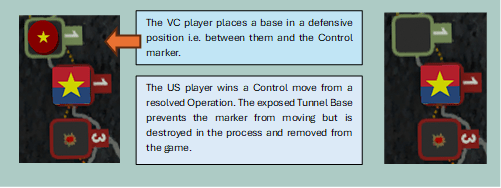
- When a base is utilised at the end of the round to effect Control it is exposed and flipped face-up, which makes it easier for the US player to destroy it and remove it from play.
- They count towards the Tet Offensive. If the game reaches the Tet Offensive, all Tunnel Bases remaining in play are returned to their home spaces and the relevant number of Tet tokens are added to the Tet bag.
Bases – Positioning
Defensive Positioning: If placed between you and the control marker the base will defend against your opponent’s control gains by absorbing one control reward gained from Operation successes.
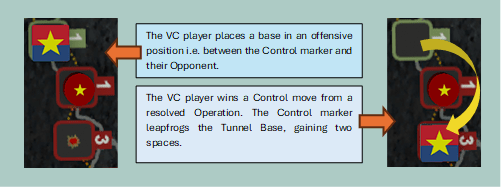
Offensive Positioning: If placed between the control marker and your opponent the base will accelerate your gains by allowing the control marker to leapfrog the base, turning one gain into two.
Caches

Cache tokens represent the weapons, ammunition, and supplies moved south from North Vietnam to sustain and reinforce VC operations. In Iron Triangle, they model the material support that underpinned insurgent actions by allowing the VC player to increase Strength during Operations.
Supply action cards reflect organised resupply efforts, enabling multiple cache tokens to be distributed across one or more Operations, with each token providing a +2 Strength bonus. As in the historical conflict, however, these stockpiles carry inherent risk: once deployed, caches become exposed targets, vulnerable to US actions aimed at locating and destroying enemy supply networks.
Refugees
Infrastructure Icons and Their Impact on Play

Some operation cards include infrastructure icons, which signal that certain U.S. actions aimed at disrupting Viet Cong supply through displacement of the local population will remove Caches from the VC player supply but will also generate Refugee tokens.
Likewise, these cards can be played against Operations which contain VC deployed Caches. In this instance the US player can choose between removing the +2 Strength tokens or targeting infrastructure and removing Caches form Supply (as detailed above).
Saigon

When these actions are taken, the resulting Refugee token(s) are placed in Saigon, representing the humanitarian pressure created by large-scale disruption.
How Refugee Tokens Function
As refugee tokens build up in Saigon, they give the VC player several strategic options on their turn:
- Recruit — Discard two tokens to draw an additional card.
- Infiltrate — Discard four tokens to place a Tet token into the draw bag.
- Escalate Crisis — When eight or more tokens are in Saigon, discard them and immediately reduce Stability by one step.
Tet Offensive
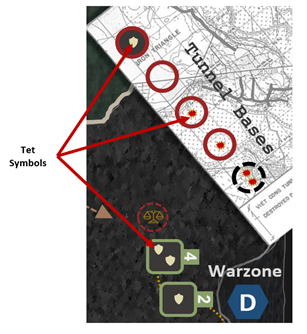
If neither side achieves an early victory by the end of round three, the game escalates into the Tet phase. At this point, the Tet token bag is prepared with three VC and three U.S. tokens, along with any additional VC tokens introduced earlier through the Infiltration of Saigon.
Further VC and U.S. tokens are then added based on the number of Tet symbols present across key areas of the game, including the final positions of the Region Control markers and the status of Tunnel Bases, with all in‑play tunnel bases returned and reassessed from their nearest adjacent free spaces.
Five tokens are then drawn from the bag, and Public Opinion is reduced by one step for each VC token revealed. If Public Opinion reaches or passes the bottom of its track, the VC secure victory; otherwise, the U.S. player claims the win.
Collectively, these mechanisms aim to intensify asymmetrical play and build tension by providing players with divergent, yet mechanically connected, decision spaces. The final article in this series will present an example of a full round of play, culminating in the Tet Offensive phase that finished the game.
Previous Articles: