

THE PHYSICIST AND THE DENTIST: A CHECKPOINT CHARLIE STORY
By Russ Brown
Edith stood in the line of Brits and Americans, her papers in hand, waiting to register with the US Soldiers at Checkpoint Charlie. That was the first step in the ritual of crossing into East Berlin. A few people sat at the window seats of Café Adler across the street, casually sipping coffee and pretending to read newspapers while carefully watching the checkpoint.
The Berlin Wall in that part of the city actually ran east to west. A few blocks to Edith’s left, it turned north, around Potsdamer Platz and up past Brandenburg Gate. She waited in that line because there was an elevated viewing platform over there where westerners could stand and look over the wall across Potsdamer Platz, and that morning one of Weller’s boys had stood up there and noticed something on the other side of that desolate plaza.
Normally, anyone who got within a hundred meters of the wall on the east side risked being shot by border guards, but there was a small brick building on the east side of Potsdamer Platz, barely fifty meters from the wall, which had once been a shop on that bustling market square. Its western wall had been cleanly removed by an American bomb during the war and had never been repaired. It had been repurposed as a bus shelter, and East Berliners had learned they could stand in there and stare across at the West all they wanted, especially at the people up on the viewing platform staring back at them. The plaza they gazed across, where many of them had done their shopping before the war, was now deserted and criss-crossed with barbed wire and tank traps. The bus shelter was especially busy on Sunday mornings, as if the new religion of the East was staring west and imagining what might have been.
When the crowds had cleared that morning, Weller’s boy, armed with binoculars, had noted a small yellow chalk mark, waist-high on the bricks of the shelter’s surviving back wall. He’d sketched out what he’d seen, a horizontal line with two descending lines, “Like one of them arches at Stonehenge.” But it wasn’t Stonehenge. It was the Greek letter pi, the signal that Peter Simanis, a Soviet scientist who had been feeding a British Secret Intelligence Service dead drop whenever he visited East Berlin, was getting nervous and wanted out.
The American soldier at Checkpoint Charlie was the easy part – a polite smile and a cursory glance at your documents so they could report your name to the second soldier in the booth behind them for their log. Today’s soldier looked too young to be in the army and was barely taller than Edith. She could have been his mother, if she wasn’t married to the service. He actually seemed to be enjoying his job, standing out there in the July heat, and after looking at her papers twice and nodding three times, he asked how long she would be “over there.” The soldiers all asked this, so they could add it to the log and know when to go looking for lost sheep.
“All day. Lots of shopping.”
He looked at her papers again. “Dentist, huh?”
“Dental hygienist. For the British troops.”
She braced herself for the usual jokes about British teeth, but the boy in a man’s uniform just nodded again, held up one finger for her to wait, and popped into the shack to give his report before handing back her papers. “Have a good time.”
She wasn’t a dental hygienist, but she had studied Russian language at the army school at Shrivenham, at the same base as the army’s dental training center, so it was a good cover. It meant she could act as a courier between SIS Station and the army posts. It also meant she had army-issued papers, which drew less attention from the East Germans than a diplomatic passport. It was even possible that the KGB believed she was there to clean teeth.
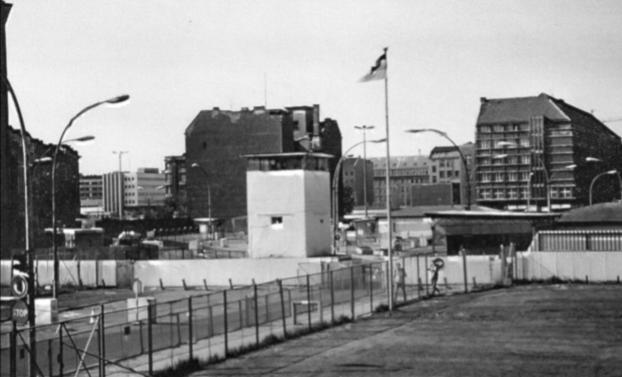
Soviet side of Checkpoint Charlie, Berlin. Image by Roger Wollstadt, licensed under Creative Commons Attribution-Share Alike 2.0
She walked across the small no-man’s land between the West German and East German barriers, stepping over the white line marking the border. The first person she encountered was an East German police officer, a Vopo, standing with his hands folded in front of his long coat that looked far too warm for the day. He held out his hand to stop her, as he had with each person in front of her, and made a show of looking in her handbag before letting her pass. She had to do as he asked, but it was important, she had been told, to not make eye contact or even nod in acknowledgement of anything he said. The Allies didn’t accept the splitting of Germany, and therefore didn’t recognize East Germany as a state or East German authority to control the crossing, and apparently it was everyone’s duty to help get that diplomatic message across.
The concrete Soviet barrier came next. It didn’t have a dedicated shack like the American side. Instead, the Soviets used the remains of a small shop as their interview post. Pedestrians making the crossing had to actually step inside with the Soviet soldier while their documents were recorded and verified. It had been intimidating the first time, but had become routine. Westerners made this crossing all the time, mostly to spend money in East Germany, where certain items were ridiculously cheap. The Berlin Wall was for keeping East Germans in, not keeping westerners out. She knew all that, but today she had to calm herself down. She wished, for a moment, that she had taken Weller up on his offer to loan her his car for the crossing. Even though it might have made the checkpoint easier, she was sure the KGB knew it well. It was flashy, American, only a few years old, and already had eighty thousand miles on it. Weller said the retiring diplomat he’d bought it from had driven it hundreds of times back and forth across the East German corridor “just because he could.”
She waited in line for her turn, making a show of checking her watch and pulling out a compact to fix her makeup. When she reached the front of the line, she prepared herself for some interrogation, but actually spent less time in the storefront booth with the pale Soviet soldier than she had with the American. She had been so concerned with what was coming next that she hadn’t noticed the much younger, much prettier American woman in line behind her. But the Soviet soldier noticed. He pushed her papers back at her with barely a glance and ushered her out of his booth to make room for the younger model. Was that trick in any of the tradecraft manuals back in London Station? It ought to be.
As she left the booth, the screech of the elevated S-Bahn train coming into Friedrichstrasse station to the north reminded her that she had a schedule. She could have taken that train across the wall, shown her papers at the station, but it would have felt like a betrayal. Most West Berliners had stopped riding the S-Bahn months ago, when they found out that the fares they were paying were going straight toward building the wall that divided their city.

Friedrichstrasse station, Berlin. 1960s. Bundesarchiv, Bild 183-36219-0001/CC-BY-SA 3.0
She stowed her papers and stepped into yet another old storefront, this one used as a currency exchange. She waited in another line to trade British pounds for East German marks. She was only required to exchange five pounds, but she handed over ten and patted her oversized bag to show she was serious about a day of shopping.
When she stepped outside, she immediately noticed a black and white Wartburg coupe only a dozen paces up the street, parked facing the checkpoint. A man in a suit and a trenchcoat leaned against the front of the car with his arms crossed, watching the crossing. He would have been the perfect stereotype of a spy if he wasn’t wearing a white straw porkpie hat. She recognized him immediately, mainly because of the hat. The codename the SIS used for him was Keaton. He was a Stasi agent, a member of the East German secret police. The KGB had better resources, but the Stasi knew their own city well and could be far more dangerous. Fortunately, it was very unlikely his presence had anything to do with Professor Simanis. The professor was Soviet, a Latvian physicist who had worked his way up through Minsk and Lomonosov to the state nuclear research facilities at Sarov. The Stasi wouldn’t care if he was sharing Soviet secrets.
Edith ignored him and headed north toward her first meeting along Unter den Linden street.
Crossing into East Berlin was like going back in time a decade or more. Very few signs of the war remained in West Berlin, except in a few places like Mehringplatz, and where war damage was intentionally left as a memorial, but in the east, bombed out buildings were everywhere. Many of them still had piles of rubble, untouched for more than fifteen years. Most of the streets were as deserted as during a wartime air raid. Unlike wartime Berlin, however, the walls of many buildings, and placards along the sidewalks, were covered in communist propaganda slogans and cartoons
The areas the East Germans had rebuilt, with the help of the Soviets, were filled with plain, brutalist structures, entirely about function and without style. Everything and everyone in the East seemed deathly afraid of looking anything like the capitalist West.
She had a little time to kill, and a fair amount of money that she couldn’t exchange back, so she ordered terrible coffee and a simple but passable sandwich in a diner near her first meeting spot. She checked her watch, which she had actually bought in a shop not far from that diner. East German watches were solid and reliable, and embarrassingly inexpensive given the exchange rates.
She had rehearsed this whole mission just a week earlier – the crossing, the brush pass on Unter den Linden, and the actual extraction through an abandoned office building up near Wedding. She had even checked out the path to her backup hideout if things went south.
The timing of her rehearsal wasn’t a coincidence. Simanis had left a note in the dead drop ten days ago and whatever was in it had set wheels turning. Apparently, the chalk mark on the bus shelter hadn’t surprised anyone. Edith had no idea where the dead drop was, or what Simanis had provided through it over the past few months, but it must have been valuable if the SIS was paying him back by bringing him across rather than just cutting him loose. Or maybe they were worried that if they left him in the East, the KGB might find out everything he had given them and who his contacts were. She pulled a pen and a small piece of heavy drawing paper from her bag and wrote an exact time, 17:55, and the address of a night club north of the train station. She folded the note and tucked it into the pocket of her dress.
The coffee ruined the sandwich so she left most of it uneaten. She had a description of Simanis and knew he would be wearing wire-rimmed glasses and no hat on his balding head. She walked east along the sidewalk, on the north side of the street, which was fairly busy for East Berlin. She spotted him up ahead and had time to get his attention and give the signal by rubbing the back of her neck. He nodded back, which he wasn’t supposed to do, and shifted slightly to his left, joining a small group of people he had been walking beside. That would make the pass more awkward, but maybe he knew where his surveillance was and was moving to screen the exchange. She was probably giving him too much credit. She smiled at him, hoping it would calm him down and wouldn’t be noticed, or would at least be misinterpreted by anyone following him. The worst thing would be if he panicked. It would be better just to miss the exchange and have to make another pass.
But it worked. At the last moment, she pulled the paper from her pocket and held it out, against her body at waist level. The small group of pedestrians had accepted the professor as one of their own for the moment and gave him cover as he deftly grabbed the paper without breaking stride.
She breathed, holding her bag tight and scanning the sparse storefronts on her left. Now she had until sunset to just shop and work her way north. She hadn’t needed to rehearse that part.
She arrived outside the club just before nine and could see Simanis approaching. He was dressed in the same suit as earlier, which might stand out in the club, but it wouldn’t matter. He walked right up to her and she offered her arm and then led him inside. They moved quickly through the groups of schnapps drinkers to a side door that let out into a zig-zag alley between buildings. In seconds they were deep in the dark streets on the east bank of the river Spree with no sign of anyone following. She traced a path to the abandoned office building that avoided the open spaces and clear views from the border guard stations. She led him through a doorway with no door and up a flight of stairs to a room with a large, open window and no window pane. In the corner of the room, where no one could see them through the opening, they sat quietly for a moment, listening.

West German border guard watching the wall. Library of Congress.
They would be looking for him, scouring the city, alerting the checkpoints.
“Outside, beneath this window is a small ledge. In a few minutes, you’ll hear the S-Bahn breaking as it comes into Friedrichstrasse station. When you do, count to twenty like this…one…two…three…four.” She tapped out the rhythm on her leg. “The guards in the stations to the south will be changing at that time. When you hit twenty, you step out onto the ledge and shimmy along it to the right.”
Over the nine months since the wall had gone up, guard towers had popped up all along it, mostly to the north and south. However, in the center of the city, buildings could block the view or sometimes provide as good a vantage point as a tower at no cost. Her main concern right then was one window on the fourth floor of a building to their southeast.
“The guards will only be able to see you for the first five meters or so.” She pointed through the wall behind them in the direction of the guard station. “Then you’re in the clear. The west side of this building is part of the wall, with all the windows bricked up. From the ledge you’ll be able to reach the wall and climb over. Someone on the other side will help you down.” Another one of Weller’s boys. “There’s a narrow gap in the barbed wire where they haven’t yet attached it to this building.”
He nodded.

Section of Berlin wall. From the Berlin Experience
She wasn’t asking him to do anything she hadn’t done. She had been through all of this a week ago, at that exact time, but hadn’t gone over the wall. She wasn’t going to tell him how narrow the ledge was. She looked down at his feet. They were big. “Take your shoes off.”
That was it. The train would arrive soon. She had done her part and now it was up to planning, some dumb luck, and a physicist’s sense of balance.
Edith left the way they had come, moving through the same blind spots, but turned toward a hidden corner where she knew she could see that ledge but no one could see her.
As she drew closer in the darkness – East Berlin was also much darker than West Berlin – she thought she heard voices just as the screech of the train started. She pressed against a wall and started to count along with Simanis, but she needed to see if he had made it. As she moved slowly toward her viewing spot, she saw that someone else was already there. It looked like three people. Even in the darkness she could make out a white hat.
Keaton had found them. But how? It was unlikely that the Soviets had called in the Stasi when they lost track of Simanis, and it looked like the three of them were just waiting there, expecting someone. They weren’t even looking toward the abandoned building or the wall, and she couldn’t allow them to. The train was already pulling into the station. Simanis had to be stepping out of that window.
She worked it all out, or at least she had a plausible explanation. Keaton wasn’t there because of Simanis, he was there because of her. Someone must have spotted her during her rehearsal and gotten suspicious. Apparently, they hadn’t seen her in that building, or that’s where they would have gone. Had Keaton come to Checkpoint Charlie that morning to verify it was her? That would mean the Vopo there was watching for her and had called Keaton when he spotted her.
She couldn’t let her mistakes compromise Simanis, so she ran. She made sure her footfalls were loud enough at first that they would hear her, then she moved more quietly. She took the route she had practiced toward her fallback hideout, an all-night Schnitzel restaurant a kilometer to the southeast, run by a friend of the service.
The train had stopped at the station and was silent. If Simanis hadn’t choked at the last minute, he would be climbing over the wall. She hadn’t heard any gunshots from the guards in that window. Even if Simanis had fallen from the ledge and was injured, they wouldn’t hesitate to shoot him, so she was hopeful that he had made it.
She paused long enough to be sure Keaton had lost her trail, at least for now. She would have to find her own way back. The Stasi, at least, no longer believed she was in Berlin to clean teeth.