

Coast Watchers – Production Set First Look

Here is a preview of Coast Watchers – Volume I in my new Recon Series – in action as a final product, including a peek at solitaire play.
After the faraway printing plant produces the physical games, it typically air freights a few to GMT for a final check before the 1000s of copies begin their surface journey to the Warehouse. I received my designer’s advance copy in Virginia the other day, as others went to GMT principals and to Coast Watchers solitaire co-designer Todd Quinn in Australia.
What we are checking for at this late stage: Does everything have the proper thickness, gloss, rounding, color? Do physical bits truly fit together as we planned? Did we provide fully up-to-date art files? Are all components in there? And so on.
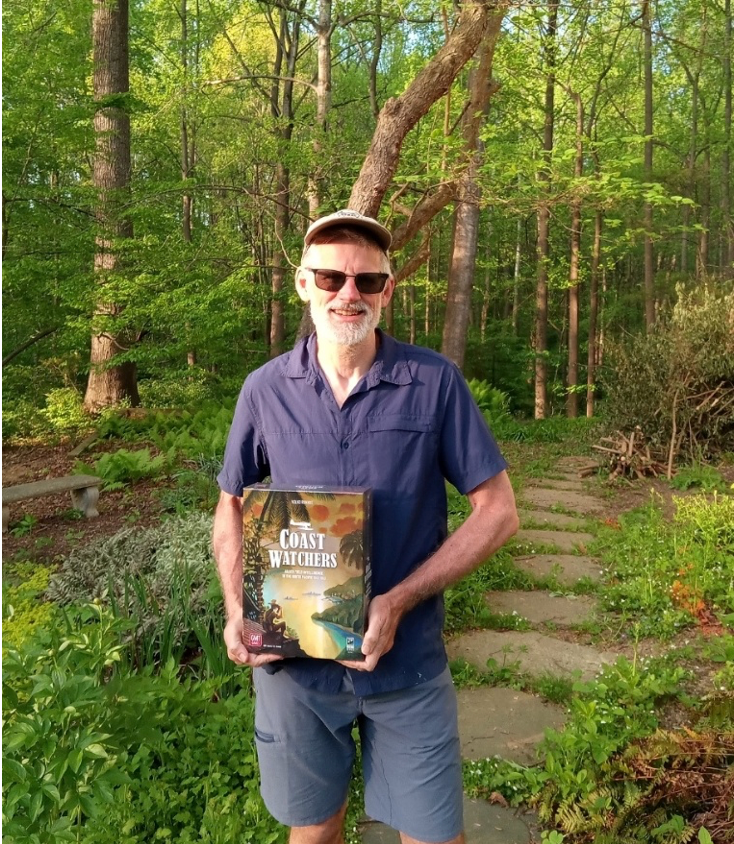
With a double-thick board, three booklets including a weighty Playbook, thick mats and counters, six card decks, scoring pad, heavy stock play aids and set up sheets, 64 blocks plus spares, and rather chonky pawns, this box is heavy! By popular feedback, the booklets are matte finish rather than glossy, not just to avoid glare but to make it easy for you to highlight rules, mark notes and – heaven forbid, but best to be ready – any errata.

This is, as far as I know, GMT’s first product featuring painted rather than embossed or stickered blocks and gameboard recesses to hold them. In the Recon Series, the standup blocks hide the status of each location on the map – here, the potential network of Allied stations spying on the Japanese across the South Pacific theater.

The Coast Watchers board is double-thick to accommodate recesses that tidily hold each Station block in place – so you can be sure in play that no jarring can give away your stealthy move. I think this feature is again a first for GMT production!

The finished Coast Watchers is the product of a team of three artists. Robert Altbauer, who has done so much great work within my Levy & Campaign Series, did the game map. Matthew Wallhead, another Levy & Campaign veteran, did the cover painting. And Wouter Schoutteten did all the other art – including integrating the whole into a harmonious, tropical look.

If you want to hear and see more about the art and the artists, be sure to take Candice’s Showcase video!
Having unpacked the whole Coast Watchers package, spread it out, opened the decks and punched the counters, no production issues discovered. It’s time to set up and see how she runs!
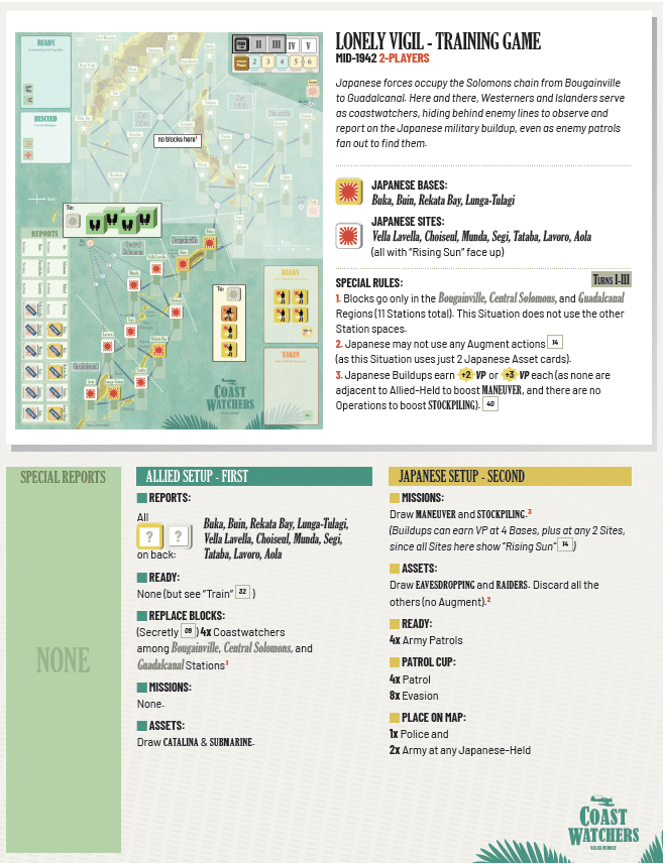
Head of GMT Development Jason Carr did just that, even before I had the wrap off my copy. Naturally he started with the first tutorial scenario in the game, “Lonely Vigil”. You can read about the game’s full array of 15 “Situations” in my scenarios preview here. This first Training Situation (setup sheet shown here) gets you going with just a portion of the map – the Solomon Islands chain from Bougainville down to Guadalcanal – and just a few cards.
Here are a couple photos from Jason of his set in action.

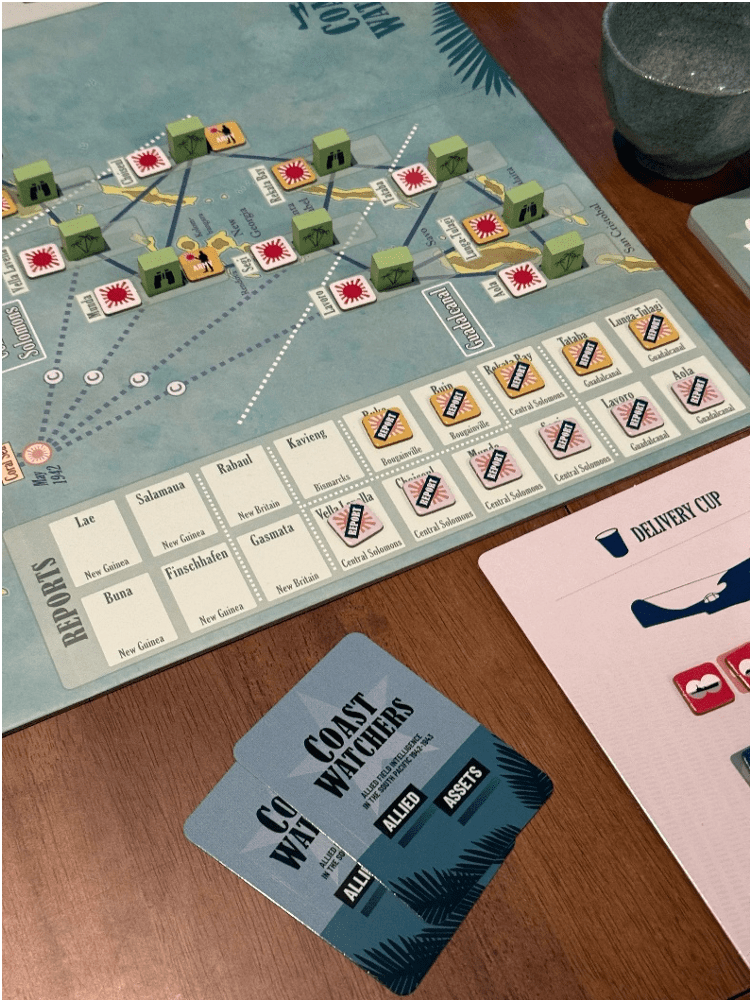
Here are a few more setup shots from me, as I wanted to see what the different Situations look like in the finished product and perhaps kick them around a bit on my table:

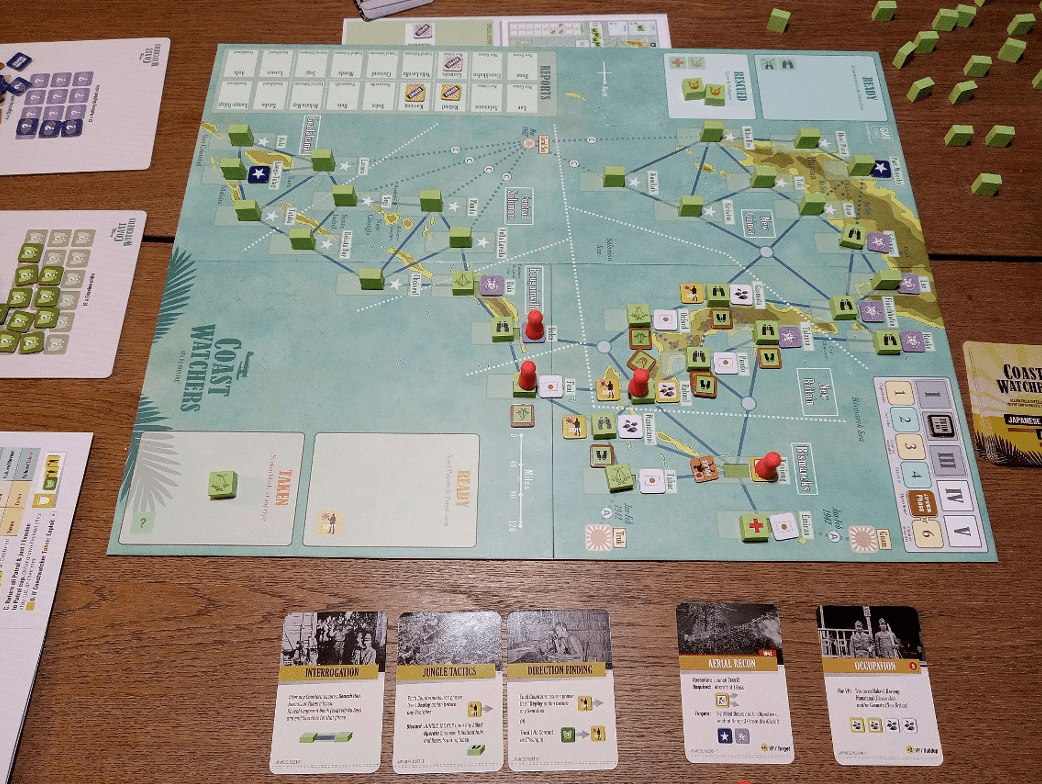


Meanwhile, in Canberra, Coast Watchers developer and solo systems co-designer, Australian Todd Quinn, takes his new set for a spin – starting with the solitaire experience that he did so much to create. Here as the Allies. His photos and report:

“I stayed away from Kavieng and Rabaul due to the Police, which was just as well as both were targeted during Turn I.”
“Crap, just realised I did not Evade Buin. Missed that. Paul Mason is in some trouble come Turn II. … Oh no never mind. They just found him. I can Evade him soon. …”
Some details of what you are seeing in his solitaire playthrough:

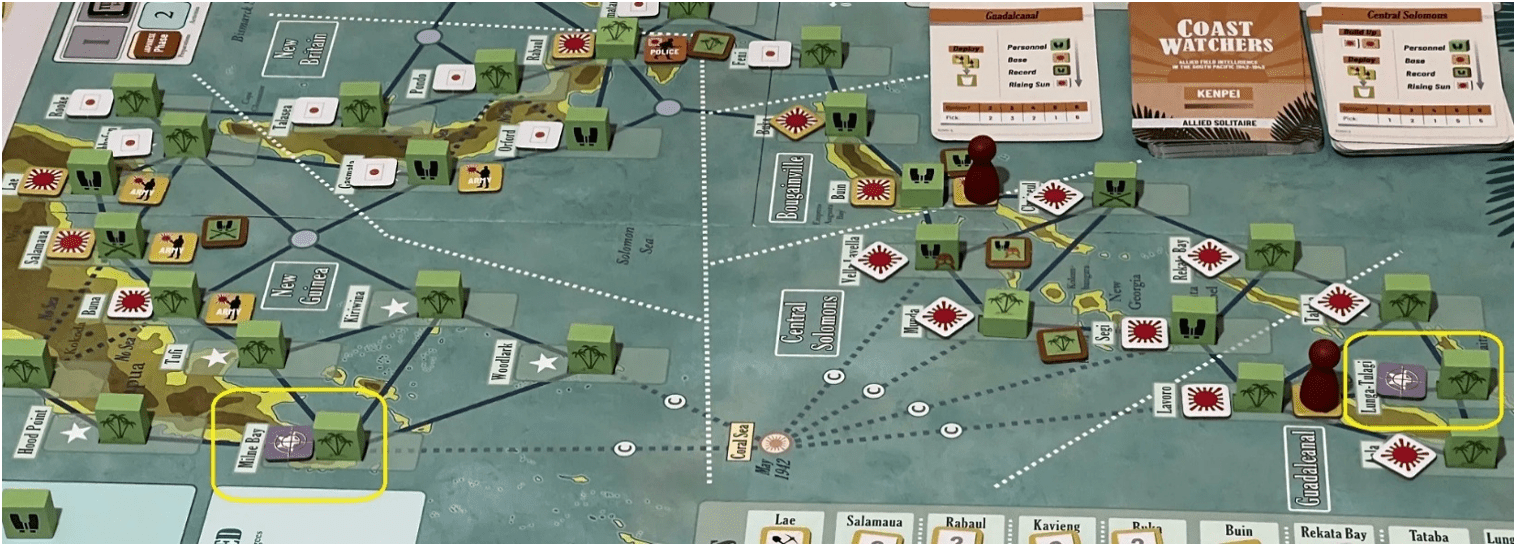
Todd is playing Situation E WATCHTOWER August 1942: US forces have just landed on Guadalcanal, and the Japanese military is reacting. The coastwatchers need especially in this moment to provide warning of Japanese counterattacks by air and sea.

… Meanwhile, the Japanese also have an amphibious assault in the offing against the Australians at Milne Bay at the tip of Papua. So Milne Bay along with Lunga Point and Tulagi Island at Guadalcanal are marked as Allied Controlled (white star) Japanese Targets. …
The Playbook includes a visual analysis of where Japanese military activity might occur in this Situation – including air and sea Missions against Allied targets. This “brief” is not needed to play but can help you focus your coastwatching efforts.
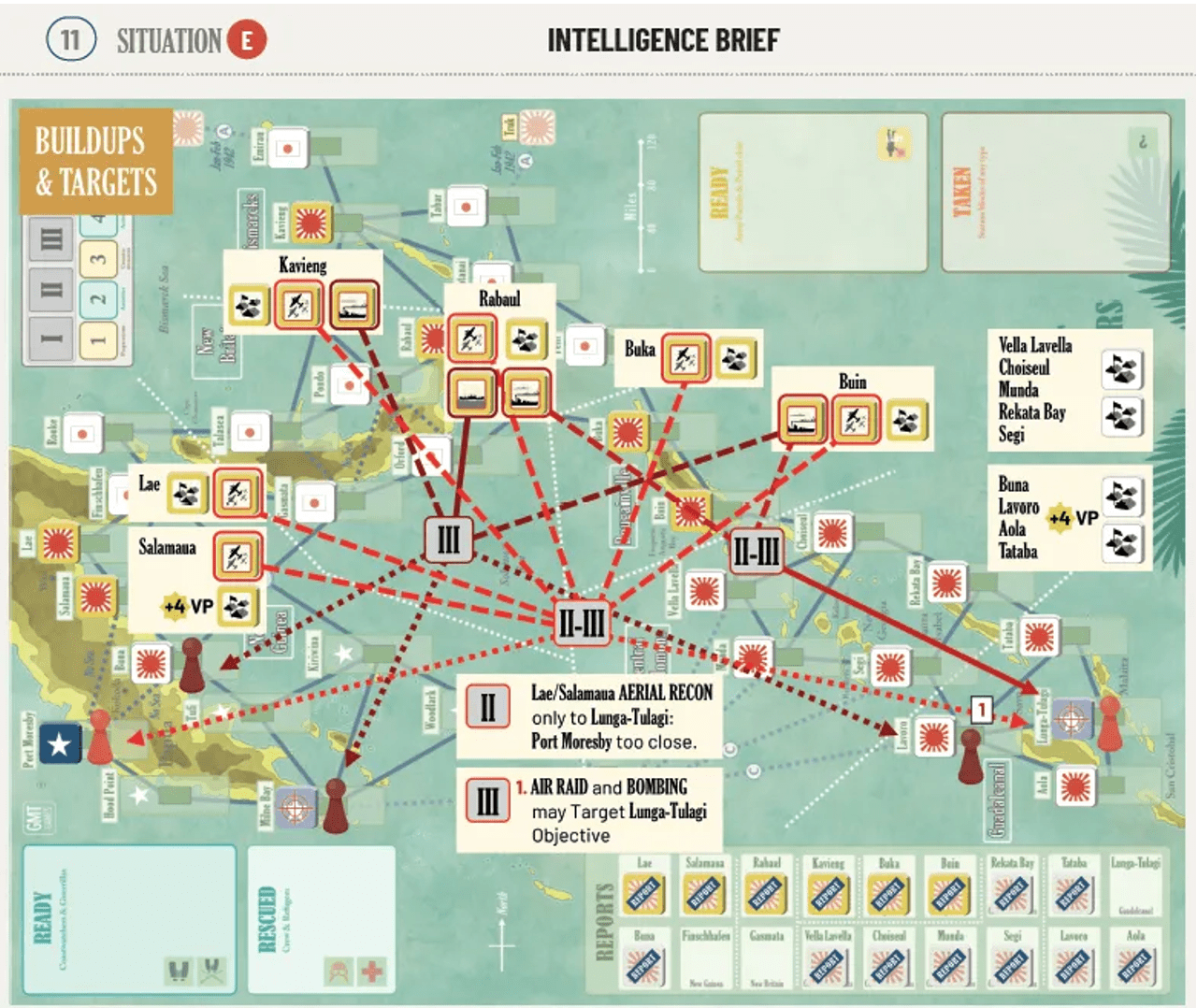
“Intel brief” illustration
Below, red pawns mark Japanese Searches, and faceup blocks show where they have Revealed the status of Allied Stations: the Coastwatcher at the chokepoint of Buin is under pressure! By Turn I of a possible III turns, Coastwatchers have already Reported construction at Lae & Buin “Clear”.
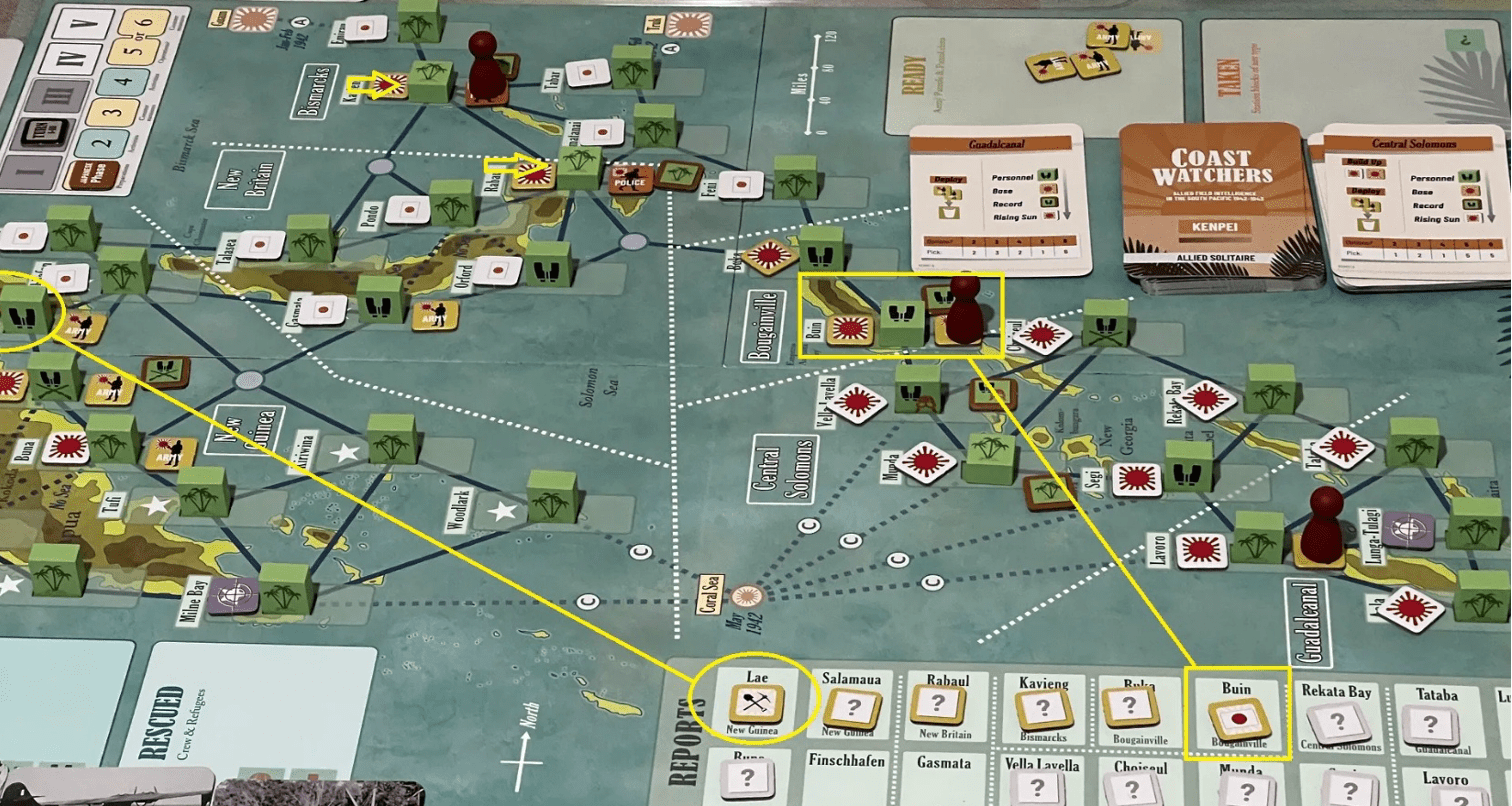
Nearby, Vella Lavella Coastwatchers have retrieved downed Allied air crew (tan icon). But that Delivery got spotted, laying both those blocks faceup and requiring the Coastwatcher to Evade to hide again. Brown Record markers show what we know the enemy knows — likely to draw Patrols.

Lastly, all the palm trees on Guadalcanal itself show that the Coastwatchers are not currently active there. This will make it harder to Warn against Japanese counterattacks there. But Japanese intelligence officer Ishimoto (Japanese Asset card) is active in the region, so perhaps just as well!

The end result: the Japanese launch operations on Turn II to end the game then. Coastwatchers’ warning proves inadequate against simultaneous enemy operations east and west – the pawns mark the paths. Kenpei bot beats its maker by 12VP!

They beat me by running operations to both Lunga and Milne Bay.” – Todd
So there just a few glances at the Coast Watchers game set that will reach players later this year. Let’s hope the logistics gods speed those finished copies along over the sea!
-Volko