

Foxes and Lions (Part 2): Political Traditions, Sentiment, and Economics
This is the second of many articles to come on Foxes and Lions: Renaissance City-States in the Age of Machiavelli, now on P500. This game is in the same series as Here I Stand, Virgin Queen, and Tanto Monta. See part 1 for a thematic overview of what makes Foxes and Lions unique, as well as an exploration of how Machiavelli’s ideas both inform and are interrogated by the design.
Among the distinguishing game concepts is the interplay of three crucial elements described below, the conjunction of which aid in reading the game state of any space and player dominion. Your dominion includes any spaces under your control, and within that dominion, your capital (Venezia, Milano, Napoli, Roma, or Firenze) naturally plays an important role; should that capital be lost, you will assign a temporary capital. Yet unlike many other games where extending a dominion is simply a matter of adding spaces and territories by conquest, in Foxes and Lions you must manage often heterogeneous governments, popular sentiment, and trade values in each space within your dominion.
This reflects the essentially chaotic nature of Italy in the early modern era, when Italy was a dizzying scene of political volatility, economic innovation, and cultural development (a subject of a future piece on patronage figures and their abilities in the game). Any treatment of the Italian Wars must take these elements into account, or it risks devolving into a purely military calculation without reference to Italy’s unique, shifting characteristics on the ground. As Swiss cultural historian Jacob Burckhardt famously put it in his own magisterial yet controversial summation of the Renaissance, Italy was the stage on which the “state as a work of art” was dramatically explored.
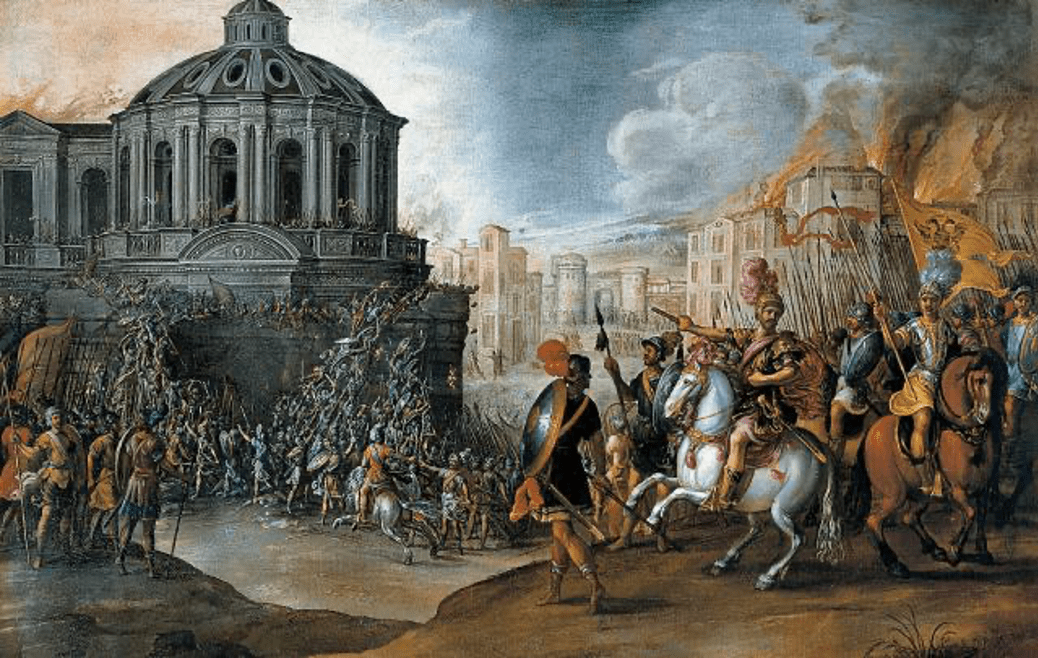
The Sack of Rome, by Juan de la Corte
Previous games in the Here I Stand “series” generally treat governments and popular sentiment as abstractions, and economics as a function of classic Command Point (CP) allocation via card play, which is completely appropriate given the topic and focus of these games. But as the COIN series and many other recent designs remind us, there are more granular dimensions to these matters that must be addressed to account for certain historical conflicts. How does one do this in a series CDG game without going down the micromanagement rabbit hole of a game like Europa Universalis? Europe Universalis is a game that we greatly respect in both its computer and tabletop incarnations, but that level of granularity would not be something we would seek to impose on this series.
Foxes and Lions tackles these elements via streamlined mechanics that capture the potential diversity within any dominion, which impacts everything from unit construction and trade to vulnerability to rivals’ espionage or military activities. Some player powers, such as Naples or Milan, will begin the game with relative homogeneity in their dominions (Naples especially as a fundamentally feudal dominion). Others, such as the Papacy, Florence, or Venice, will have relatively more heterogeneous situations at game start, with dominions consisting of politically diverse (and often unruly and resentful) populations. Embracing or pursuing dominion homogeneity may be a winning strategy for one power, while accepting or encouraging heterogeneity may be the path forward for another. The game allows for both approaches, each of which has its advantages and tradeoffs.
First, we must consider the political traditions of any space, which reflect its current and past government. The six government types in the game range from merchant republic to princedom, feudal aristocracy, theocracy, vassal, and tribute state. These are of course abstractions and simplifications for game purposes of what was historically a far messier reality, but they nicely capture an array of political systems at work in Italy during this period. A future article will explore these six types in greater detail, but for now this summary suffices. A power’s central government reflects that of its capital (e.g., the Venezia space’s merchant republic), but within Venice’s dominion may be other republics, princedoms, or tribute states; perhaps a feudal aristocracy or even a theocracy may emerge in that dominion via conquest, espionage, or an essential Machiavellian concept and game mechanic—lawgiving, to which we return shortly.

Prototype government counters: Merchant Republic, Princedom, Feudal Aristocracy, Theocracy, Vassal, Tribute (not final graphics)
When scanning a given space in the game, you will see one or possibly two indicators of political traditions there. Printed on map is the dominant historical government in that space reflecting roughly a century of previous political trends. If that printed government is showing, then that is also its current government; if it is covered by a marker with a different government, then the current and historical governments differ. Firenze is a perfect example here at game start; under Piero de’ Medici, Florence is a de facto princedom, with a marker indicating this. Yet beneath the surface of that princedom marker is the printed merchant republic on map, reflecting the republican traditions that Firenze had known and that arguably the Medici had corrupted in their ascendancy. The people of Firenze live under their current arrangements, but they may yearn to restore their republic, much as Machiavelli in The Prince warned they would when he wrote, “In republics there is greater vitality, more hatred, and a stronger desire for revenge; they do not forget, indeed cannot forget, their lost liberties.” A very different space may instead not have these republican traditions at all and lean toward vassalage or some other governmental form altogether.
What does the government affect in the game? For one thing, unit types, which we discuss in much greater detail in our next article. Depending on the government in a space, you may or may not have access to citizen militia or feudal levies (closest to regulars in other series games). In every type of space, even in unrest, you will always have access to building mercenaries, provided some are left in the limited pool shared by all players. Your central government in your capital may also have many other impacts, including on the roster of rulers for your power.
Sometimes governments will change due to events or ruler transitions (e.g., the rise of Savonarola will make the Firenze space a theocracy). A government may also change due to conquest (defaulting to a tribute state or vassal upon conquest depending on your central government). What if you wish to shape the governments within your dominion, however, especially after a conquest? Attempting the lawgiving action is endeavoring to change the government of a given space on your own initiative, something far easier said than done. This comes more easily to innovators like Florence and Venice, less so to Naples and the Papacy; Milan is middling in this regard. If you are attempting to return a space to its historic (printed) government, this will generally make things easier, as will a sentiment of Hated in that space (see below, as this indicates a change might be welcome). Factors that can make this more difficult include if the sentiment there is Feared & Loved, indicating a resistance to change, or if you are attempting to dismantle a merchant republic and replace it with something else, thereby incurring resentment over lost liberties. In a future article, we will give lawgiving a much closer look with detailed examples.
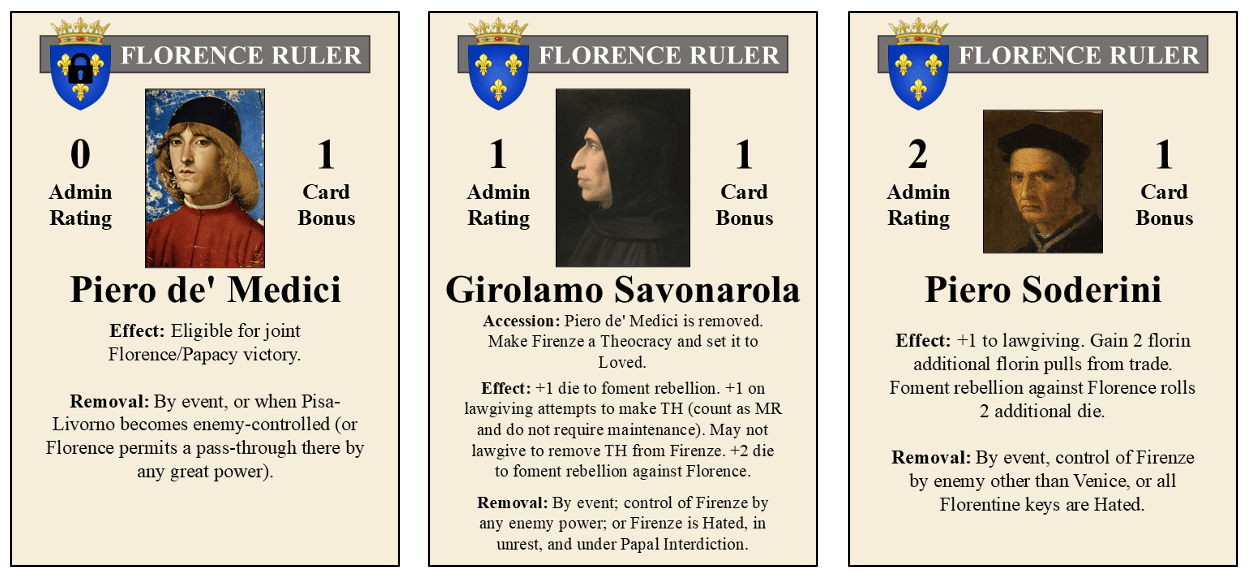
Potential rulers of Florence (not final graphics)
Our second key metric in any given space, sentiment, reflects the populace’s relationship there both to its local government and to any player power counting that space in its dominion. Drawing on Machiavelli’s own language, this ranges on a three-point scale from Hated, to Feared, to Feared & Loved. Machiavelli is famously remembered to have insisted that when faced with a choice, it is better to be feared than loved. What is often forgotten is his insistence that a regime ought not to be hated, as this could lead to popular unrest and revolt. He granted that the ideal condition was to be both feared and loved, which combines a populace’s intimidation in the face of state power alongside a general appreciation of how that state is being managed. Thus, Feared & Loved is the best state of sentiment in the game, while Hated is the worst, although a space subject to sentiment degradation at Hated will then incur an unrest marker familiar to series players. Aside from lawgiving impacts mentioned above, sentiment is also tied to many other game elements, including vulnerability to espionage (especially foment rebellion actions) and the relative defense of a space in field battles and assaults. A space at Hated may find itself more responsive to lawgiving, but also more exposed to rivals’ interference and invasion.

Prototype control and sentiment counters: Milanese control at Feared & Loved, Feared, and then with a Hated counter placed on top (not final graphics)
Lastly, a space’s trade value reflects its economic prosperity and trade potential that supports the collection of florins in the game’s unique parallel economy to the CP economy of most classic CDG titles. Your government in a space is mapped directly to your trade value, which is highest (3) for merchant republics; middling (2) for feudal aristocracies, princedoms, and theocracies; and lowest (1) for tribute states and vassals. A space at Hated sentiment may still trade, but spaces that are in unrest or enemy-occupied may not. We will have a detailed example of trade, the collection of florins, and their many uses in the game in a future article.
These new dimensions to consider for dominions in Foxes and Lions reflect crucial insights throughout Machiavelli’s works, but they are quickly grasped by a scan of any dominion. Appreciating the nuances of how political traditions, sentiment, and trade value impact your military and espionage endeavors (and those of your rivals) is crucial to success in this game. Tried and true strategies in other series games will need rethinking or recalibration with these elements.
In our next article, we will give an overview of military matters in the game, including the conceptualization behind the “captains” and condottieri who feature so prominently in it and are essential to the pursuit of victory on the battlefield (and in some cases, beyond it).