

It’s all about the Cards
Exploring the Card deck of Ancient Civilizations of East Asia
by Mark G. McLaughlin
(with input from Fred Schachter)
Part V: Force Multipliers and Tactics Cards for Competition
As with its predecessors (Ancient Civilizations of the Inner Sea GMT Games – Ancient Civilizations of the Inner Sea and Ancient Civilizations of the Middle East GMT Games – Ancient Civilizations of the Middle East, or ASIS and ACME, respectively), the cards quite literally “rule” the game. 110 Karma cards come in eight “flavors” (or types). The single largest block of cards by type allows players to influence Competition. Although an ACEA “Competition” is defined in the game as being any kind of conflict or rivalry over an area – economic, social, political, religious or military, let’s face it fellow gamers: Competition Cards are WAR cards.
In the previous article we looked at “Weapons and Warriors” cards that affect Competition. In this, the fifth and final of this series segment regarding Competition Cards, we examine cards which have a common theme: force multipliers and tactics. These provide an ability to Negate another civilization’s Competition card or give a bonus in Competition – either by adding disks to the card player’s side or by removing them from their foe.
82 Cavalry Reserves

Having a highly mobile reserve can spell the difference between victory and defeat, as the legendary military theoretician Sun Tzu well knew from his own experience. This card is both an investment (I) card and a Competition card. As an Investment card, a civilization may play it during its turn as its action. It has not only a value in Competition but also puts rivals on notice that it has the ability to reinforce any Competition with up to four white disks – either a Competition it initiates or one which is forced upon it.
The trade off is the act of activating this card for action takes four precious disks of the civilization’s color out of its Supply of fifty disks and removes the ability of those disks to be used for other purposes. Yes, it is a “peace dividend” of sorts, but one that comes with a price.
It should be noted taking a colored disk from this Investment card to convert it into a white disk for Competition resolution is considered PLAYING the card and thereby opens it to possible NEGATION… ah, but what are the odds of THAT happening?

An earthenware cavalry rider from the Tang dynasty, China. 618-906 CE. Height: 24 cm. (The British Museum, London)
83 Peasant Levies

Many civilizations were built by peasant farmers and other members of society’s lowest classes, and as such were often patriotically called upon, or enlisted under harsh duress, to defend their homes. There were times these masses could rise to the occasion and bolster their professional military; but in some cases, rather than risk their lives and those of their families for a cause they felt little enthusiasm for, they fled to seek safety.
This card precipitates a card draw from the deck, which can add one or even two temporary white disks to a Competition – but there is a small chance it can cost the card player a disk (to represent desertion) when a Must Play Event card is drawn… and what effect that Must Play card can wreak is unknown. However, not all Must Play cards are Barbarian Invasions! To learn more of these cards, see: It’s all about the Cards: Exploring the Karma Card Deck of Ancient Civilizations of East Asia Part I: The Seven Deadly Events – InsideGMT.
84 Allied Horsemen

The nomadic horse tribes of the steppes were a constant threat to the kingdoms and empires of East Asia – but they could also be staunch, albeit temporary, allies. Before they rose to conquer parts of ancient northern China, many of these tribes would either hire their warriors out as mercenaries or come when called upon by a king who had granted them favors or land in return for a promise of coming to his aid in time of need. Of course, being barbarians, how many warriors would show up was a matter of uncertainty (as this card so aptly demonstrates).
Unlike the preceding Peasant Levies card, there’s no downside to receiving one or more white disks for a Competition. But a card still needs to be taken from the Karma Card Draw Deck to determine the quantity of white disk assistance received and that card could always be a Must Play Event.

Depiction of a Xiongnu horseman on a bronze plaque
89 Desperate Stand
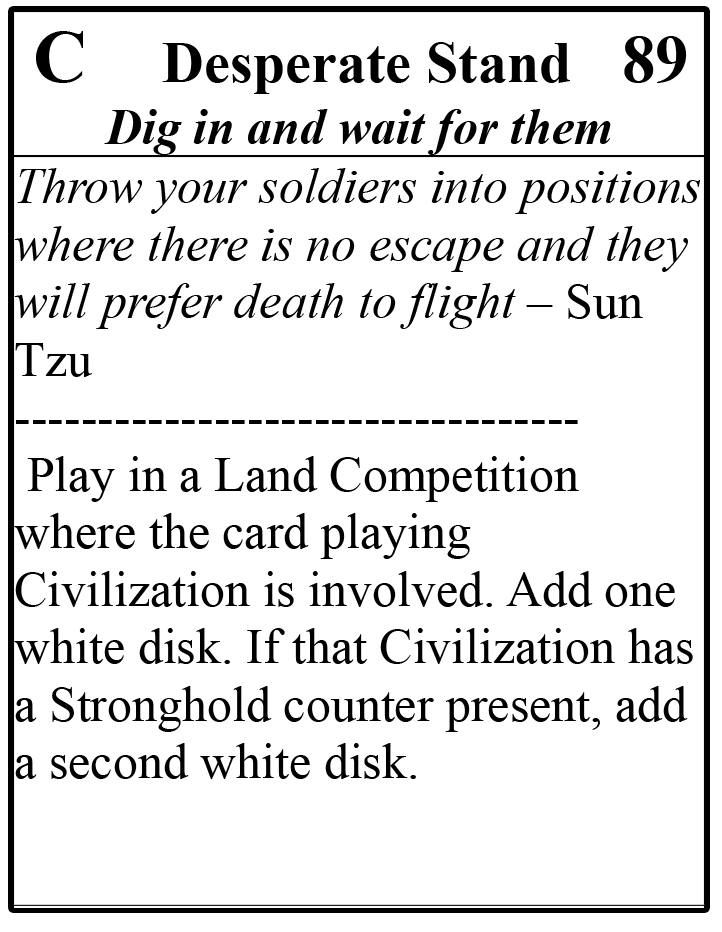
A handful of stubborn warriors holding the pass, defending the bridge, or sealing the breach of a wall with their bodies so their comrades and people could escape to safety is an enduring legend in many cultures and civilizations, including those of East Asia. Among the most famous in Chinese history is that of Xiang Yu, who with but 28 warriors during his retreat from the battle of Gaixa in 202 BC stood against Liu Bang’s cavalry on the banks of the Wu River. The defenders took down hundreds of their foes, and when defeat was inevitable, the last of them committed suicide rather than give Liu Bang the satisfaction of parading them about as prisoners of war.
Dramatic as the preceding description is, this card only generates a single white disk unless the civilization’s Land area also contains one of its Stronghold counters for a second disk. Therefore, lacking a friendly Stronghold, this is not one of the game’s powerfully impressive Competition cards (to say the least).
But lacking a Stronghold, Desperate Stand is still useful as it can offset a disk loss under most circumstances or could be used as a Resource for acquiring a new Stronghold, Terrace/Improved Irrigation System, Workshop, or for a civilization’s Cultural Development Track disk’s advancement (and is worth two Resources to purchase an advance on the Military-Political Track.

A statue of Xiang Yu at his hometown of Suqian city, Jiangsu province
90 Hemmed in Ground
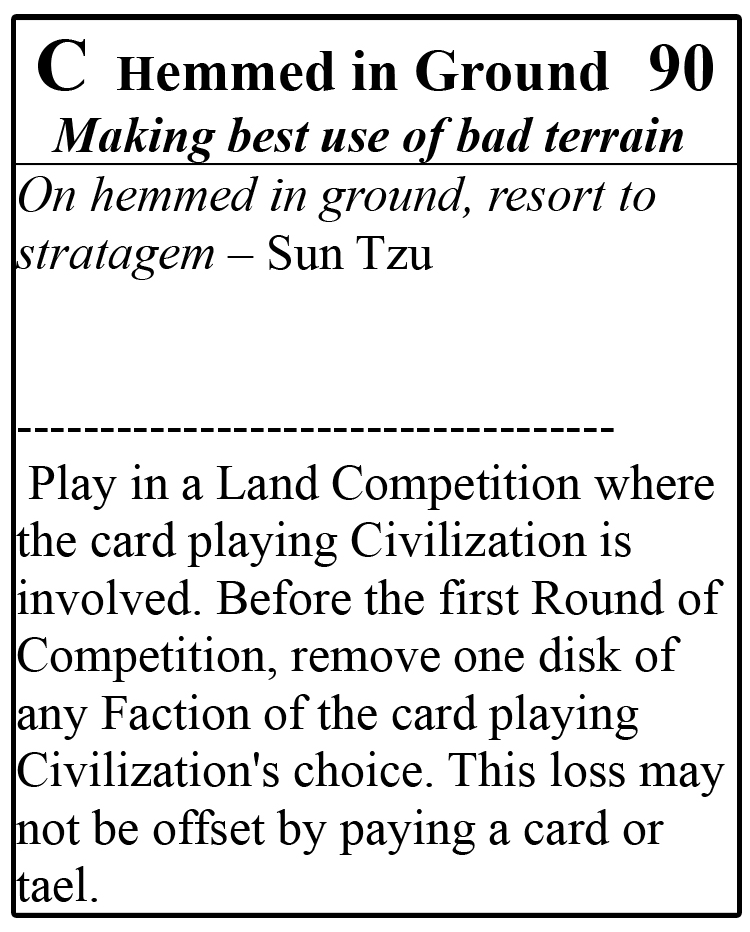
Luring an enemy into a place where he cannot maneuver is one of the classic trap plays in military history, as is placing them in a position where they can be ambushed, defeated in detail, or unable to make use of all their forces.
This card is played before resolving the first Round of a Competition, a significant advantage, and represents such a trap – one from which there is no escape as the lost disk cannot be bought off by playing a card from hand or paying a tael.
There’ll be ACEA Competitions whose winner can be determined by a single disk and Hemmed in Ground is a card which can enable that victory!
91 Misdirection
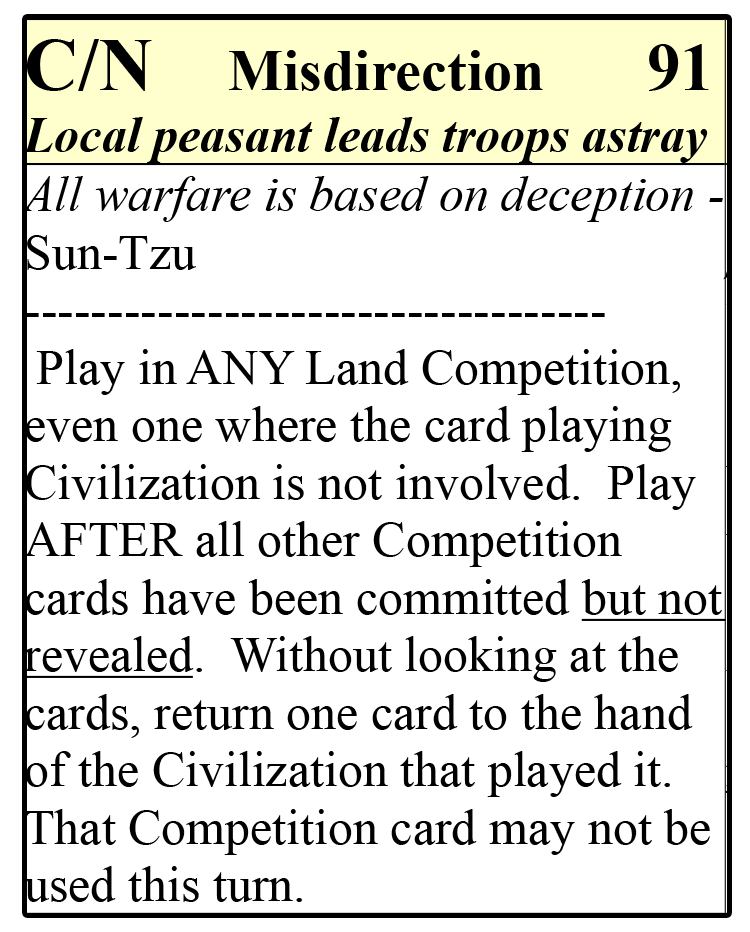
No plan survives first contact with the enemy. Couriers carrying orders get lost or ambushed. Generals do not always follow – or understand – orders. Troops take the wrong fork on a road. Just when a player thinks they have the upper hand – suddenly they don’t, as that key Competition Card one being counted on as a sure path to victory is returned to their hand unavailable, even as a resource for negating a disk loss, for the duration of that turn.
This is a potentially nasty Negate card. But it does leave the victim in possession of the negated card for potential use in another Competition… perhaps one during the next turn’s Competition Phase?
92 Reserves

This is a unique Competition card much like Misdirection above, for it represents a lost or misunderstood order or, as its title states, military reserves of one type or another sufficient to potentially turn the tide of battle, but this Competition Negate Card is even more devastating.
Why? Because the card player not only gets to choose which one of their foe’s Competition cards will have no effect after all Competition cards are revealed and/or declared for play (e.g. Cavalry Reserves), but as that chosen card is “negated” it is also discarded: just imagine if the negated card is the powerful Iron Weapons when declared for its first Competition resolution. None of its white disks would be placed!
This concludes our exploration of the game’s Competition Cards. Next up in this series is an InsideGMT article for a type of card already mentioned… Investment Cards. Therefore, this upcoming piece is aptly named – Ancient Civilizations of East Asia’s “It’s All About the Cards” Part VI – It’s Not All Bad News: Investment Cards. To learn more of this GMT P-500 listed game, see: Ancient Civilizations of East Asia. Thank you for your interest and support!