

Foxes and Lions (Part 3): Military Matters, Captains, and Condottieri
This is the third of many articles to come on Foxes and Lions: Renaissance City-States in the Age of Machiavelli, now on P500. This game is in the same series as Here I Stand, Virgin Queen, and Tanto Monta. See part 1 for a thematic overview of what makes Foxes and Lions unique; part 2 explored the conceptual and mechanical role of political traditions, sentiment, and trade value. In today’s installment, we delve into military matters and the essential role of “captains” in and even beyond the game’s battlefield conflicts.
First, a discussion of the three types of units in Foxes and Lions. All three types (feudal levies, citizen militia, and mercenaries) have their counterparts in one or more series games, yet with very important distinctions in ours in terms of their uses, strengths and weaknesses, and where you are permitted to construct them. As with anything in a historical game of this nature, there are simplifications and abstractions that are inevitable for playability and for exploring crucial theses in the game’s account of military affairs. Above all, our game looks to test (not simply accept at face value) Machiavelli’s conviction that mercenaries are unreliable and dangerous investments for one’s defense or expansion of one’s dominion. The game also allows that a formation of mixed unit types may be the most versatile.
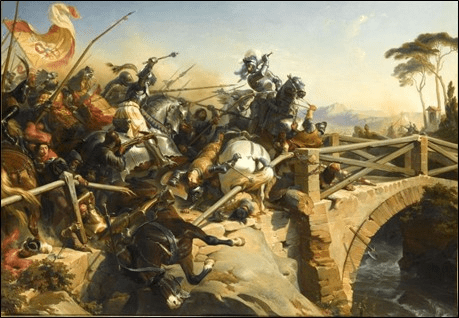
Battle of Garigliano, by Henri Félix Emmanuel Philippoteaux
With those caveats in mind, we begin with feudal levies. These units are closest in function to the “regulars” in other series games. They are versatile, reliable units; very effective in field battles, moderately so in assaults of besieged spaces, and generally balanced on attack or defense. These are late medieval troops of the sort most are familiar with, but in Foxes and Lions, they may only be built in spaces with a government of feudal aristocracy or vassal; as a result, at game start at least, they will predominantly be available to the Duchy of Milan and the Kingdom of Naples.
Citizen militia, on the other hand, were cherished by Machiavelli as the antidote to the greed and fickleness of mercenaries and their condottieri captains. He did manage to champion such troops’ inherent patriotism enough to oversee their training and achieve Florence’s longstanding goal of reconquering Pisa in 1509. Yet a few short years later in 1512, those same units would fall before the might of professional Spanish troops at Prato, thereby precipitating the collapse of the Florentine republic and the triumphant return of the Medici who had been exiled eighteen years prior. To say that the results of reliance on militia were mixed in this period is an understatement. In Foxes and Lions, militia are excellent on defense provided they are operating in their own player dominion; they are weaker when attacking, and especially so in assaulting fortified spaces. Some patronage effects (a subject of a future article) may improve their capabilities (e.g., patronizing Machiavelli himself), but by and large, militia are very situational in value. Militia may only be raised in a space with a merchant republic government, or in the special case of Savonarola ruling Florence, a theocracy.
Last, but certainly not least, are the mercenaries that descended upon Italy in this period (including special reisläufer Swiss mercenaries and the Imperial landsknechte; more on them in a future piece). From Machiavelli’s perspective, mercenaries were crass opportunists who could never be relied upon in the long term, leading only to the ruin of any who trusted them. From the perspective of a modern military historian like Michael Mallett, mercenaries were often the most professional and viable option for attack and defense. Foxes and Lions takes neither of these interpretations at face value, instead preferring to test them in the crucible of the game’s simulation of the conflicts at hand. What the game does allow is that mercenaries may be cheaply raised (using CP) from a common pool that is limited (representing the available mercenary manpower in Italy). Crucially, however, mercenaries must be regularly paid in florins to fight in attack or defense, lest they stand down from a given conflict. In terms of combat effectiveness, they are well-rounded and useful in a variety of situations, but they will be their most effective under the command of one of the game’s twenty “captains.” A mercenary formation without a captain is formidable, albeit expensive; such a formation under the right captain is potentially the most dangerous military force in the game. Being without a captain, which no player has at start, also limits your formations to the series standard four units, as no player powers have access to military leaders of their own at the start of the game.

Prototype unit counters: Neapolitan Levy, Venetian Militia, Mercenary, Reisläufer, Landsknechte (not final graphics)
This raises the question of how Foxes and Lions conceptualizes captains. As designers, we wanted the game to feature many condottieri strictly defined as freelance contractors who might change sides over time (e.g., Fabrizio Colonna, Giovanni dell Bande Nere, etc.). Out of necessity we had to restrict this group, so some favorites may not appear in the game as published (at least initially). At the same time, we wanted the appearance of other figures who are equally fascinating and impactful even where they do not perfectly fit the classical condottiere definition. In short, all condottieri in the game are captains, but not all captains are condottieri traditionally understood.
For example, Cesare Borgia indeed qualifies for the most part as such a figure, but he enters the game clearly on the side of the Papacy and is most dangerous so long as his father Alexander VI (the Papacy’s starting pope) remains alive. Another example, Gonzalo Fernández de Córdoba (famously known as El Gran Capitán), is someone historically affiliated with Spain, but who also occasionally led Italian forces in their various conflicts. “Affiliation” and “great powers” are game features that we will discuss at length in a future article, but in short, El Gran Capitán will never fight against great power Spanish units or interests, but he may be enlisted to the cause of one of the Italian player powers. Two cardinals of the Church also feature as “captains” in the game, with most unusual benefits (one allowing Michelangelo to be more easily patronized, another permitting access to Swiss Reisläufer elite mercenaries). Lastly, Caterina Sforza exemplifies a formidable woman who excelled in defense while under siege by her enemies, infamously (and perhaps apocryphally) defying conspirators who had kidnapped her children; it is said that Caterina defiantly lifted her skirt to expose her genitals, saying her enemies should kill them as they wished since “I have the power to make more.”
We felt that no game on this conflict should be without these extraordinary and colorful characters, and that too restrictive a definition of “captains” would impoverish the game and its historical perspective. Our mechanism for introducing these many kinds of captains into the game builds upon the basic framework of CP-generating mandatory events familiar to series players. With the exception of two captains who appear on turn 2 and turn 5 respectively, all other captains in the game are found on mandatory event cards that are shuffled into the main deck; as usual, such mandatory events afford the player 2 CP after the event is resolved. In some games, many captains will appear early in a game; in others, they may be frighteningly scarce and the source of vicious competition to employ.

Notable captains (not final graphics)
When a mandatory captain event is played on a player impulse, it immediately results in a blind auction to gain control of that captain; this auction requires florins (acquired through trade actions as discussed in part 2 of this series, events, and other game effects; trade will be the exclusive subject of a future article featuring a detailed example). Some captains may lean toward employment by a particular Italian power; others may refuse to work for a particular power at all, reflecting historic animosities. Each captain also has unique strengths and vulnerabilities such that no two captains are identical, and each has a situational advantage. Some advantages even impact other aspects of the game, including governance, trade, or patronage. If one is intent or desperate enough to secure a captain (and has perhaps failed in bidding on them in blind auctions), you may even use the espionage action Suborn a Captain to cause someone else’s captain to switch sides to you, perhaps even taking all his mercenary units with him (more on espionage in a future article).
It is no exaggeration to say that captains are perhaps the most important commodity in Foxes and Lions. Being without one while your rivals have one or more is a very precarious position indeed. As will be discussed in a future article on alliances and coalitions, the command ratings of your captains will have more uses than simply increasing your formation size as in other series games; those ratings can even establish who is the lead commander in an allied offensive formation (yes, in Foxes and Lions, allied formations can go on the offensive together, not just defend together).
In our next article, co-designer Liz Davidson will explore the fundamental role-playing conceit of Foxes and Lions. A fair and vital question in any game like this is “Who the hell are you?” In other series games like Here I Stand, it is generally clear that you are playing the ruler of your side (e.g., Suleiman the Magnificent for the Ottomans, Emperor Charles V for the Hapsburgs, but arguably with the Protestants, a far more open question). In Foxes and Lions, this is an altogether different and delightfully messier issue. Stay tuned for Liz’s amazing insights there!