

“Who the hell are you?” The Role-Playing Conceits of Foxes & Lions
In Foxes and Lions, players step into the roles of five powers of Renaissance Italy: Florence, Milan, Naples, the Papacy, and Venice. But you, the player, are not exactly the ruler of those city-states. Nor are you truly masters of Italy, not with larger powers eyeing you hungrily and interfering with your best-laid plans. In fact, as the game’s title suggests, you never fully embody a single role, because you must be flexible to survive in a world of betrayals, reversals, and surprises.
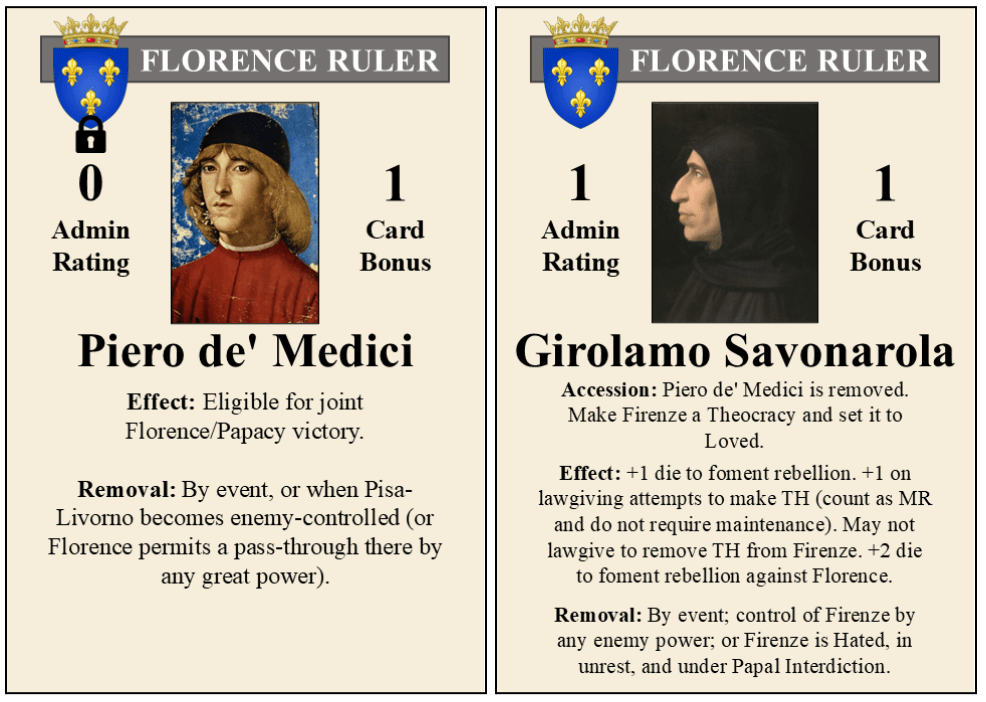
Tough luck for Florence while Piero’s in charge…but is the alternative any better?
Who is in charge here? (Probably not you)
When you take on the role of a city-state in Foxes and Lions, you take on its position, its enemies, its ambitions, and fears… but you do not take on the role of a king, prince, pope, or doge. Rather, these leaders are more or less inflicted on you throughout the game. While several of Italy’s leaders during this era were powerful, some were, shall we say, less competent. Florence will weep while ruled by Piero the Unfortunate, who lives up to his name, as he is one of the worst leaders in series history. And if you are playing the Papacy, you will not even have the assurance of getting a more fitting ruler down the line, because you stand at the mercy of papal conclaves whenever your current leader bites the dust.
Nor are you a great warrior–those are the condottieri you bid for as they emerge from the deck. These capricious, greedy men are hard to deal with, but they are even harder to do without. You have choices when raising forces, based on the types of government present in your dominion, but mercenaries and their captains are undeniably the most powerful military forces in the game.
Of course, this is all very flexible, and you will feel that you embody different roles at different times. Paul Wright, my co-designer, frequently imagines himself as a polity or, broadly, a people dealing with a tumultuous time in history.
When I am playing the game, I tend to think of myself as someone very much like Machiavelli himself, an influential political figure attempting to guide the direction of the city-state that I serve. I have a lot of responsibilities, but I don’t always get full say over what happens in my dominion, especially when less-capable rulers are foisted upon me. I have to keep my people happy, even when their happiness has nothing to do with my personal choices. I have to keep mercenary captains paid and, hopefully, loyal. But that is rarely guaranteed. Many of the emergencies I face are not my fault. Every single one of them, however, is my problem.

The Great Powers have their own ambitions in Italy, but can also be manipulated by the players
Stalwart or Lapdog?
When playing Foxes and Lions, your role differs from previous games in the series because you are an Italian power, but you are in no way a great power. Great powers appear from off-board to use you as their playground, either for their own ends or at the behest of others. You will play both the fox and the lion among your opponents, but you will also have to choose whether to resist or kiss up to the external powers that can lead to your collective defeat.
The Great Powers in Foxes and Lions–France, Spain, the Holy Roman Empire, and the Ottoman Empire–will all activate and interfere with Italy on their own, whether you want them to or not. If they interfere too much, if you allow them to interfere too much, Italy as a whole will lose the game by losing all of its Virtù. Each time you allow a Great Power to pass through your dominion unimpeded, you contribute to the loss of Italian Virtù and put more pressure on others to clean up your mess.
But once you figure out that you can summon the Great Powers to do damage to your enemies–even enemies you are not personally at war with–it becomes ever more enticing to invite them in. Why not attain influence with them and then spend it to send them into places where my own power does not yet extend? Why not use them to waste another power’s entire turn when I am pretty sure they were planning to attack me? Or even if I wasn’t sure at all?
Going into this game, you may think that you will remain a resolute defender of Italy no matter the cost, because that is who you want to “be” during play. But temptations abound, and you might have to do a little toadying if you want to win. Be warned, however: If all players collectively lose due to depletion of Italian Virtù, the game will assign blame. If you whisper honeyed words in the ears of the Great Powers, and you do it more than anyone else in the game, you will receive the title of “Lapdog.” While everyone can lose together, you will be the biggest loser, with the title to prove it.
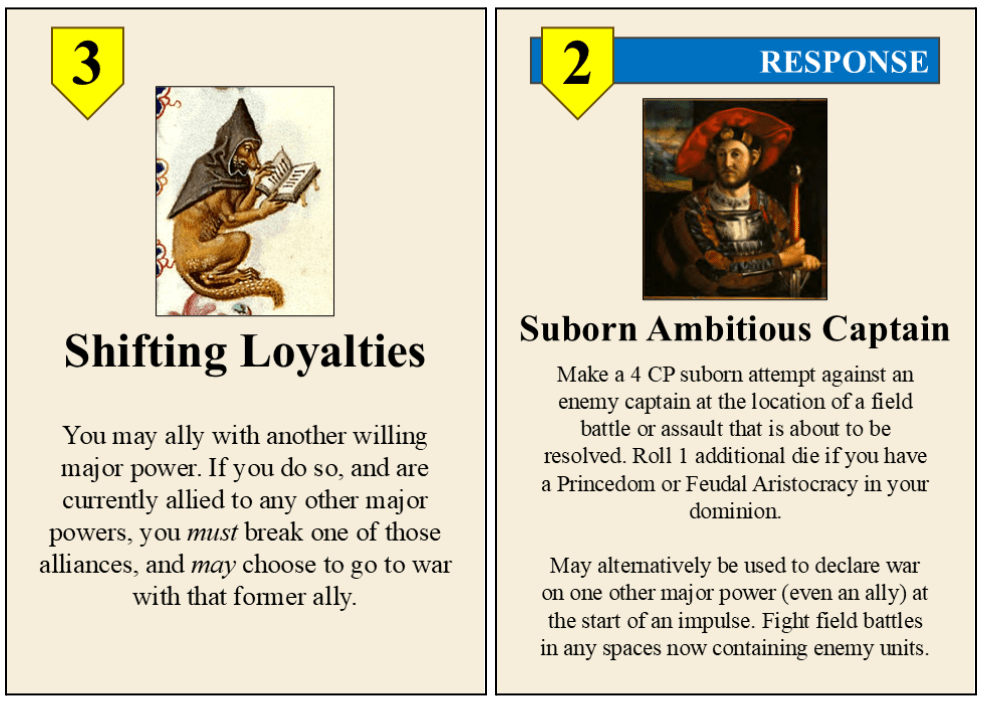
Shifting loyalties and ambitious captains offer many opportunities for betrayal
Enemies and Frenemies
When people hear the name “Machiavelli,” they immediately think of brutal tactics and cruel betrayals. While we hope that your time with Foxes and Lions will leave you with a more nuanced view of a legendary political thinker, we also want to leave you with extended options for bad behavior–at least compared with other games in the series.
In Here I Stand or Virgin Queen, it can be difficult to damage powers you are not at war with. A well-negotiated alliance can make you relatively safe for the duration of a turn. But in Foxes and Lions, you are not safe even from your allies.
First, there are cards liberally sprinkled throughout the deck that allow you to break alliances and declare war in the middle of a turn. Think of the Machiavelli card from previous series games, but multiplied. If you draw one, you might consider holding onto it until you need it. While observing other players, you need to constantly worry that they might have one.
Second, even if you can’t attack someone because you aren’t at war with them, you can summon others to do your dirty work for you–namely the Great Powers mentioned above. There are absolutely no rules in the game that prevent you from sending someone else into battle against your closest ally, so long as you yourself do not wield the sword.
Third, the espionage rules in Foxes and Lions are extended to allow you to do damage in or out of wartime from turn 1. In Foxes, you can freely foment rebellion, you can sabotage fortifications, and you can attempt to assassinate or suborn mercenary captains. In other words, you have the option to be a stalwart ally in the field, then turn right around and stab that same ally in the back–while your alliance remains in place. They will of course remember your perfidy later, but that will have to wait. Unless, of course, they are holding a card that allows them to declare war in the middle of a turn…
In other words, Foxes and Lions is a game that gives you choices that will cause you to question the sort of person you are, at least within the context of a game. As someone playing a historical role, you are powerful, but not powerful enough. As a human being, the results remain to be seen. Just how loyal an ally are you? How much do your diplomatic promises mean? You and your “friends” are about to find out.