

“Artists, scientists, and humanists, oh my!” Changes to Patronage in Foxes and Lions
By Paul Wright
This is the fifth of many articles to come on Foxes and Lions: Renaissance City-States in the Age of Machiavelli, now on P500. This game is in the same series as Here I Stand, Virgin Queen, and Tanto Monta. See part 1 for a thematic overview of what makes Foxes and Lions unique; subsequent parts have explored many thematic and mechanical distinctions from the series. Most recently, Part 4 featured co-designer Liz Davidson’s compelling take on the role-playing conceits of the game. In today’s installment, we delve into the patronage system of Foxes and Lions, including how it compares to the system inaugurated in Ed Beach’s Virgin Queen.
When I first had the original inspiration to bring Foxes and Lions to life, I always envisioned cultural, artistic, scientific, and literary dimensions being important, however indirectly, to the political and military struggles of the period covered. When Liz and I retooled the game for the HIS series framework, I was more convinced than ever that Virgin Queen’s patronage system had pointed a way forward here, although we made some very important changes to that model that are far more than cosmetic. Today we explore those essential differences; strategies for patronage that may have worked in VQ may not avail you at all in Foxes and Lions.
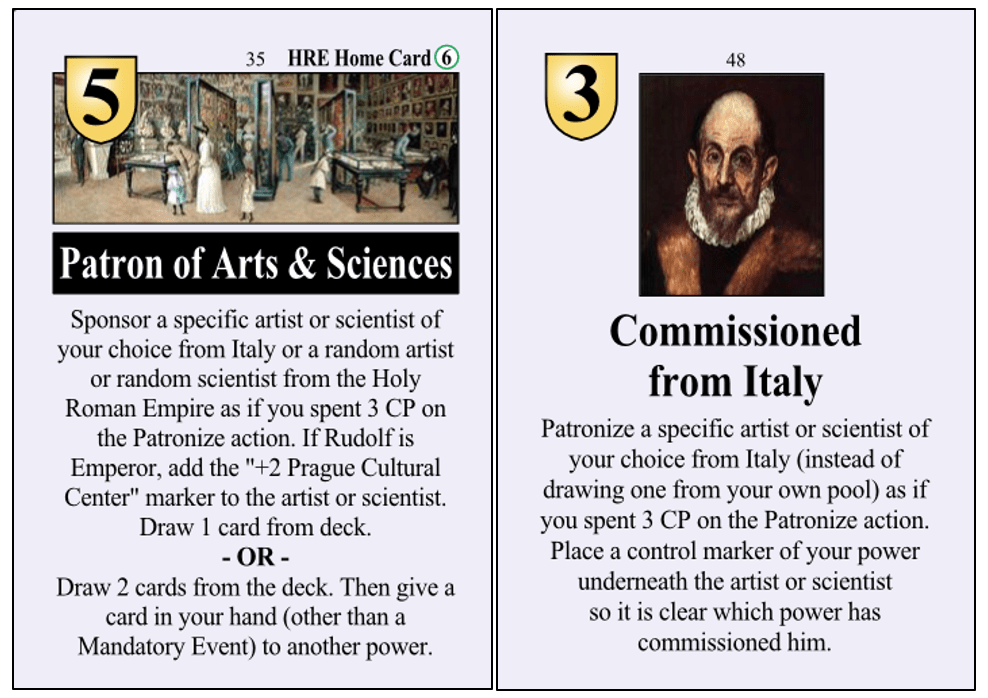
Two Virgin Queen cards allowing sponsorship of Italian artists and scientists
For one thing, in VQ, most patronage figures are tied to precisely one player power (e.g., Shakespeare to England), with the exception of a handful of Italian figures who can be accessed through certain event cards. For Foxes and Lions, we have reversed that trend and made it so that most every patronage figure in the game can be hired by any of the five player powers (Milan, Venice, Florence, Naples, and the Papacy). We felt this would increase the game dynamism of patronage as well as reflect the historical realities of a very mobile intelligentsia in the Italian context; figures like Da Vinci and Michelangelo should naturally be open to many potential patrons given their wide-ranging itineraries. A handful of figures are indeed tied to one potential patron (e.g., Machiavelli and his beloved Florence), but the vast majority of our thirty potential patronage figures are open to more than one (and usually all) player powers. Most of the patronage figures are of course Italians, but a good many hail from abroad, yet spent significant formative years honing their craft in Italy at some point.
Foxes and Lions has ten artists, ten scientists, and ten humanists—the latter a brand new category of patronage subject added to the two categories found in VQ. Given that my own scholarly work (since my doctoral dissertation even) has focused on Renaissance humanism in Italy and abroad, I found myself wishing VQ had this separate category, and I certainly found it essential to the cultural story of Foxes and Lions. Humanism is also vital to understanding Machiavelli himself. As a hotly debated cultural phenomenon, humanism has been variously understood as everything from a specifically educational classicism in battle with medieval scholasticism to the foundation for emerging and profound conceptions of what defines humanity. The orientation to a new (Greek and especially, Roman) classicism certainly reflects Machiavelli’s manifestation of the term, as is evidenced by his political classic, the Discourses on Livy.
A very different example is found in Baldassare Castiglione, a humanist patronage figure in our game, who authored Il Libro del Cortegiano (commonly known in English as “The Book of the Courtier”), one of the period’s most successful and widely distributed books on how to survive and thrive in the vicious courts of Castiglione’s time. A sort of Renaissance “self-help” book on “how to win friends and influence people” at court, the book entertains all kinds of philosophical notions about what defines human beings, but at one point playfully rejects all the grandiose statements for saying simply that the human being is “un animal risibile,” or “an animal that laughs.” This is a humanism with ontology (the philosophical study of being) on its mind.

Baldassare Castiglione and Tullia d’Aragona, Italian humanists
Given the wide range of things evoked by the term humanism, our game’s humanists encompass an equally wide array of cultural, linguistic, historical, and literary interests. They are impossible to define categorically, and many humanist figures in our game might be disputed as belonging to their “official” ranks (if any such ranks can even be affirmed). What is clear is that all these influential figures were shaped in important ways by the new approaches to classicism—which, contrary to popular assumption, was always a part of culture in late antiquity and the medieval period. It was the nature of classicism (and its secular and religious impacts) that was changing dramatically in the Renaissance. Our game’s “humanists”, broadly defined, include political thinker Machiavelli; publisher Aldus Manutius; poet Ludovico Ariosto; religious poet Vittoria Colonna (daughter of one of our illustrious military captains in the game); Castiglione (see above); philosopher and syncretist Pico della Mirandola; historian and “frenemy” to Machiavelli, Francesco Guicciardini; Michelangelo as poet; classicist Cardinal Pietro Bembo; and the poet-courtesan, Tullia d’Aragona.

Michelangelo and Raphael, Italian ninja turtles artists
Our artists include the usual suspects: Michelangelo, Da Vinci, Botticelli, Raphael, Titian, Cellini, Bramante, and the Dutch Vermeyen; we also include Properzia de’ Rossi, one of the most significant female artists of the era. Urs Graf is also represented among the artists; his engravings and woodcuts displayed the gritty lives of ordinary mercenaries in a manner indispensable to military historians of the era. Much as with humanists, “scientists” in our game also run the gamut of experimental pursuits that in a few cases border on what we might today call pseudo-science. These include Da Vinci (as military engineer); Copernicus (whose educational sojourn in Italy was essential to his evolution as a thinker); the “father of accounting”, Luca Pacioli; polymath and syphilis expert, Girolamo Fracastoro; alchemist-astrologer Paracelsus; Venetian naval architect, Vettor Fausto; mathematician Niccolò Tartaglia; practical implementer of the trace italienne fort, Antonio da Sangallo; algebraic innovator, Scipione del Ferro; and Caterina Sforza, documenter of poisons and their many uses.

Da Vinci and Pacioli, Italian scientists
Hopefully this makes clear the cultural and intellectual range of the patronage subjects in Foxes and Lions, even within each of the three domains. Eagle-eyed readers will note we have two versions of Michelangelo (artist and humanist-poet) and Da Vinci (artist and scientist-engineer); so, yes indeed, one player might patronize both versions or more typically, one version, while another player pursues the other version.
Another key change from VQ’s patronage model is that patronage figures in Foxes and Lions roll out gradually in any given game—two randomly per turn per category are added to the available pool. So, while most figures can be patronized by more than one and usually all players, the available figures of each type will change in each game, and only by turn 5 will all ten of each type have been revealed. We have found in testing that not only does this make the patronage game very different each time out, but it also cuts down on the information processing load around patronage in the early game, with only six figures to think about on turn 1, twelve by turn 2, etc. There will be games where your power’s favorite figure is there from the beginning, and other games where you may not see that figure until the game is entering its end phase in turn 5 (with 7 total possible turns, the game nonetheless has a good chance of being resolved by turns 5 or 6).
Another very important difference from VQ patronage is the fact that in Foxes and Lions, every single patronage figure (of any type) has the potential of scoring victory (or virtù) points, but it also has an associated ability or bonus unique to that figure’s historical achievements (real or envisioned). For me at least, I always found it frustrating that artists in VQ were only VP-generating, and that game-impacting abilities were reserved to the scientists; it also struck me as unusual that scientist abilities were chosen from a list upon successful patronage at the end of turn. These design choices clearly have an important rationale in VQ that I won’t go into here, but for Foxes and Lions, we wanted every patronage figure to have a story and area of expertise tied to it.

Florence and Milan, both centers of art and culture, especially excel at the patronage game
Regarding patronage figure ratings (an element found in VQ too), here they range from 4, for a few exceptional figures in each category, down to 1. Note that the ratings are not meant as absolute value judgments of the quality of a figure’s gifts, mind, or works. The values are of course important in game terms as they impact your roll for successful patronage, but they often reflect not merely historical achievements, but in many cases relative fame or a figure’s social and political traction within a sphere of activity (or any hindrances to that). The ratings in the cases of some female patronage figures reflect the realities of gender discrimination in the period (again, not a reflection of quality as much as circumstance).
As just a few examples from each patronage category illustrate, the advantages of a high roll on patronage go well beyond VP. If you successfully patronize artist Raphael, you raise sentiment in your capital and receive +1 to all future humanist patronage rolls. This captures something like Raphael’s stunning School of Athens in the Vatican, which both reflected and shaped humanist culture in that time. If you successfully patronize scientist Luca Pacioli, his mastery of double-entry bookkeeping benefits both your allies and you, permanently improving the power of your trade actions, especially if you maintain those alliances. If you successfully patronize humanist Tullia d’Aragona (one of the most storied poet-courtesans of her age), you take Tullia’s marker and place it on another player’s power card, taking florins from that rival and making Tullia a permanent, extra informant on that rival for all espionage purposes (stay tuned, as espionage will certainly be a hot topic of one of these articles). In other words, once the Tullia informant is on your power card, she stays there as her charms (literary and otherwise) are undeniable.
These three examples alone demonstrate how pliable and yet historical the patronage system in Foxes and Lions can be. Every patronage subject has potential benefits (some immediate and one-time, others permanent) as well as being a possible source of VP. We have seen aggressive patronage activity be decisive in many early tests of the game, especially when one rolls well enough to secure both the VP and the abilities. As with VQ, you are limited to pursuing patronage of one figure of each type per turn (so barring any card ability permitting more, three total efforts per turn). Many of the player-specific home cards also take advantage of patronage to help you pursue victory.
Naturally, your dice will sometimes betray you and your patronage subject may only afford an ability or VP, not both; a worse roll may be no result or perhaps even cause the figure to disappear altogether. In the end, however, the juice is very often worth the squeeze in this aspect of Foxes and Lions, although another player (or even a non-player great power) invading your home spaces may understandably distract from your patronage game. Just as often though, these figures may afford you a lifeline in your struggle against rivals or against your own dominion’s frailties. Timely patronage and creativity in exploiting patronage abilities may be every bit as important as the units you deploy on the battlefield. Captains will understandably get the lion’s share of attention in the game, but you overlook some foxy patronage at your own peril.