

SETI Board Game Review

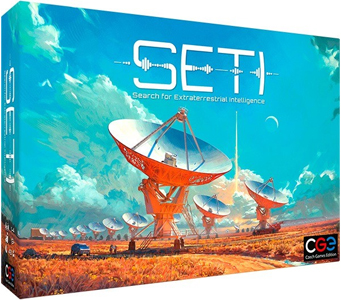 Stats:
No. of players: 1-4
Amount of time to play: 60-160 min
Age requirements: 13+
Set-up time: minimal
SETI: Search for Extraterrestrial Intelligence is a board game inspired by the real-world SETI project, the game simulates the race to be the first to contact alien civilizations through scientific discovery and space exploration. You need to scan the skies, send probes to planets and their moons, advance your technology, and gather data to discover alien life (and score VPs).
SETI Rules Description:
In SETI you represent a team of scientists trying to discover alien life. The game is played over five rounds. You start the game with four publicity, four credits, three energy, and five cards. The first thing you’ll do is turn one card into income (and instantly receive it). There are other opportunities to increase your income and you will collect it between each round.
Every card may be used in a few different ways. The upper left hand corner shows an icon that can be used to gain movement, publicity, or data. In the center of the card is a main action you may resolve that usually costs credits. The icon in the lower right corner of the card shows what you gain when it is used for income.
On your turn you may take one main action and as many free actions as you like. If you cannot afford (or no longer want) to take an action you can pass. After all players have passed the round ends.
The main action include:
Play a card – Resolve the main action on a card. Some of these include missions that can get you additional resources or VPs
Launch a probe – Pay two credits to place one of your probes on Earth
Orbit – Once your probe has moved to a planet it may orbit that planet for the cost of one energy and one credit. This will often score VPs and get you other resources or income.
Land – A probe at a planet may land on it. This action costs three energy (or two if there is a probe orbiting the planet) and will get you VPs and other resources as well as a yellow life trace.
Scan – For one credit and two energy you can scan the stars above Earth. This gets you data and can score VPs once the scanning track is full. The player with the most scan tokens scores and gets a bonus including a red life trace.
Analyze data – If your computer is full of data you may spend an energy to analyze the data which empties your computer and gets you a blue life trace.
Research a tech – Gain a tech for six publicity. These tech come with an instant bonus and can upgrade your computer, probes, and scanning capabilities.
Pass – Discard down to four cards, rotate the solar system (only the first player to pass), and select one card from the end-of-round pile putting the rest back.
Free actions are:
Place data – You may place data you have collected into your computer
Complete a mission – If you previously played a card with a mission on it you may complete it and gain the rewards.
Play a card for its free-action – Discard a card to gain the resource in the upper left corner.
Buy a movement – Spend one energy to move a probe one space
Buy a card – Spend three publicity to gain a card
Exchange resources – Swap two of the same resources for one other resource.
Once you and your opponents have marked one blue, yellow and red life trace, you reveal the aliens. They will add additional cards and possible missions for you to accomplish.
There are lots of ways to score VPs in this game including end game scoring tiles. You choose which three of the four end game scoring tiles you’ll use when you pass 25, 50, and 70 VPs. After five rounds the game ends and you add the end game scoring to your total. The player with the most VPs wins.
Quick Review of SETI:
SETI: Search for Extraterrestrial Intelligence is a simple yet complicated board game. The actions are easy to understand and straightforward but it will take a few games to understand when best to take them. You have a lot of options early in rounds, but as you play cards and spend resources, your options dwindle.
The components for this game are great. Though it takes up a lot of space the game looks impressive. The highlight is the solar system that actually rotates. The art looks good and the cards are well laid out. The iconography might take a game to take in but once understood it does a good job communicating actions and other information. There is also an excellent player aid to help you remember and translate things. The rules are well written, but I highly suggest watching this excellent how to play video.
The cards in SETI can be used for different things. You must decide how best to use your cards given the resources you have. You must also balance short term gains with building an engine that will propel you to the stars in later rounds. It creates a fun and interesting puzzle. And with 200+ cards the puzzle is never quite the same.
SETI’s theme is based on the actual science we are using to scan space. Obviously alien discovery and contact has not occurred, but it is cool that past and present technology is in the game.
Also adding to the theme are the unknown aliens. They add a sense of discovery especially the first time you encounter each race. They add some chaos to the game by changing the board’s landscape and letting you score in additional ways. Some might feel having only five alien races will limit replay value, but I would be surprised if we never see an expansion with more.
The solo mode is fun, doesn’t require you to learn a lot of new rules or mechanics, and you can adjust its difficulty to your liking.
Like I mentioned that this game is a card-driven puzzle. And how you often have many options but which is best can be hard to determine. This is especially true on your first couple of plays. There is a learning curve, but it is not steep. The game is not super complex, but knowing what to do when is tough.
Another thing to be aware of is that you should explore to win. Scanning is helpful but if you focus there you will probably get outscored by players that launched probes and took to the sky. Landing on moons can get lots of points and traveling to distant planets is worthwhile.
Lastly, know that with higher player counts there is more downtime. This is exacerbated if someone in your group suffers from analysis paralysis. I have also heard that if you fall behind in the early game, there is no mechanic to help you catch back up.

If you are looking for a fun, medium-heavy weight board game, pick up SETI. It will take a couple plays to comprehend the puzzle of this game. But you will enjoy learning and then playing more. It is worth the investment.
Score and synopsis: (Click here for an explanation of these review categories.)
Strategy 4 out of 6
Luck 4 out of 6
Player Interaction 4 of 6
Replay Value 4 out of 6
Complexity 4 out of 6
Fun 5 out of 6
Overall 5 out of 6