

The Congress of Vienna & Napoleon’s 100 Days (1814–1815)
A New Scenario for GMT’s Congress of Vienna to be Published by C3i Magazine!
Part One of Two – DESIGNING A SCENARIO
Introduction by Fred Schachter, CoV Assistant Designer & Editor: Frank and I are thrilled to share the news, and as much of the story that we can, regarding the upcoming publication of a new Congress of Vienna scenario within the hallowed pages of C3i Magazine. We also thank GMT for this opportunity to share this announcement and hopefully invite readers’ interest and enthusiasm with this two-part InsideGMT article! Frank now takes the reins in describing the origin of this upcoming CoV scenario.
Introduction
When we designed and developed Congress of Vienna (CoV) GMT Games – Congress of Vienna, 2nd Printing, the transatlantic playtest team — that dedicated and slightly mad but always capable, insightful, and entertaining group of wargamers scattered across Europe and North America, who met religiously over the internet on weekends — kept returning to the same question after our Vassal game sessions concluded: “But what happens next?” Napoleon has abdicated, the Allies occupy Paris, and the Bourbon king Louis XVIII sits uncomfortably back on his throne. The full campaign game, as well as one short three turn scenario, ends with Turn 10, March-April 1814, and yet the most dramatic act of the entire Napoleonic saga is yet to come.
After completing the long development of CoV’s solitaire Bots and the game’s two and three-player scenarios, it seemed a pity that we were ending the story before the real Congress of Vienna had even begun. The Diplomacy Phase mechanic, with its debates, trades, and backstage maneuvers, was precisely what was needed to allow players to simulate the extraordinary, pressure-filled, negotiations that took place in Vienna between September 1814 and March 1815. Therefore, who could resist adding the thunder of Waterloo to that equation?
Almost before we knew it, within barely a month after inception, we had a first prototype of rules and components ready to test via Vassal. The spark had been lit and a creative fire begun!
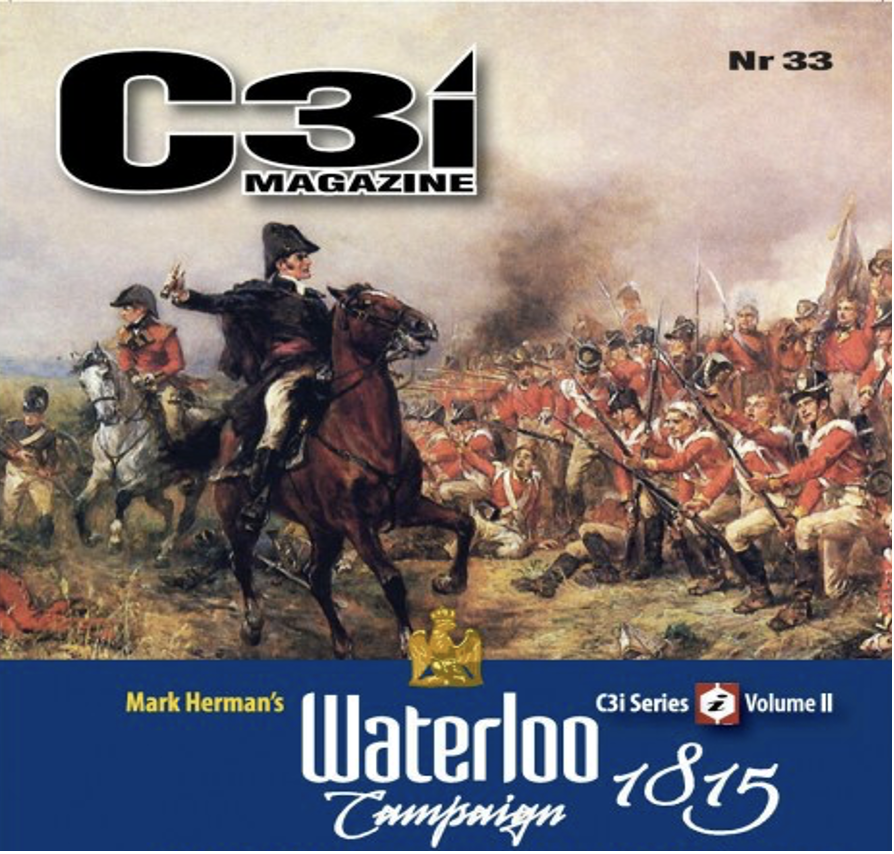
This article introduces that scenario, or variant, as it may also be referenced as: the Congress of Vienna & Napoleon’s 100 Days (1814–1815), which will be published in prestigious C3i Magazine. Alas, the original plan to publish was delayed when fate intervened — the terrible California wildfires and the deeply lamented and sudden death of the legendary Rodger B. MacGowan halted this project. Now, with the magazine’s revival under his son Steven, and as a tribute to Rodger’s towering legacy to our hobby, we are finally bringing this scenario to players in C3i Issue Nr. 39 in late 2026: (https://c3iopscenter.com/rbm-studio-store/)
A Word From C3i Magazine Publisher Steven MacGowen
When I returned to work on C3i Nr. 38 in the aftermath of the fire and Rodger’s passing in early 2025, that issue Nr. 38 naturally became a tribute to him. Amid everything required to bring it together, publishing a Congress of Vienna variant had to be set aside. But now, anticipating this scenario completed for C3i Nr. 39 now feels like continuing that tribute. I am deeply grateful to Frank and Fred for proposing the variant and for carrying it through to completion. It is an exciting addition to an already superb GMT title, and I believe readers will find it deep, varied, and a fitting continuation of the design and Napoleonic era history that inspired it… Steven
From the Drawing Board: Origins of a New CoV Scenario

The basic premise of this four-player scenario was straightforward: pick up the story exactly where CoV ends, with its tenth March-April 1814 turn. Napoleon is exiled on Elba. Talleyrand — the consummate, cagy diplomat, supreme opportunist, and spectacularly amoral negotiator — represents a weakened France in Vienna. He is its Leader in Congress of Vienna game terms. The other three Major Powers are no longer allies in any meaningful sense: they are rival empires aggressively competing for the largest slice of a redrawn map of Europe
Design challenges emerged quickly, however. Several of the original CoV game’s Issues were now historically over: Armistice, Sweden at War, Austria at War, and military Recruitment (since what was now needed was demobilization for soldiers who’d at long last be heading home, not mobilization!). New Issues demanded inclusion: the reorganization of Germany into a German Confederation, the external Borders of France, the fate of the Balkans and the Ottoman Empire, Spanish America, to represent the struggle of Spain to retain its American colonies against the winds of revolution, and Britain’s crusade via another new Issue: Slave Trade Abolished. Some CoV character cards had to be retired; others demanded editing or outright replacement.
The result — and I confess I was surprised by how elegantly it worked — was remarkably economical. By adding just five new Issues and removing five others, modifying nine existing cards and adding nineteen new ones while retiring another nineteen.
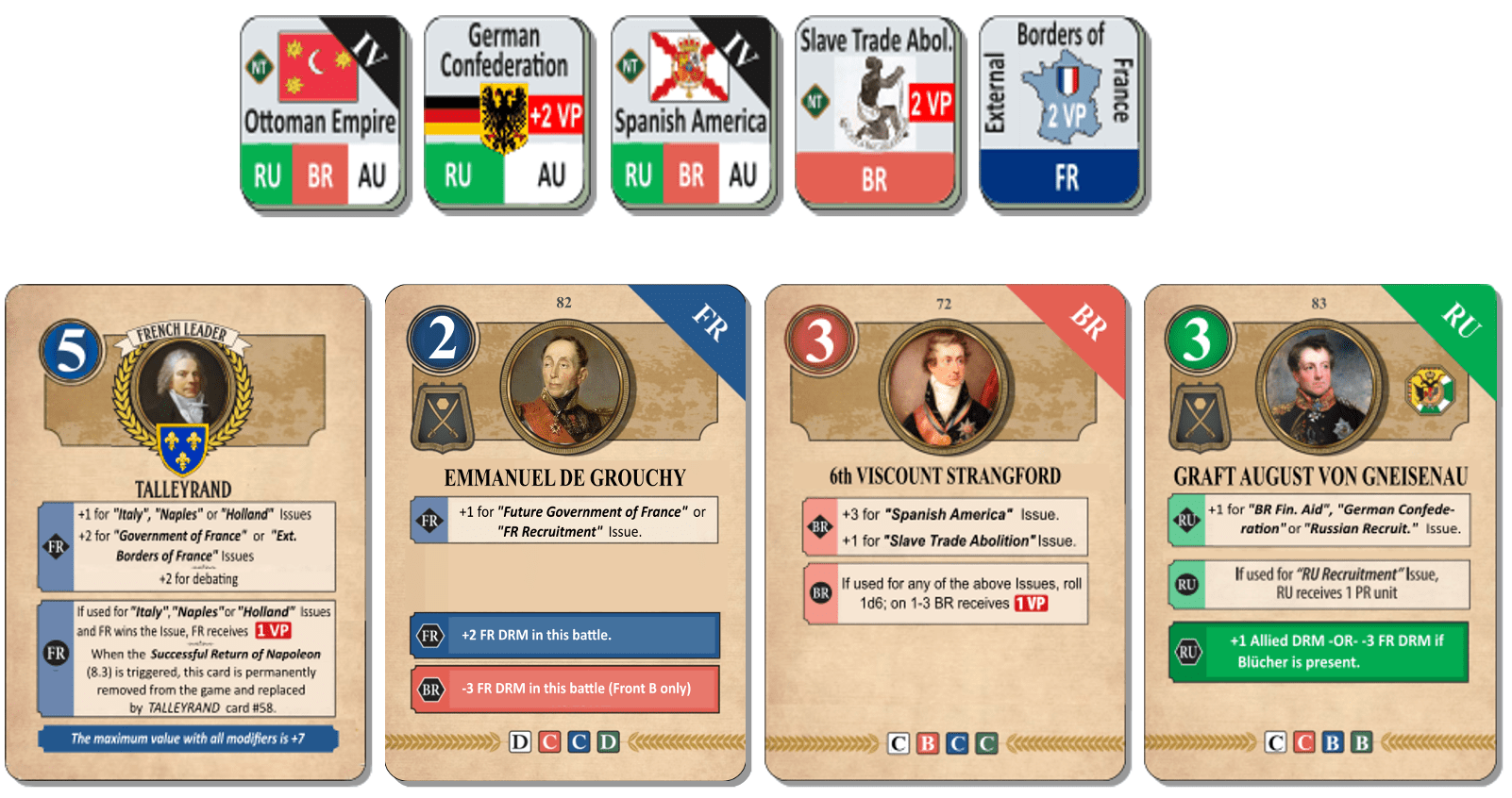
All components will be provided in this upcoming C3i Magazine publication. We believe we’ve achieved a compelling, fun and interesting Congress of Vienna scenario, a new scenario for those who already own, or will P-500 acquire a CoV 2nd Printing copy, that keeps most of the original game intact. It uses the same CDG engine, the same diplomatic tension, but presents a completely new historical situation for a most fascinating period of the Napoleonic era.
Those who already know how to play Congress of Vienna should have little difficulty jumping right in and being able to confront the challenging conundrums of achieving victory with France, Britain, Russia, or Austria in The Congress of Vienna & Napoleon’s 100 Days (1814–1815).
A few further design notes are worth mentioning. We kept the total Issue count at 30, the same as the base CoV game. This means the Diplomacy Display needs no structural change beyond accommodating the new counters. The 19 removed cards were not casualties of laziness but of historical irrelevance: characters who were decisive during 1813-1814 had, by this scenario’s time, retired, died, or simply ceased to matter. The nineteen new cards introduce the statesmen, diplomats, and second-tier commanders who actually shaped events during this period. The nine modified cards are those whose historical role shifted enough to warrant their updated revised text.
Additionally, players familiar with CoV will notice three further changes: each Major Power’s Recruitment Issue has been redesigned for a dual Demobilization/Recruitment mechanism (the problem of 1814, after Napoleon’s first abdication, was not raising armies but standing them down). Players can now receive a VP reward for reducing the number of their armies’ military units. How much reduction to make is a challenging balancing act since there’s the possibility of Napoleon returning from exile and hostilities resuming.
The Absolutism/Liberalism Track now allows players to push the opposing Powers’ pawn downward OR advancing their own upward, making ideological competition considerably more volatile.
Notably, Britain enters this scenario without the Pax Britannica Track — that particular source of British Victory Points belonged to the now settled war in Europe (although The War of 1812 still rages on just as it does in the standard Congress of Vienna game). But do not despair potential players of Britain, this scenario provides other opportunities to acquire VP!
Two Games in One: Initially, France Ruled by the Bourbons
The most important design decision we made — and one that defines this scenario’s unique environment — was embracing the scenario’s inherent duality. This can make for a truly interesting and challenging gaming experience for the French player!
France, stripped of its VP advantages from territorial control, is diplomatically fragile. The Allies are arch competitors, not partners. Every turn, for those about the negotiating table in Vienna: that ornate table is the only battlefield that matters.
This produces a fascinating dynamic. France starts as the weakest player diplomatically and therefore must exploit inherent Allied tensions to improve its position. Those magnificent military cards — now largely useless for their intended purpose — must now serve to dominate a diplomatic agenda. Not only for France, but for its three rivals as well!

The above Figure shows, after an exceptional first two turns by France, enhanced by three overly self-centered Allied players failing to sufficiently coordinate, French VPs have overtaken Britain’s and are getting dangerously close to the lead. In this case Napoleon may never come into play!!
But this is a crucial decision for the French player to make when the “window of opportunity” opens. Ah, decisions, decisions… but that’s what makes our hobby interesting and fun!
After Napoleon’s Return, should that occur, everything changes. The game pivots completely. Diplomacy recedes in importance, armies advance towards battle, and the fate of Europe can be decided by a new mechanics for the War Phase: the dramatic Splitting vs. Pinned Battle decision, the quest for Strategic Surprise, the coordination of the Anglo-Dutch and Prussian armies in Belgium (who now have a Generalissimo Issue of their own for either Russia or Britain to control). The game becomes a race against time precipitated by a revived French Empire surrounded by enemies. The players who mastered the diplomacy part of the game must now become military strategists as well!
Next: The Possible Return of Napoleon (and a Waterloo!)

Napoleon’s escape from Elba and reclamation of power in France was one of the most astonishing events of 19th century European history. It is the central dramatic mechanism of this RBM Studio CoV scenario.
What made this possible historically — and what makes it uncertain in the game — was the question of loyalty. Not the loyalty of the French people in the abstract, but the very specific, personal loyalty of individual marshals, regiments, and commanders who had to choose, in a matter of days, between the returning Emperor and their oaths to the Bourbon King Louis XVIII.
A game procedure captures this with a simple but evocative resolution: the quality and loyalty of French military figures available to each side via their cards (the British player assumes the role of the Bourbons), the state of French public opinion as tracked through the turn’s Initial Situation Card, and the broader political context of the moment all feed into a single dramatic reckoning. Did Ney ride out to arrest Napoleon and end up joining him instead? Did Davout’s iron discipline hold the army to the Bourbon cause, or did sight of the Imperial Eagle undo everything? The outcome is never pre-determined.
If French public opinion has already swung decisively toward the Emperor, the Return can happen almost automatically — he simply walks back into the Tuileries unopposed. If not, it is a gamble, and a failed one carries lasting consequences for France… for if the attempt fails, the Napoleon Leader Card is removed from the game and for its duration France suffers a -3VP penalty each turn instead of a +5VP reward for every turn Napoleon is in power.
The French player’s opportunity to bring Napoleon back to power, should the player decide to do so, consists of a four turn “window”: from turn 14, Nov.-Dec. 1814 through turn 17, May 1815. It uses the above-described step-by-step procedure, involving luck with the cards and luck with dice, just as within the regular Congress of Vienna game. However, few could argue that Napoleon’s remarkable return to re-establish himself “Emperor of the French” did not contain more than a bit of good fortune.
The New Diplomacy Phase Issues of The Congress of Vienna & Napoleon’s 100 Days (1814–1815)
The five new Issues of this scenario are what gives it its historical authenticity. Each reflects a real crisis debated in the marble-floored salons of Vienna, each bringing its own distinct flavor of intrigue to the gaming table.
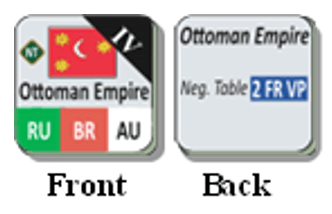
The Ottoman Empire Issue captures something the statesmen in Vienna rarely discussed openly, but thought about constantly: what to do with the Balkans once the Turk’s grip weakened? Within a decade of the Congress, those unresolved tensions would produce the Greek War of Independence and Serbian autonomy. In 1814 Vienna, no one wanted to directly raise the subject — Russia coveted its influence over Orthodox populations, Britain feared Russian naval access to the Mediterranean via a compliant Constantinople, while Austria dreaded instability on its southern flank. If any of the Allies wins and Resource funds the Issue, 1VP is the reward. However, the Ottoman Empire Issue tends to hover over the Negotiation Table, producing circular arguments and no conclusion. Historically accurate, and enormously convenient for France, which VP benefits, without needing to expend a Resource, whenever the Allies are too busy quarrelling over Constantinople to focus on Paris.

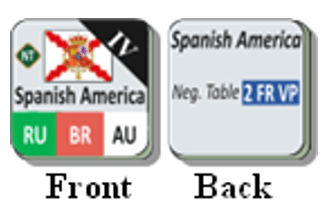
The Spanish America Issue is perhaps the most entertaining of the five new Issues to play. Spain’s American colonies were in open revolt, and every European power had an opinion. Britain wanted trade access, not reconquest. Russia, with characteristic audacity, actually sold a squadron of rotten, barely seaworthy warships to Spain — at full price (!) — under the pretense of helping suppress these colonial rebellions. The new Tatischev card in this scenario commemorates this piece of diplomatic roguery with the affection it deserves. Furthermore, if this Issue remains on the Negotiation Table at a Diplomacy Phase’s conclusion, it is France reaping a 2 VP reward!
The Slave Trade Abolition Issue is Britain’s alone to carry, and it is a genuine burden. Castlereagh arrived in Vienna with a parliamentary mandate to secure an international commitment to abolish the loathsome trade. He received polite smiles from every delegation and almost nothing of substance. The Issue reflects this: Britain can win significant diplomatic credit — but if the other Major Powers outmaneuver it, the embarrassment is real. Wilberforce’s great cause is reduced to a bargaining chip. Note the British player gains 2 VP for winning and Resource activating this Issue but loses -1 VP if any other player has it on their Negotiation Track. Should it remain on the Negotiation Table, France gets 2 VP. No Resource activation is needed by RU, AU, or FR.
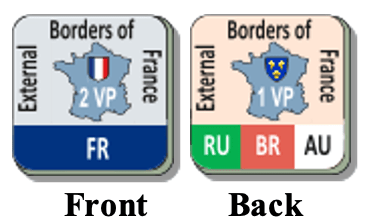
The External Borders of France Issue is where Talleyrand earned his legend. Arriving in Vienna as the representative of a defeated, occupied, and diplomatically isolated power, he somehow managed to secure for France essentially the frontiers of 1792 — a result far more generous than the Allies had initially intended. His technique was to position France, not as a defeated supplicant but as the champion of legitimacy and the rights of smaller states, splitting the Allied front. In game terms, this dynamic translates directly: each time an Allied power wins and activates this Issue, it gains 1 VP — the reward for successfully pressing upon French weakness. But if France wins and Resource activates the Issue, the reward is doubled, reflecting Talleyrand’s extraordinary ability to turn the tables on his tormentors. No other Issue in the scenario so directly rewards the French player for playing against expectations. If you are France, this is the Issue you must keep returning to turn after turn, because every time you prevail you are, in effect, recreating one of the most improbable diplomatic triumphs in modern history.
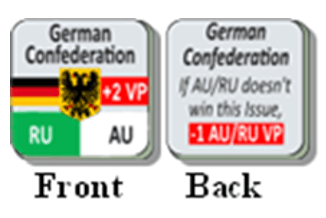
Finally, the German Confederation Issue represents the most genuinely contested negotiation of the entire Congress. Metternich wanted an Austria-dominated Germany of middling states, too weak to threaten Habsburg primacy, but capable of acting as a buffer against France and Russia. Prussia wanted territorial compensation and a stronger voice. Russia’s Tsar Alexander had opinions about everything and rarely kept them to himself. The Issue is accordingly one of the richest in the scenario: Austria and Russia compete for its resolution, the rewards for success are meaningful, and the penalties for failing to secure what you have invested in are correspondingly harsh. A good Austrian player treats this Issue as a priority; a wise one knows when to stop bidding.
Next up is this article’s Part Two of Two where we’ll explore a unique battle option, as well as provide “how to play” advice for each Major Power of this upcoming C3i Magazine’s feature: The Congress of Vienna & Napoleon’s 100 Days (1814–1815).
END OF PART ONE OF TWO